



During its earliest years, the Church faced persecution and heretical ideologies on all sides. While some people fought these obstacles through fervent prayer, others translated their God-given wisdom into ink to offer guidance to fellow Christians.
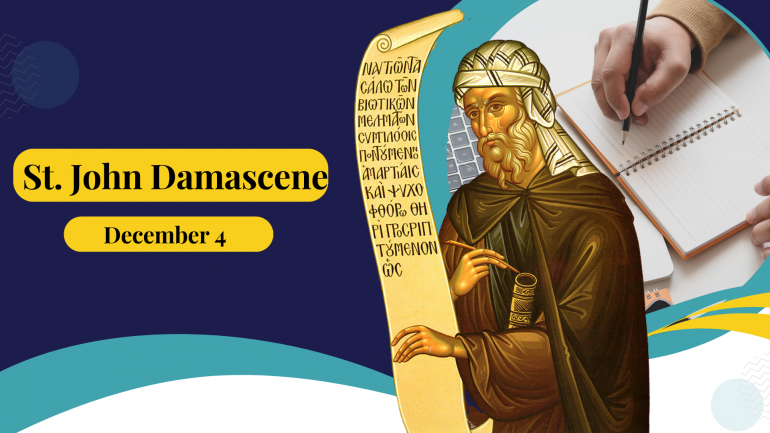
One of the individuals who did the latter is Saint John Damascene, and he did it in an extraordinary manner.
An Eastern Christian monk and theologian born in Damascus in 675, he was known by the Greek nickname “Chrysorrhoas” or “gold-pouring” because of how his writings, approximately 150 documents in total, resonated in the Christian and Orthodox Churches.
He was venerated in the Eastern and Western Churches and was granted the title Doctor of the Church by Pope Leo XIII in 1890.
An exalted name in Orthodox
Despite being born in a wealthy Christian family, his eventual dissatisfaction with life at court made him enter the monastery in Mar Saba around 700. Aside from constant reflection and meditation, John spent his time as a monk writing almost endlessly about faith, producing more than a hundred manuscripts.
He gained prominence for his treatise, “Exposition of the Orthodox Faith,” a summary of the Greek Fathers’ thinking about theological truths in light of philosophy. He would be remembered as the last of the Greek Fathers, and this writing is considered the Eastern equivalent of the Western’s “Summa Theologica” by Saint Thomas Aquinas.
John also wrote “The Source of Knowledge,” a synthesis of Christian philosophy and doctrine. It became the principal textbook in Greek Orthodox theology and had a profound influence on the direction of medieval Latin thought.
A terror against icon haters
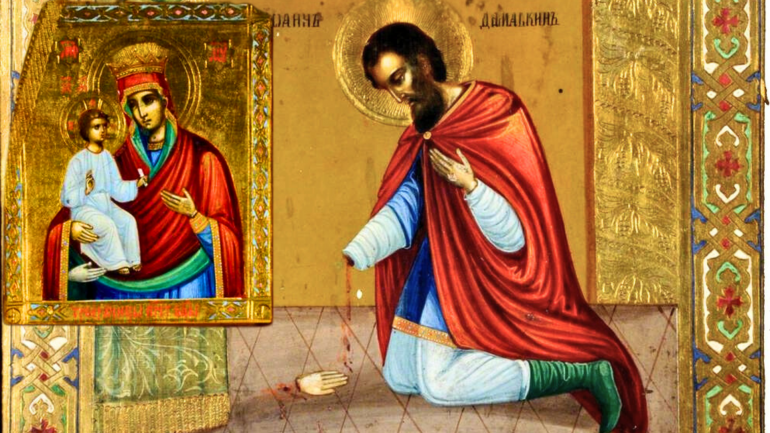
In the Roman Catholic Church, the veneration of images and icons is owed to John, whose writing put down the iconoclast movement centuries ago.
Controversy about the use of images rose in the Byzantine Empire in the 8th century. Iconoclasts, who rejected images, claimed that it directly goes against the Ten Commandments, while defenders insisted that images should be viewed in their symbolic nature.
In response to this dispute, John wrote the “Discourses Against Those Who Calumniate the Holy Images,” a collection of three treatises. He wrote: “since God has now been seen in the flesh, and lived among men, I represent that part of God which is visible… I do not venerate matter, but the Creator of matter, who became matter for my sake and deigned to live in matter and bring about my salvation through matter.”
John also said that images are not venerated in absolute terms as God. “How could that which, from nonexistence, has been given existence, be God?... But I also venerate and respect all the rest of matter which has brought me salvation, since it is full of energy and holy graces,” he wrote.
As expected, his writings drew the ire of iconoclasts. But because he was living in a monastery in a Muslim territory, he was able to write his heart out and speak freely against this movement without fear of persecution.
A few years after John died in 749, the iconoclastic Council of Hieria was convoked by the Empress Irene in 754. This condemned the veneration of holy images, and icon defenders were persecuted during the reign of Constantine V.
Nevertheless, John’s writing continued to resonate across the Church, and his message against iconoclasm endured. His three-part treatise would be key in putting down the movement once and for all during the Second Council of Nicaea in 787. The veneration of holy images was restored, and the practice still prevails to this day.
A fierce and peaceful defender of faith
Saint John Damascene proved that anyone can make a stand for the faith, not just by shouting from the rooftops. His quiet prayer in the monastery, wherein he lived for the rest of his life, moved his hand to write and shed light on the truth of Christian doctrine. His writings put heretics in their place and helped lay the most important pillars of our faith. Pope Benedict XVI said that he is “a privileged witness of the cult of icons, which would come to be one of the most distinctive aspects of Eastern spirituality up to the present day.”
In every image and icon we venerate in our churches and homes, may we remember how Saint John fought hard to make this practice possible. For in these tangible materials, we see God’s natural creation be transformed into vehicles of grace “by virtue of the invocation of the Holy Spirit, accompanied by the confession of the true faith.”