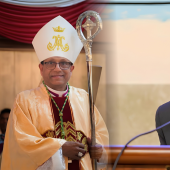



Pope Leo XIV has delivered a strong and timely message to journalists, urging them to remain faithful to truth, verification, and ethical reporting amid the growing complexities of global conflict and media polarization.
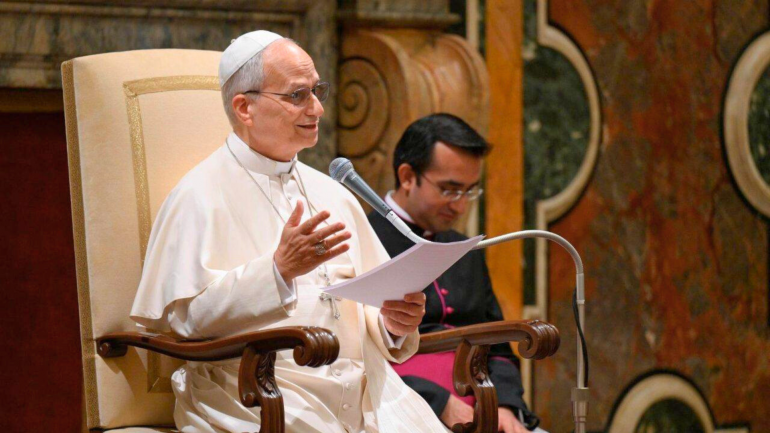
Speaking at the Vatican to the editorial staff of TG2 of RAI, the national public broadcaster of Italy, on its 50th anniversary, the Pope reflected on the evolving landscape of journalism, from analogue broadcasting to the digital age, and stressed that no technological innovation can replace critical thinking, editorial independence, and freedom of thought.
Framing his address within the realities of modern newsrooms, he highlighted the essential mission of journalists: to verify information rigorously and avoid becoming “mouthpieces of power.”
He warned that in times of war, the risk of media turning into propaganda becomes more acute, making the work of reporters, editors, and newsrooms both “urgent and delicate.”
“The task of journalists is essential,” he said, underscoring fact-checking, source verification, and editorial discernment as pillars of credible journalism.
Reporting War with Human Depth
In a fast-paced media environment shaped by algorithms and breaking news cycles, the American born pope called for a return to human-centered reporting.
He urged journalists to move beyond headlines and political narratives by focusing on the lived experiences of those affected by conflict.
“It is up to you to show the suffering that war always brings,” he said, encouraging reporters to document reality through the eyes of victims rather than reducing war coverage to statistics or spectacle.
Such journalism, grounded in field reporting and eyewitness accounts, resists the tendency to portray war as a “video game” and instead highlights its human cost with dignity and accuracy.
Defending Pluralism and Editorial Integrity
Pope Leo praised TG2’s commitment to pluralism of sources and editorial openness, describing them as essential for trustworthy journalism.
He cautioned against ideological bias and echo chambers, where media risks amplifying only confirming narratives.
“True communication requires openness,” he said, emphasizing the importance of diverse perspectives, balanced reporting, and inclusive newsroom dialogue in countering polarization and misinformation.
Journalism at a Crossroads: Technology, Ethics, and Peace
Addressing the rise of artificial intelligence, the Pope warned that technology must serve journalism, not replace human judgment. He called on media professionals to distinguish clearly between tools and editorial purpose, insisting that ethical responsibility cannot be delegated to machines.
His message also extended to global conflict reporting. The Vatican confirmed that the Pope spoke with Mahmoud Abbas about the worsening humanitarian situation in the Middle East, reaffirming the Holy See’s commitment to peace through dialogue and respect for international law.
For journalists worldwide, the Pope’s message stands as both a professional guideline and a moral call: prioritize accuracy over speed, verification over speculation, and human dignity over sensationalism.
In doing so, journalism fulfills its deeper mission, not only to inform, but to bear witness to truth with integrity and compassion.
Radio Veritas Asia (RVA), a media platform of the Catholic Church, aims to share Christ. RVA started in 1969 as a continental Catholic radio station to serve Asian countries in their respective local language, thus earning the tag “the Voice of Asian Christianity.” Responding to the emerging context, RVA embraced media platforms to connect with the global Asian audience via its 21 language websites and various social media platforms.
Latest News