
Among the saints who have captured the imagination of Christians across cultures and centuries, few are as beloved, and yet as misunderstood, as St. Nicholas of Myra, whose feast the Church celebrates in December While modern folklore often remembers him as the cheerful gift-giver, the historical Nicholas was a bishop of deep faith, brave conviction, and quiet generosity. Beneath the well-known legends lies a genuinely pastoral saint whose life continues to inspire the Church today.
A Bishop Formed by the Gospel
St. Nicholas was born in the late third century in Patara, in present-day Turkey, into a devout Christian family. Orphaned at a young age, he inherited significant wealth and chose to use it in accordance with the Gospel. Ordained as a priest and later selected as Bishop of Myra, Nicholas became a shepherd with a strong sense of justice and a tender concern for the poor. His episcopal ministry took place during turbulent times of persecution and theological confusion, requiring both courage and compassion.
Church tradition recalls that Nicholas endured imprisonment during the Diocletian persecution and later took part in the Council of Nicaea (325), where the Church defended the truth of Christ’s divinity. Whether or not all details can be confirmed historically, the memory of Nicholas as a firm defender of orthodoxy remains central to his legacy.
The Saint of Secret Giving
One less-known, but highly revealing, part of St. Nicholas’s life is his dedication to anonymous charity. He believed that good deeds should never embarrass the recipient or bring attention to the giver. For Nicholas, charity was closely tied to humility.
This conviction shaped his pastoral approach. He did not simply distribute alms; he aimed to restore dignity. His generosity was genuine and prayerful, flowing from long hours spent before God. At a time when bishops were often public figures of authority, Nicholas embodied a hidden holiness that spoke louder than words.
The Essence That Reveals His Heart
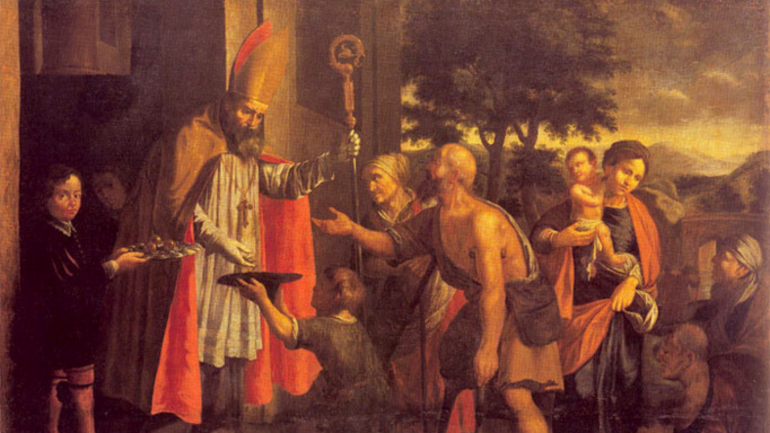
The most famous and meaningful story about St. Nicholas involves three poor sisters. Their father, unable to afford dowries, feared they would be forced into exploitation. Hearing about their situation, Nicholas decided to help, but secretly. Under the cover of night, he threw a bag of gold through their window (or chimney, according to another version). He repeated this act on successive nights until the family was saved.
When the grateful father finally found his benefactor and tried to thank him publicly, Nicholas urged him to stay silent and thank God alone. This simple yet powerful story reveals the essence of Nicholas: compassion guided by discretion, generosity marked by humility, and faith expressed through courageous action.
Special Devotions in the Church
Devotion to St. Nicholas spread quickly after his death (c. 343). He became especially honoured in the Eastern Church, where he is regarded as a wonder-worker and protector of sailors, travellers, merchants, children, and the poor. In the Western Church, his relics, transferred to Bari, Italy, in the 11th century, made him one of Europe’s most venerated saints.
Churches dedicated to St. Nicholas are common across continents. In many cultures, St. Nicholas Day (December 6) is celebrated with special prayers, acts of charity, and gift-giving to children, reflecting his lifelong concern for the young and vulnerable. He is also often called upon for justice, safe travels, and help in times of trouble.
Voices of the Popes
Modern Popes often highlight St. Nicholas as a model bishop:
-
St. John Paul II, reflecting on St. Nicholas of Bari, emphasized him as a connector between the East and West, noting that his veneration unites Christians beyond historical divisions and reminds the Church of her call to unity.
-
Pope Benedict XVI, in a catechesis on early Church pastors, described Nicholas as a bishop whose life demonstrated how orthodoxy and charity go hand in hand, emphasizing that true faith must always produce love.

Beyond Santa Claus: Rediscovering the Saint
One cannot discuss St. Nicholas without mentioning his transformation into the widely recognized figure of Santa Claus. While cultural adaptations have often overshadowed the saint’s Christian origins, reclaiming St. Nicholas does not mean rejecting joy or generosity. Instead, it encourages the Church to re-centre joy in the Gospel, reminding believers that genuine giving stems from love of God and neighbour.
St. Nicholas teaches that generosity isn't seasonal, that joy comes from justice, and that true miracles often happen quietly.
Relevance to Today’s Church
In a world filled with inequality, self-promotion, and public acts of charity, St. Nicholas provides a prophetic counter-witness.
-
For bishops and priests, he exemplifies an icon of pastoral courage and doctrinal clarity combined with compassion.
-
For the laity, he presents a model of everyday holiness through simple acts of kindness.
-
For the global Church, he reminds us that unity, charity, and truth should never be separated.
-
For a consumer-driven society, he redefines generosity as a relationship rather than a transaction.
Above all, St. Nicholas urges today’s Church to rediscover the strength of quiet goodness, deeds done not for praise but out of love.
Looking Beyond the Myths
Celebrating the feast of St. Nicholas this December invites us to look beyond the myths and rediscover the bishop whose life was shaped by the Gospel in its purest form. He was not a saint of spectacle, but of substance, not of words, but of deeds. In a noisy world, his silent charity still speaks. In an anxious Church, his confident faith still guides, and in a divided humanity, his compassion still heals.
St. Nicholas remains, above all, a reminder that the Church is strongest when she loves quietly, gives generously, and trusts deeply in God.