



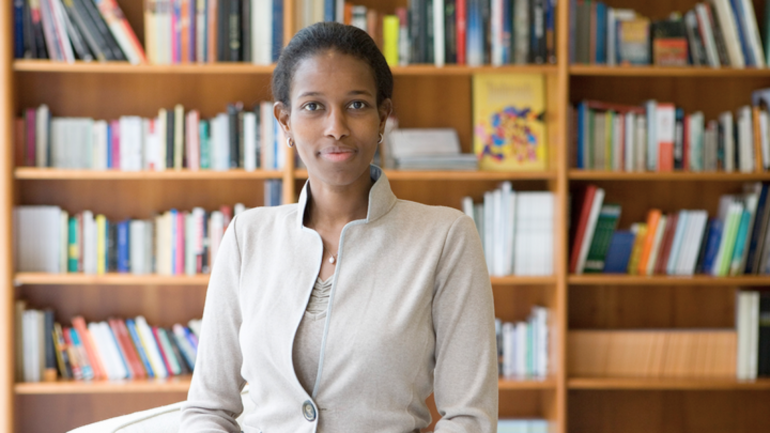
As the world marked World Refugee Day on June 20, the story of Ayaan Hirsi Ali stands out as one of the most remarkable journeys of displacement, intellectual transformation, and spiritual searching in recent decades.
Born in Somalia in 1969, Hirsi Ali spent much of her childhood moving between countries amid political instability and family upheaval. She lived in Saudi Arabia, Ethiopia, and Kenya, where she was raised within a strict Muslim environment. At the age of five, she underwent female genital mutilation, a procedure arranged by her grandmother, an experience she would later describe as one of the defining events of her childhood. Like many refugees, her early years were shaped by uncertainty and the challenge of finding a place to belong.
In her early twenties, Hirsi Ali fled to the Netherlands to avoid an arranged marriage.
Seeking asylum in the Netherlands, Hirsi Ali rebuilt her life through education and public service, eventually serving in the Dutch parliament. Her writings and advocacy on issues of women's rights, religious freedom, and integration earned international attention. In 2005, Time magazine named her among the world's 100 most influential people, cementing her status as a prominent public intellectual.
Over time, Hirsi Ali emerged as one of the world's most prominent critics of Islam, particularly of practices and beliefs she viewed as harmful to women. Following the September 11, 2001 terrorist attacks in the United States, she became increasingly outspoken in her criticism of religious extremism and eventually identified herself as an atheist.
Her views drew both admiration and controversy. In 2004, Dutch filmmaker Theo van Gogh, with whom she collaborated on a film critical of the treatment of women in some Muslim communities, was murdered by an Islamist extremist. A death threat directed at Hirsi Ali was reportedly left at the scene. The incident thrust her into the center of an international debate over free speech, religion, and security.
For nearly two decades, Hirsi Ali remained one of the most recognizable atheist voices in public life. Through books, lectures, and media appearances, she defended secular values and argued that religion often contributed to oppression and conflict.
Then, in 2023, she surprised supporters and critics alike by announcing that she had become a Christian.
Reflecting on her journey, Hirsi Ali recalled an encounter with the work of British philosopher Bertrand Russell, one of the twentieth century's most influential critics of Christianity.
"In 2002," she wrote in November 2023, "I discovered a 1927 lecture by Bertrand Russell entitled 'Why I Am Not a Christian.' It did not cross my mind, as I read it, that one day, nearly a century after he delivered it ... I would be compelled to write an essay with precisely the opposite title.”
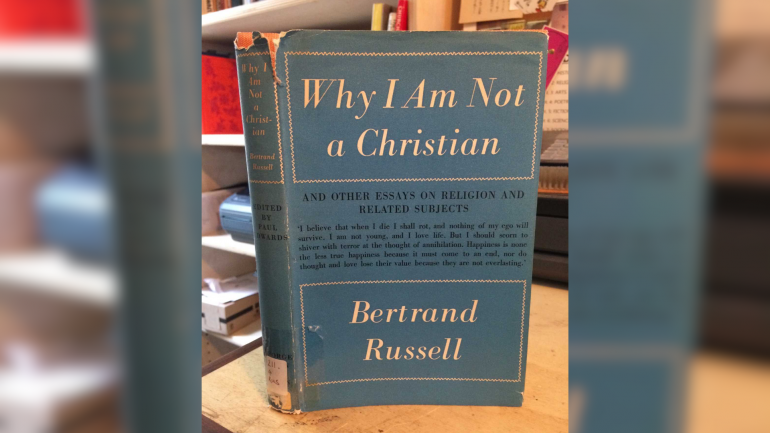
Writing in an essay titled “Why I Am Now a Christian,” Hirsi Ali explained that her change of heart did not arise from a sudden religious experience. Rather, she argued that secularism and atheism had failed to provide satisfactory answers to questions of meaning, morality, and human purpose. She also expressed concern about what she viewed as growing cultural and political challenges facing Western societies.
According to Hirsi Ali, Christianity offered a moral and spiritual framework that she found lacking in secular worldviews. Her essay sparked widespread discussion among believers and nonbelievers alike. Some welcomed her decision as evidence of faith's enduring relevance, while others questioned her reasoning or viewed her conversion primarily through a cultural and political lens.
Whatever one's perspective, Hirsi Ali's journey is difficult to ignore. Few public figures have traveled such an unusual path—from a Muslim upbringing to atheism, and later to Christianity. Her life has unfolded across continents, cultures, and ideologies, shaped by experiences of exile, controversy, and public scrutiny.
As the international community observes World Refugee Day, Hirsi Ali's story serves as a reminder that refugees carry more than physical belongings when they cross borders. They also carry questions about identity, freedom, and belonging.
In her case, those questions eventually extended beyond politics and philosophy to matters of faith.
Whether people agree with her conclusions or not, Ayaan Hirsi Ali's life illustrates how the search for home can become a search for meaning itself.