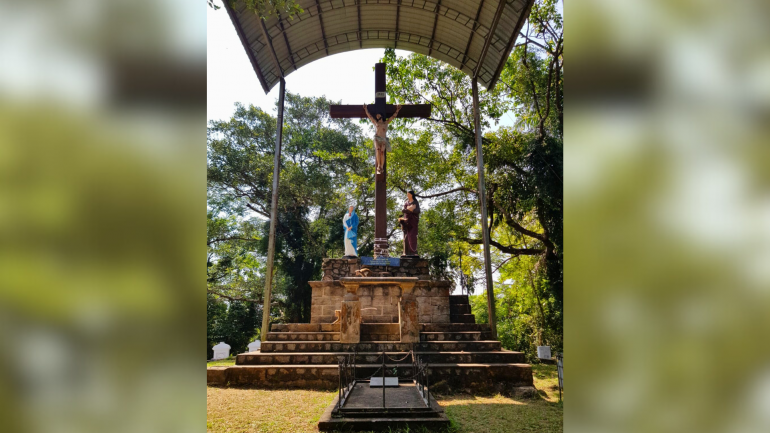
For Christians, the Lenten season is a time of deep reflection and pilgrimage. The historic Hill of Calvary in Jerusalem, located just outside the city walls, remains a solemn site of Christ’s crucifixion. Yet it also stands as a symbol of ultimate victory over death. This profound symbolism has inspired the creation of Calvary shrines across the world. In Sri Lanka, the oldest and most significant of these is the Maggona National Calvary Shrine, which marks 126 years of spiritual service this year.
A Gift from a French Missionary
The visionary behind this sacred site was Fr. Isidore Bell (OMI), a French missionary who dedicated his life to serving the people of Sri Lanka. Born on May 15, 1861, in the village of Saint-Laurent-en-Royans at the foot of the Vercors Mountains in eastern France, Fr. Bell arrived in Sri Lanka in 1883 while still a seminarian in Rome. Remarkably, he chose to travel directly to the island without returning to his home village to bid farewell.
Fr. Bell was ordained a priest in 1884 by Archbishop Christopher Bonjean at St. Lucia’s Cathedral in Kotahena. Before beginning his transformative work in Maggona, he served in several areas, including Moratuwa, Kegalle, Bolawalana, and Katunayake.
The Transformation of Maggona
In 1898, Fr. Bell was appointed Director of St. Vincent’s Home in Maggona. At the time, the institution was a unique center for social welfare, housing the country’s only reformatory for children, a teachers’ training college, a printing press, an orphanage, and a technical school. Under his leadership, the facility welcomed children from across the island. Recognizing the need for inclusive education, he established a Tamil-medium school to serve Tamil-speaking students.
The Birth of the Calvary Shrine
Near the reformatory stood a rugged, rocky hill covered in thick undergrowth. Fr. Bell saw in this landscape a striking resemblance to the Hill of Golgotha (Calvary) in Jerusalem. Inspired by this vision, he resolved to build a shrine there. Under the guidance of Brother Joseph Gonsalvez of the Franciscan Order, and with the help of the children from the reformatory and orphanage, a pathway was carved out to accommodate the 12 Stations of the Cross.
The shrine was officially consecrated on September 14, 1900, the Feast of the Holy Cross, by the then Archbishop of Colombo, Andrew Melizan, making it the first Calvary shrine in Sri Lanka.
The Bronze Cross from Rome
In 1905, during a visit to Rome, Fr. Bell learned of four special bronze crucifixes that had been cast to be sent to the four corners of the world. He secured one for the Maggona Calvary. That 120-year-old bronze crucifix remains at the summit of the hill today, serving as a focal point for thousands of pilgrims.
Recognition as a National Shrine
The historical and spiritual significance of the site was formally recognized by the state on May 8, 2017. Through Extraordinary Gazette No. 2018/06, the Government of Sri Lanka declared Maggona Calvary a National Shrine.
Architectural and Spiritual Features
Commonly known by locals as “Kurusa Kanda” (The Hill of the Cross), the shrine is distinctive for its architectural homage to Jerusalem.
• Granite Craftsmanship: Each of the Stations of the Cross is housed within a granite structure with a stone roof, carved from the natural rock found on the site.
• The Lourdes Grotto: In 1911, following a vow made during a contagious disease outbreak that affected both the orphanage and the village, a grotto dedicated to Our Lady of Lourdes was carved into a natural rock face. In 2026, the grotto marks its 115th anniversary.
A Center for Modern Pilgrimage
Today, Maggona remains one of the most visited Calvary shrines in the country. Following its 125th Jubilee celebrations last year, the shrine continues to offer extensive spiritual services during Lent, including confessions, the Way of the Cross, sermons, and Holy Mass in Sinhala, Tamil, and English.
The shrine is currently administered by the Oblates of Mary Immaculate (OMI), with Fr. Jude Saparamadu serving as Director. The OMI missionaries, who first arrived in Sri Lanka in 1847 under the leadership of Fr. Stephen Semeria, have played a significant role in the growth and spiritual life of the Catholic Church in Sri Lanka, a legacy that continues through the enduring witness of Maggona Calvary.