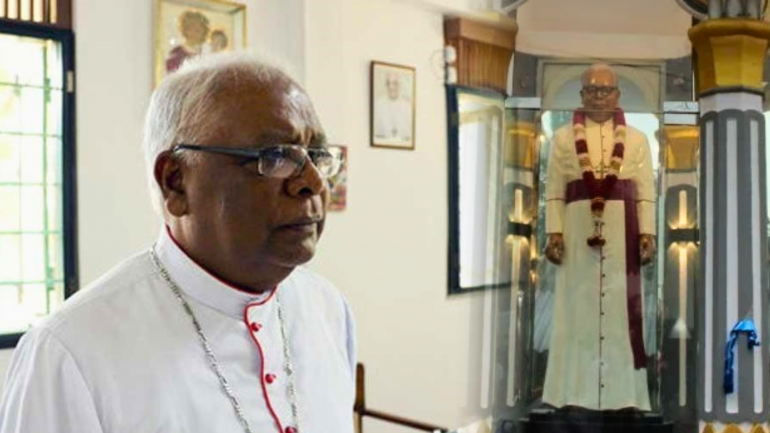
April 1 marked the fifth death anniversary of Bishop Rayappu Joseph, the former Bishop of Mannar in Sri Lanka, remembered for his unwavering commitment to his people during decades of war, suffering, and uncertainty.
Rayappu Joseph was born on Delft Island (Neduntheevu) in northern Sri Lanka. His family later moved to Jaffna, where he studied at St. Patrick’s College and then at St. Joseph’s College, Anuradhapura. After his priestly formation in Jaffna and Ampitiya, he was ordained in 1967.
A gifted scholar, he pursued higher studies in Rome, earning a doctorate in Canon Law. Upon returning to Sri Lanka, he served as a lecturer in Jaffna, combining academic excellence with pastoral commitment.
The Second Bishop of Mannar
In 1992, he was appointed Bishop of Mannar, a diocese deeply marked by faith and suffering amid Sri Lanka’s civil war. His episcopal ordination took place at the Shrine of Our Lady of Madhu, surrounded by thousands of displaced people seeking refuge.
In his first homily, he captured the reality of his flock: “Jesus hung between heaven and earth. Today, our people hang between life and death. Through them, God speaks to us.”
Of his 24 years as bishop, 17 were spent in the midst of armed conflict. Mannar witnessed killings, abductions, displacement, and constant fear. Even clergy were not spared. Before his appointment, Fr. Mary Bastian (1985) and Rev. George Jeyarajasingham were killed for their service to the people.
In such a climate, silence was often expected. But Bishop Rayappu Joseph chose a different path. He remained close to his people, refusing to abandon them despite risks.
A Voice for Truth
For Bishop Joseph, speaking the truth about suffering and injustice was part of his pastoral duty. As the war intensified, so did his voice.
In January 2007, after airstrikes in Iluppaikkadavai killed 14 civilians, including children, he visited the site and publicly testified to what he witnessed. While officials denied civilian casualties, he affirmed that those killed were innocent. His words challenged official narratives and drew criticism and hostility.
Yet he did not retreat.
The war severely restricted access to essential goods and services in conflict areas, leaving thousands in dire conditions. Priests and religious served in refugee camps and relief centers, often under suspicion.
On September 26, 2007, Fr. Packiyaraj Ranjith, a young priest serving displaced communities, was killed by a claymore bomb. Despite the risks, Bishop Joseph ensured that his funeral was held with dignity at St. Sebastian’s Cathedral. Thousands attended, and the procession became a powerful expression of grief and solidarity.
Madhu: A Sanctuary Under Threat
One of the most painful episodes of his ministry came in 2008, when the Shrine of Our Lady of Madhu, long a symbol of refuge, was caught in the crossfire of advancing military forces and the LTTE presence.
Bishop Joseph appealed for the shrine to be declared a peace zone, urging both sides to respect its sacred status. Despite his efforts, the area came under attack, forcing the evacuation of civilians.
In a deeply symbolic moment, even the statue of Our Lady of Madhu was moved to safety alongside displaced families. The decision drew criticism, but for the bishop, protecting human lives was paramount. The suffering people themselves, he believed, embodied the living presence of Christ.
Throughout and after the war, Bishop Rayappu Joseph became a prominent voice for the Tamil people. This made him a target of suspicion and hostility. He was closely monitored, criticized in sections of the media, and even accused publicly by political figures.
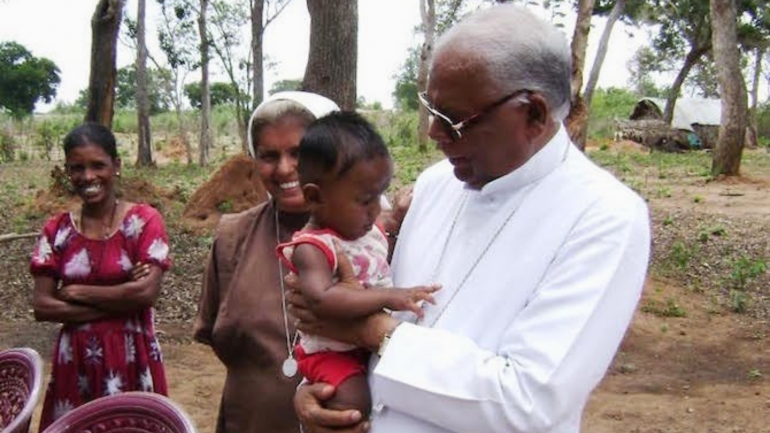
At a time when journalists and activists faced abductions and violence, concerns for his safety grew. In response, people of different faiths in Mannar, Christians, Hindus, and Muslims, came together to demand his protection, reflecting the deep trust he had earned across communities.
After the War
Following the end of the war in 2009, Bishop Joseph continued to advocate for justice, reconciliation, and dignity. While reconstruction focused on infrastructure, he pointed to the deeper wounds of trauma and loss.
“The people in war-torn areas have become like walking skeletons,” he once said. “They live with painful memories, without even the space to mourn.”
He called for meaningful political solutions, respect for identity, and an end to militarization in the North and East. He also supported international efforts to ensure accountability and justice when local mechanisms fell short.
Despite continued criticism, he remained steadfast.
The ‘Romero of Mannar’
Bishop Rayappu Joseph saw his mission clearly: to be the voice of his people and a shepherd to the suffering. For him, defending human dignity was inseparable from faith.
Though some labeled him a traitor, many, especially among the marginalized, saw him as a courageous pastor. He came to be known as the “Oscar Romero of Mannar,” a tribute to his fearless witness to truth and justice.
Even in the face of misunderstanding and persecution, he remained a shepherd of compassion, standing firmly with his people until the end.