


Saving the Sacred: A Catholic Journalist’s Mission to Preserve Goan Christian Art

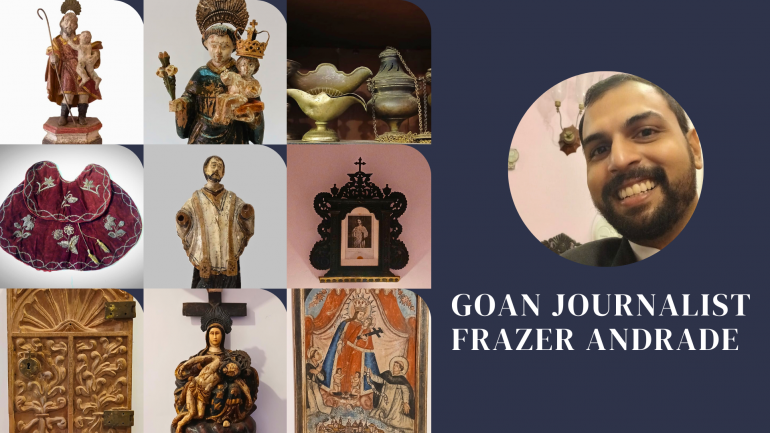
In a simple home in Goa, southwest India, lies a remarkable private collection that tells the story of centuries of Christian faith expressed through art. Carefully preserved and documented by young Goan journalist Frazer Andrade from Fatorda, Goa, this collection of more than 700 artifacts stands as a testimony to Goa’s unique Indo-Portuguese Christian heritage.
Andrade, speaking to Radio Veritas Asia, said that this journey began not in a museum or archive but during a formative experience after his Class X board examinations. During a visit to the Prince of Wales Museum in Mumbai in 2012, he encountered a world of historical artifacts that sparked a new curiosity in him. As he admired the exhibits, his father casually remarked that many of the objects looked similar to those lying unnoticed in their own home.
“That remark stayed with me,” Andrade recalls. What began as simple curiosity soon turned into a deeper exploration of the forgotten objects within his family home. Gradually, this interest evolved into a passionate commitment to preserving Goa’s cultural past.
A Turning Point in a Chapel
A decisive turning point came in 2014. While cleaning a small chapel outside his ancestral home, Andrade discovered a bag filled with old religious statues that had been discarded near the gate. When he asked his grandmother about it, she explained that in many Goan households, damaged religious statues are often considered inauspicious and are thrown away, burned, or left at roadside shrines.
“That moment changed everything,” Andrade says. “If sacred objects could be treated like this in my own locality, I wondered what might be happening across the rest of Goa.” From then onward, he resolved to focus his efforts on preserving Christian art and devotional objects before they disappeared.
Treasures that Tell Goa’s Story
Over the years, his collection has grown to more than 700 artifacts dating from the early seventeenth to the early twentieth century. Crafted from wood, ivory, bone, metal, textiles, and leather, these objects reflect the devotional life and artistic creativity of earlier generations of Goan Christians.
Among the most fascinating traditions he encountered is the custom of gifting a statue of the Infant Jesus to daughters at the time of marriage. Often carved in ivory, bone, wood, or silver, these figurines were believed to bring blessings upon the new family.
One of the treasures in his collection is an eighteenth-century sandalwood votive casket that reflects a blend of Sri Lankan and Indo-Portuguese artistic styles. His textile collection includes a rare eighteenth-century processional banner and vintage leather-bound missals. Particularly meaningful to him is a small statuette of St. Anne that his grandfather carried in his pocket whenever he went to school to write examinations.
From a theological perspective, such objects are far more than historical curiosities. Christian art has always served as a visual language of faith, helping believers contemplate the mysteries of God.
A Unique Indo-Portuguese Legacy
Goan Christian art developed through centuries of interaction between Portuguese missionaries and local artisans. According to Andrade, this artistic tradition reflects influences from Portuguese, Hindu, Islamic, Buddhist, and even East Asian styles.
Local craftsmen, many of them Hindu or Muslim, applied their skills to Christian themes, creating altars, statues, and sacred objects that blended European iconography with indigenous techniques and motifs. The result was a distinctive Indo-Portuguese aesthetic that is difficult to reproduce today.
To share this heritage with a wider audience, Andrade created the online platform “Indo-Portuguese & Goan Christian Art” on social media, where he shares photographs, research insights, and stories about the artifacts.
“These platforms help bring these masterpieces to a global audience,” he explains. “Many of these works rarely receive the attention they deserve.”
A Dream for the Future
Despite growing interest in his work, Andrade has largely financed the collection himself. Many artifacts were purchased from antique shops or private homes, while others were gifted by people who admired his dedication. Space remains a challenge, as the collection is currently stored in different parts of his home.
His long-term vision is to create a comprehensive catalogue of the collection, which would assist historians, researchers, and Church institutions studying Indo-Portuguese Christian art. He also dreams of establishing a heritage centre where the artifacts could be properly displayed and studied.
“I envision a space that not only preserves objects but also tells the story of Goa’s faith and culture,” he says.
For Andrade, the mission is deeply personal. “To many, I may look like just an antique hoarder,” he admits. “But in my heart, I know I am a son of Goa trying to protect a piece of her heritage.”
His message to young people and the Catholic community is simple: heritage must be valued before it disappears.
“Goan Christian art is not merely about old statues or paintings,” he says. “It is a testimony of our faith, history, and identity. If we learn to value it and work together to preserve it, this unique legacy will continue to inspire future generations.”