



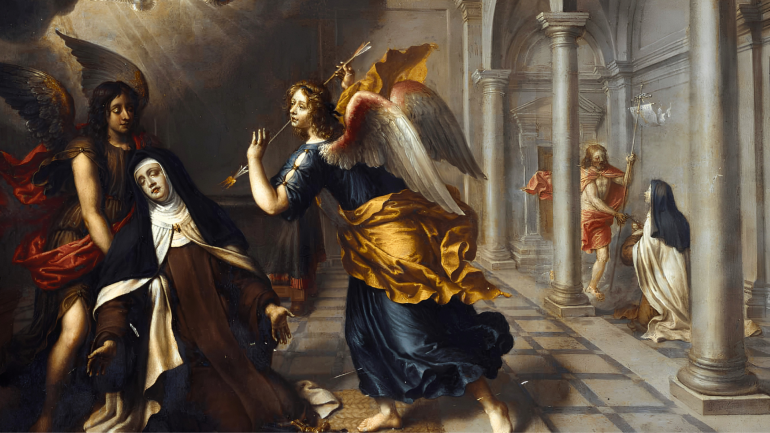
On 15 October, the Church commemorates Teresa of Ávila, the sixteenth-century Spanish Carmelite who was named a Doctor of the Church in 1970 and thus became the first woman to receive that title, along with Catherine of Siena. Bernini's marble statue, depicting the swooning saint and the smiling angel, has established a popular image of a woman immersed in rapture. In fact, the actual Teresa was lively, funny, practical, and highly suspicious of the kind of experience that the statue praises.
Beyond the Ecstasy
The usual picture of the situation is complicated by the fact that Teresa's grandfather, Juan Sánchez, had been a converso and had suffered punishment from the Inquisition for allegedly returning to Judaism, after which the family bought a certificate of nobility to advance. The fact that she grew up with a secret insecurity regarding her lineage in a society which was obsessed with 'purity of blood' had an effect. She later stated that she cared nothing about honour or genealogy and maintained that her convents should admit women regardless of their family background.
Her health was always in a chronic condition. When young, she had a serious illness which left her partially paralysed for several months, and she then endured frequent fevers, headaches, and pain for many years. She spent almost twenty years at the Carmel of the Incarnation, a large and busy convent with people constantly arriving and departing, living there in a condition she described as mediocre. She did not pray regularly, felt guilty about this, and at times stopped praying altogether. The reforms she started were not undertaken with youthful enthusiasm but in middle age, after decades of struggle.
She was also suspected. The Inquisition looked into her writings, and her confessors at times doubted her; one papal nuncio referred to her as a "restless, disobedient gadabout woman". In reply, she founded seventeen convents all over Spain, travelled by mule cart through the heat and mud, negotiated with the bishops, and looked after the money. Among the four hundred letters that have survived, there is evidence of a woman with a sharp sense of humour and with common irritations. It is famously stated that she complained to God that if this was the way he treated his friends, it was no wonder that he had so few.
A Psychology Before Psychology
The work Teresa produced, The Interior Castle (1577), presents the soul as a crystal castle with seven dwelling places; it is an early depiction of inner development, and readers nowadays have discovered parallels with psychology.
The first step should be self-knowledge, Teresa maintains, and for her humility is just another way of saying the truth. This view is one that modern therapy would acknowledge: personal change begins with a genuine and non-defensive examination of one's true motives and patterns.
She had a distrust of the 'high' sort; she kept stressing that visions and raptures aren't a sign of holiness and that sadness, together with imagination, can mimic such experiences. She told her nuns to eat properly, to get sufficient sleep and to laugh, and at one time remarked that God keeps us from having gloomy saints. Her concern for the connection between body and mind shows a forethought of psychosomatic ideas. She instructed the prioresses to deal with some of the overly excited sisters by lightening their fasts and assigning them easy duties, in effect, distinguishing between a spiritual crisis and exhaustion.
Attention and the wandering mind: she refers to the mind as being uncontrollable, describing it as "the madwoman of the house", a phrase frequently associated with her, and advises for a patient rather than a severe suppression. This is in line with contemporary mindfulness methods, in which the practice consists of returning.
Friendship is the means by which Teresa describes prayer as a close sharing between friends, involving spending time alone with someone who knows and loves us. According to attachment theory, such a relationship is referred to as a secure base, since it allows one to be honest about their doubts, anger, and dryness.
Love that is practical. She maintained that the test of prayer lies in action, since progress is shown by one's love for one's neighbor rather than by intense emotion. Behavioural science also holds that values are expressed and strengthened through behavior.
A warning should be given: the mystical experiences of Teresa have been diagnosed by later writers as being caused by epilepsy, hysteria, or psychosis. However, such retrospective diagnoses are speculative and fail to take into account the fact that Teresa had submitted her experiences to theologians for examination. While psychology can explain the mechanisms behind an experience, it cannot determine what the experience actually was.
Why She Matters Now
Teresa addresses the exhausted achiever; although she was ill, opposed and frequently discouraged, she still reformed a religious order without feigning strength, and her combination of ambition and self-forgiveness is a useful example for those experiencing burnout, namely by working seriously and resting deliberately.
She addresses those who are spiritually restlessly active; in a time when various practices are tried and then given up, her belief in keeping on with a practice even when it is dry offers something rarely advertised: persisting with a discipline even when it does not yield rewards.
She also gives speeches to women in institutions that underestimate them; Teresa never saw herself as a rebel, instead quietly establishing alternative communities in which women could read, pray, and look after their own governance, and in this way she succeeded.
The famous bookmark, which was discovered in her breviary, states that nothing should disturb or frighten us, that all things are temporary, and that God is quite sufficient. Whether interpreted as an expression of faith or as a way of reframing things, it serves as guidance for difficult and anxious periods.