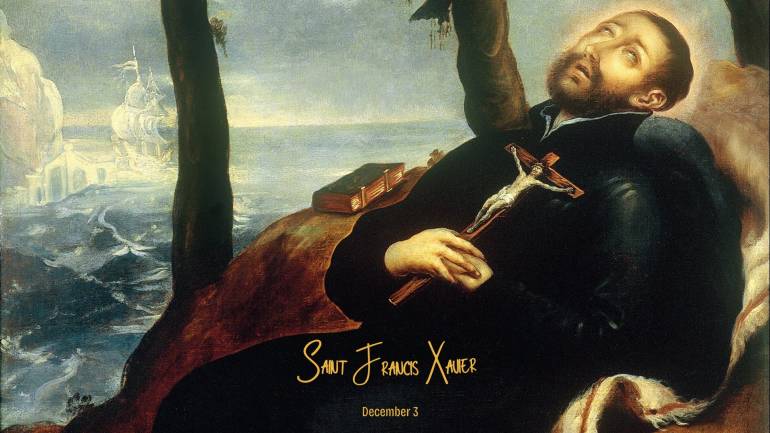
As the Church celebrates the Feast of Saint Francis Xavier on December 3, we will explore some important Q&As on the life and mission of this remarkable saint.
Who were the Xavier (Javier) family?
St. Francis Xavier was born Francisco de Jaso Azpilicueta, the youngest of six children, on April 7, 1506, at Xavier Castle in the village of Xavier, northern Spain (called Javier in Spanish). His family was noble, wealthy, and very religious. They belonged to the Basque race, an independent race from the Pyrenees Mountains on the border between France and Spain, known for their unique mountainous culture, language, and strong Catholic faith.
The Xavier family was strong loyalists of the Kingdom of Navarre. In 1469, when Spain's kingdoms of Castile and Aragon united to resist French forces in the Pyrenees, the Xavier family fought on Navarre's side. The conflict began in 1512 and lasted for over 18 years. However, they ultimately lost, resulting in the loss of their Xavier Castle and huge family fortune.
So, why is he known as St. Francis Xavier and not by his birth name?
Although his birth name was Francisco de Jaso Azpilicueta, it was common at the time to sign letters with the name of one's birthplace. As a result, he signed his letters as Francisco de Javier (Francis from Xavier), which is how he became known as St. Francis Xavier. This is also the name under which he was canonized by Pope Gregory XV on 12 March 1622, at the same time as St. Ignatius Loyola.
How did Francis’ mother influence his faith and early life?
The Catholic faith was deeply rooted in the Xavier family. Before losing Xavier Castle, the heart of the family's life was the castle chapel, where the chaplain and assistant priests celebrated Mass daily, along with a solemn Mass on Sundays, and recited the Divine Office.
St. Francis Xavier’s father passed away in 1515, when young Xavier was only nine years old. His mother, Dona Maria (María de Azpilicueta), played a significant role in shaping his faith. Every evening, she would gather the children to pray the Rosary before a venerated crucifix and sing the Salve Regina.
Who was Peter Faber? How did he influence the life of Francis Xavier?
Young Francis completed his early studies in the nearby cities of Sangüesa, Leyre, and Pamplona. At the age of 19, the flamboyant and charming Francis, known for his passion for dancing, athleticism, intelligence, language-learning skills, and charismatic nature, was sent to study at the University of Paris. Like many teenagers, he dreamed of becoming famous and returning home to pursue a distinguished career.
At the University of Paris, St. Francis Xavier’s first encounter was with his roommate Peter Faber, a young man from Savoy (southeastern France) who came from a poor shepherd family. Despite his humble beginnings, Peter’s love for books helped him reach Paris to study for the priesthood. Francis was drawn to the simplicity, goodness, and spirituality of Peter, who later played the divine role of introducing him to Ignatius Loyola.
How did Ignatius Loyola impact Francis Xavier's life?
In what one could call divine providence, Ignatius Loyola, fifteen years older than Francis, came from the same Basque race, and his ancestral castle was not far from the Xavier family’s. However, Ignatius had been a soldier on the side of the Castilian and Aragonese monarchs. He was wounded while defending Pamplona from a French and Navarrese army. Driven by a desire to help others, he came to Paris to study for the priesthood after a dangerous pilgrimage to the Holy Land.
Ignatius quickly realized that Francis was unique, with his intelligence, energy, and generous temperament. However, he also saw that Francis was stubborn and resistant to change, clinging firmly to his worldly ambitions and the dream of a brilliant career in the Church.
Ignatius guided Francis through his famous Spiritual Exercises, and it was through these exercises, along with the powerful words of Scripture, “For what shall it profit a man, if he shall gain the whole world, and lose his own soul?” that St. Francis Xavier experienced his conversion.
How did Francis Xavier end up being sent to India?
Francis was ordained a priest in Venice on June 24, 1537, becoming one of the original companions of Ignatius in founding the Society of Jesus (the Jesuits). While Ignatius initially planned to send him to the Holy Land for missionary work among the Muslims, Francis' appointment to India happened almost by chance.
The King of Portugal wanted some Jesuits to go to India in the merchant fleet soon to leave Lisbon, and when one of the chosen priests fell ill, Ignatius appointed Francis instead, saying, “Master Francis, here is your enterprise. Go, set the world on fire.”
Francis responded, “Good; I am ready.” It was a short and simple interview that led to great things. Francis eagerly accepted, and the two friends parted ways, never to meet again in this life.
Distance only strengthened their friendship. In Malacca and Japan, Francis would read Ignatius' letters, often moved to tears by the words they ended with: “I shall never forget you; entirely your own, Ignatius.” He carried on all his voyages, Ignatius’ signature and a copy of his vow in a reliquary around his neck.
What was the mission of Francis Xavier?
On April 7, 1541, on his 35th birthday, Francis embarked on a dangerous voyage from Lisbon to Goa. The journey took 13 months, with many perils, including fever and food shortages. Francis devoted himself to caring for the sick, distributing food, and comforting the dying. His selfless acts earned him the respect of all aboard.
Upon reaching Goa, he began his life's mission. Francis had an immense love for children, seeing them as little apostles who could help him reach their parents. He would walk through villages ringing a bell, with children following him to the church. He taught them hymns about the creed, which they then shared with their parents, who sang them while working in the fields or fishing.
His greatest concern was always for sinners, both Portuguese and natives, spending countless hours in the confessional. Francis soon realized that a major obstacle to converting the natives was the corrupt, sensual, and depraved lifestyle of the ruling Europeans.
For eleven years, until his death at 46, he tirelessly evangelized across India, Ceylon, Malacca, the Moluccas (Indonesia), and Japan, a country whose culture he adored. His ultimate dream was to reach China, but he was unable to fulfil this. He passed away in Sancian, near China, on December 3, 1552.