




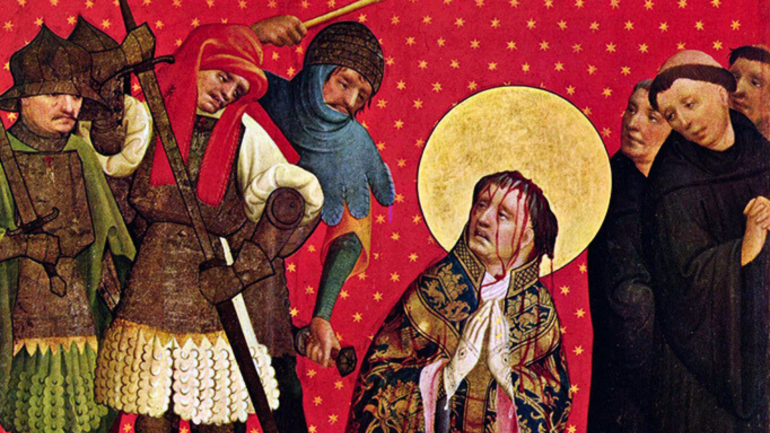
St. Thomas Becket (c. 1119–1170), Archbishop of Canterbury and martyr, whose feast is celebrated annually on December 29, stands as a compelling witness to the primacy of conscience in Christian life. His journey from royal privilege to martyrdom reveals how faith can transform a person and challenge unjust power. In a world where truth is often compromised and prophetic voices silenced, Becket’s life continues to speak with urgency to the Church and society.
From Royal Power to Spiritual Conversion
Born in London to a prosperous Norman family, Thomas Becket received an excellent education in Paris and in the study of canon and civil law. His intelligence and administrative skill brought him to the attention of King Henry II, who appointed him Chancellor in 1155. As Chancellor, Becket enjoyed wealth, influence, and royal favour, serving the interests of the crown with efficiency and loyalty.
Everything changed in 1162 when Henry II appointed him Archbishop of Canterbury. The king expected his close friend to safeguard royal authority within the Church. Instead, this appointment marked a profound inner conversion. Becket renounced his luxurious lifestyle, embraced simplicity and penance, and devoted himself to prayer and pastoral responsibility. His allegiance shifted decisively, from the king to God.
A Spirituality Anchored in Conscience
At the heart of Becket’s transformation was a deep commitment to conscience. For him, conscience was not stubborn resistance but obedience to God’s truth. As archbishop, he believed he was entrusted with defending the Church’s freedom to carry out its mission without interference from secular power.
This conviction brought him into conflict with King Henry II over the Constitutions of Clarendon (1164), which sought to limit ecclesiastical authority and place clergy under royal courts. Becket recognized that accepting these measures would compromise the Church’s integrity. Despite pressure and threats, he refused to submit, echoing the apostolic conviction: “We must obey God rather than human beings” (Acts 5:29).
Exile and the Cost of Fidelity
Becket’s resistance led to his exile in France, where he spent nearly six years. These years were marked by isolation, suffering, and misunderstanding. Cut off from his diocese and abandoned by former allies, Becket experienced the heavy cost of faithfulness.
Yet exile became a time of purification. Through prayer and endurance, his faith was refined and deepened. Stripped of power and security, he learned to trust completely in God. His experience embodies the Gospel promise: “Blessed are those who are persecuted for righteousness’ sake” (Matthew 5:10). Becket teaches that true courage is not loud defiance but steadfast perseverance in truth.
Martyrdom in Canterbury Cathedral
In 1170, following a fragile reconciliation with the king, Becket returned to England. Peace was short-lived. Tensions soon resurfaced when he continued to assert ecclesiastical authority. In a moment of rage, King Henry II reportedly exclaimed, “Will no one rid me of this troublesome priest?”
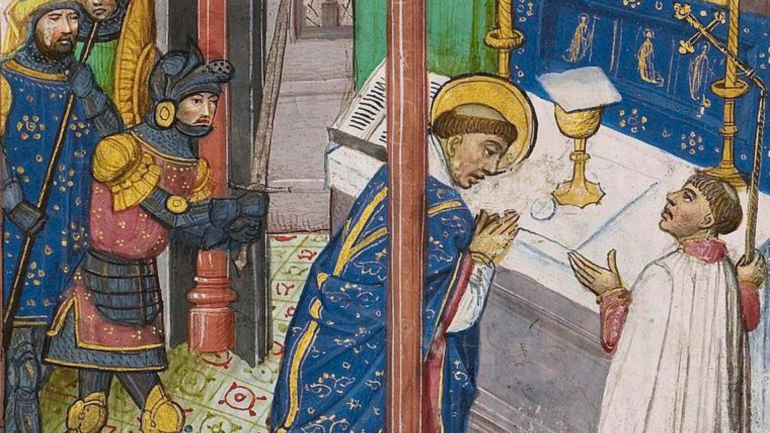
On 29 December 1170, four knights confronted Becket in Canterbury Cathedral. Refusing to flee or resist, Becket entrusted himself to God. Tradition records his words: “I am ready to die for my Lord, that in my blood the Church may obtain liberty and peace.” He was struck down near the altar, becoming a martyr for the freedom of the Church and the supremacy of conscience.
His death shocked Christendom. Becket was canonized within three years, and his shrine became a major place of pilgrimage. His martyrdom was not a political rebellion, but a sacred witness that God’s authority surpasses all earthly power.
Becket in Murder in the Cathedral
The spiritual depth of Becket’s final witness is powerfully captured in T. S. Eliot’s play Murder in the Cathedral (1935). Eliot focuses on Becket’s inner struggle, especially his temptation to seek martyrdom for personal glory. The famous line, “The last temptation is the greatest treason: to do the right deed for the wrong reason,” reveals Becket’s ultimate surrender to God’s will. Eliot presents martyrdom not as self-chosen heroism, but as obedience
Relevance for Today
St. Thomas Becket’s witness remains deeply relevant. Across the world, many face pressure to remain silent in the face of injustice. Becket reminds the Church that faithfulness to the Gospel cannot be negotiated for comfort or security. His life challenges believers to resist compromise and to trust God even when obedience is costly.
As Jesus teaches, “Do not be afraid of those who kill the body” (Luke 12:4). Becket’s courage assures us that truth defended in love ultimately bears fruit, like the grain of wheat that dies to bring life (John 12:24).
St. Thomas Becket’s journey, from royal official to archbishop, from exile to martyrdom, reveals the transforming power of conscience guided by faith. His life proclaims that obedience to God may demand sacrifice, but such sacrifice is never in vain. In a world that often rewards compromise, Becket remains a timeless witness to courageous faith.




- Reply
Permalink