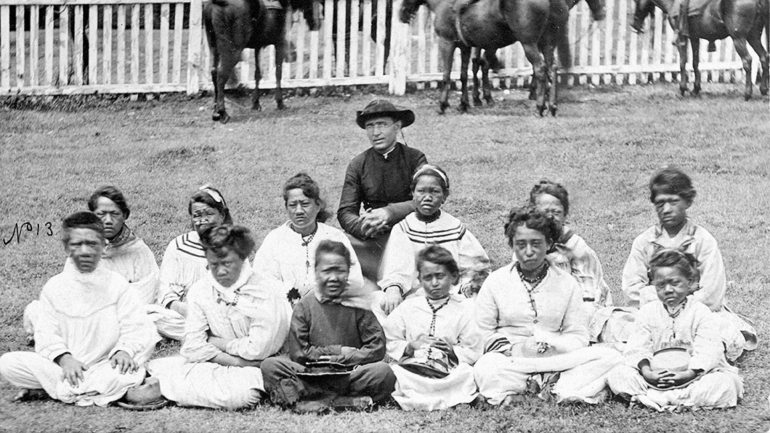
There is a particular kind of courage that does not announce itself. It does not arrive on horseback or in a blaze of rhetoric. Instead, it shows up quietly on a Tuesday. It boards a boat to a place no one wants to go. Then, it stays there, year after year, long after the novelty of sacrifice is gone. That is the courage of Father Damien de Veuster. He was the Belgian priest who sailed to the leper colony of Kalaupapa on the Hawaiian island of Molokai in 1873, and never really left.
On May 10, the church celebrates the feast of St. Damien.
Most people know the broad outline: priest goes to lepers, contracts leprosy, dies a saint. But that tidy arc hides something richer and more psychologically interesting. Damien was not, by many accounts, an easy man. He was stubborn and blunt, even to the point of tactlessness. He was frequently at odds with his superiors. Damien irritated Church authorities with incessant letters, always demanding medicine, lumber, and bandages. He could be possessive about his mission and resistant to sharing authority when other helpers arrived in his last years. He was, in short, thoroughly human. Understanding that humanity is exactly what makes his achievement staggering.
The Psychology of Unconditional Commitment
From a psychological standpoint, what Damien did at Kalaupapa represents something that researchers today call deep commitment, a phenomenon distinct from motivation, enthusiasm, or even vocation. Motivation fluctuates. Enthusiasm fades. But deep commitment restructures one's identity around a cause until leaving becomes psychologically inconceivable. Damien did not heroically resist the temptation to flee each morning. He had, over the years, become someone for whom leaving was simply not a category of thought.
This is not mysticism; it is what attachment theory and identity research tell us about how transformative service works. When Damien began physically building the homes, coffins, and church of Kalaupapa with his own hands, literally constructing the world around him, he was also constructing a self that was inseparable from that world. By the time leprosy was killing him, the island was him. This is a radically different model from the modern notion of "sustainable giving," where we are encouraged to maintain strict boundaries lest we burn out. Damien did burn out, in a sense. He burned all the way through.
What Histories Leave Out
Less discussed is the profound loneliness Damien endured for the first decade of his mission. Letters from this period reveal not a serene mystic but a man wrestling with isolation, clerical neglect, and the particular grief of watching people die whom he had come to love. He wrote to his brother Pamphile, himself a priest, with a rawness that borders on anguish. He was refused the sacrament of confession for years because no other priest would come near him. Consider what this meant for a devout Catholic: cut off from the ritual at the core of his faith, caring for the spiritually and physically abandoned, himself abandoned by the institution he served.
It was out of this crucible, not despite it, that his famous declaration emerged. When he began his Sunday homily one day in 1885 with the words "We lepers," he was not performing solidarity. He had just confirmed his own diagnosis. That shift from "you" to "we" is one of the most quietly shattering moments in the history of Christian ministry.
Relevance for a Fractured Age
We live in an era of spectacular burnout, epidemic loneliness, and a mounting crisis of meaning. Surveys consistently show that people across the developed world feel unseen, disposable, and adrift. Into this landscape, Damien of Molokai speaks with uncomfortable directness.
He is not relevant because he was perfect; he wasn't. He is relevant because he chose proximity over safety and presence over productivity. The residents of Kalaupapa did not need Damien to solve leprosy. They needed someone to sit with them, build with them, and know their names. Modern psychology increasingly recognises this as the deepest form of healing available to human beings: the experience of being accompanied, not fixed.
His life stands as a direct challenge to what the philosopher Charles Taylor describes as "authenticity culture", the belief that self-fulfilment is the highest goal of a life well lived. Damien’s fulfilment was not achieved through self-seeking, but through self-expenditure. He discovered his truest self by giving himself away, wholly and without reservation.
He was canonised in 2009, but perhaps that is almost beside the point. What truly matters is something simpler and far more demanding: a man showed up, stayed, and allowed the place to transform him until he could no longer envision himself anywhere else. In a world that prizes exit strategies and personal pivots, such steadfastness is quietly revolutionary.