(The RVA Central Office in Quezon City, Philippines, has been blessed by visits from three saints of the Catholic Church — St. Paul VI, St. John Paul II, and St. Teresa of Calcutta. Their presence remains a lasting inspiration for RVA’s mission to proclaim the Gospel across Asia. As we prepare to rename our chapel the Three Saints Chapel in their honor, RVA launches a special series reflecting on their lives, their contribution to the Church’s mission in Asia, and their memorable visits to our broadcast center. Their witness continues to guide our work of faith and communication. – Editor)
Some lives are so full, so surprising, and so richly human that they refuse to stay inside neat labels. Pope John Paul II was one such life. He was a man of deep prayer and immense courage, but also of wit, culture, energy, and remarkable human warmth. He could speak to crowds by the millions and still notice the person quietly standing at the edge of the room. He carried the weight of history without losing his sense of joy. He lived with a seriousness of purpose, yes, but never with a dreary spirit. The more one looks at his life, the clearer it becomes that he was not simply a great pope. He was an astonishingly alive human being.
Before he became John Paul II, he was Karol Józef Wojtyła, born on May 18, 1920, in Wadowice, Poland. His early life was marked by grief with a persistence that would have flattened many people. His mother died in 1929, his elder brother Edmund died in 1932, and his father died in 1941. By the time most young men are still deciding what to do with their lives, Karol had already walked through enough sorrow that would have made lesser men either bitter or broken. Yet the official Vatican biography shows that these losses helped form in him a spiritual depth and inner steadiness that stayed with him all his life.
Now here is the part that feels almost unfairly impressive. The future pope was not only prayerful and intellectually gifted, but he was also deeply drawn to literature and theatre. Yes, theatre. Karol Wojtyła was deeply drawn to theatre and became part of Poland’s Rhapsodic Theatre tradition during the war. This matters because it explains something essential about him. John Paul II did not merely speak in public; he understood how language worked. He knew how words could move people, steady them and console them. He was not performing holiness. He had simply learned, long before Rome, how truth sounds when spoken with conviction.
Then came the war years, which read less like a biography and more like a reminder that human beings can survive astonishing things. During the Nazi occupation, Wojtyła worked in a quarry and later in the Solvay chemical factory. At the same time, he studied for the priesthood in an underground seminary in Kraków. Let that sit for a moment. Quarry worker. Factory laborer. Secret seminarian. Future pope. Most people would be justified in making just one of those their whole personality. He managed all four, without the luxury of motivational podcasts. These wartime experiences gave him a close knowledge of suffering, labor, fear, and human dignity, not as ideas for speeches, but as facts of life.
By the time he was elected pope on October 16, 1978, he had already become one of the most unusual men ever to walk into a conclave. According to the Vatican and Britannica, he was the first non-Italian pope in 455 years and the first from a Slavic country. So Rome, which had grown quite accustomed to Italian popes, suddenly found itself with a Polish one who had survived war, loved poetry, climbed mountains, wrote philosophy, and had the energy of three cardinals and a youth retreat rolled into one.
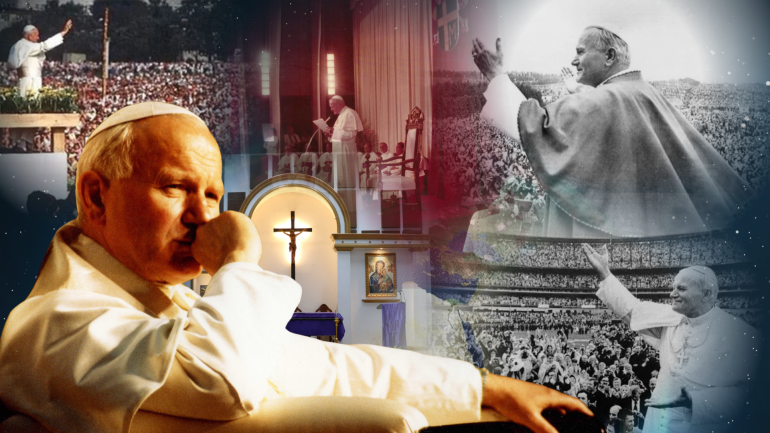
And about that energy, John Paul II did not exactly fit the “sit quietly and wave from a distance” model. He hiked, skied, travelled relentlessly, and connected with young people in ways that made him feel startlingly accessible for a man with global responsibilities. His public presence was not stiff and ceremonial in the dull sense. It had warmth. It had force. It had the unmistakable air of someone who had not given up on joy just because he had also taken suffering seriously. Vatican News and biographical accounts consistently highlight his pastoral closeness, especially to the young.
That human warmth appears even more vividly in personal recollections. In one Opus Dei account, he jokes with Carmelite nuns, asking, “So you’ve escaped from your cloister?” In another moment, after meeting an Italian family, he notices that the grandparents are standing and insists that chairs be brought for them. These stories are small, and that is precisely why they matter. Greatness is easy to fake from a balcony; it is much harder to fake in the details. The man who addressed millions also noticed who needed a chair. That says more about character than many grand speeches ever could.
John Paul II’s later years became a powerful final sermon. After surviving the assassination attempt on May 13, 1981, and living publicly with grave physical decline, including Parkinson’s disease, he chose not to hide his weakness. In doing so, he showed that human dignity does not fade when the body fails. What makes him so compelling is not only the vastness of his legacy but the depth of his humanity. The saint who loved theatre, the Pope who was once a laborer, the leader marked by grief, wit, culture, prayer, and suffering, yet always vividly alive to the world.