(The RVA Central Office in Quezon City, Philippines, has been blessed by visits from three saints of the Catholic Church — St. Paul VI, St. John Paul II, and St. Teresa of Calcutta. Their presence remains a lasting inspiration for RVA’s mission to proclaim the Gospel across Asia. As we prepare to rename our chapel the Three Saints Chapel in their honor, RVA launches a special series reflecting on their lives, their contribution to the Church’s mission in Asia, and their memorable visits to our broadcast center. Their witness continues to guide our work of faith and communication. – Editor)
In the history of modern evangelization, few Church leaders recognized the power of communication as clearly as St. John Paul II. Known as one of the most dynamic missionary popes of the twentieth century, he viewed modern media not simply as technical tools but as providential gifts for proclaiming the Gospel.
For John Paul II, communication was inseparable from the Church’s mission. Radio, television, and emerging technologies were not merely channels of information but new “pulpits” through which the message of Christ could reach people across cultures and continents. This vision closely reflects the mission of Radio Veritas Asia (RVA), a Catholic broadcasting ministry dedicated to sharing the Gospel across the diverse societies of Asia.
A missionary pope in a global communication age
When John Paul II began his pontificate in 1978, the world was entering a new era of global communication. Satellite broadcasting, expanding radio networks, and new technologies were rapidly transforming how people shared ideas and information.
Recognizing these changes, the pope encouraged the Church to engage actively with the media. In his missionary encyclical Redemptoris Missio, he famously described the world of communications as the “first Areopagus of the modern age.” The reference recalled the ancient Greek forum where St. Paul preached the Gospel in Athens, symbolizing a place where ideas were exchanged and faith proclaimed.
In the same spirit, John Paul II insisted that the Church must bring the Gospel wherever people gather, including the vast spaces created by modern media.
Through his annual World Communications Day messages, he repeatedly encouraged journalists, broadcasters, and media professionals to use technology to promote truth, dialogue, and human dignity. Media, he said, should serve the common good and strengthen communities rather than simply shape public opinion.
Radio: A voice that crosses borders
Among the many forms of communication embraced by John Paul II, radio held particular importance. In many regions of the world, especially across Asia, radio remained the most accessible medium for reaching people in remote areas, communities facing political restrictions, or populations divided by language.
Radio waves could cross mountains, seas, and national borders, bringing encouragement and spiritual guidance to those who might otherwise never hear the message of the Gospel.
This reality made the mission of Radio Veritas Asia especially significant. Established to serve the peoples of Asia through broadcasts in multiple languages, RVA has become a source of spiritual support for millions of listeners.
Through programs that include news, catechesis, prayer, and pastoral reflections, the station connects listeners with the wider Church and offers a platform for sharing the faith across cultures.
For John Paul II, such initiatives embodied the Church’s missionary calling, ensuring that the voice of the Gospel could reach people far beyond traditional centers of Christian life.
A visit to Radio Veritas Asia
The connection between John Paul II and Radio Veritas Asia became particularly visible during his apostolic journeys to the Philippines.
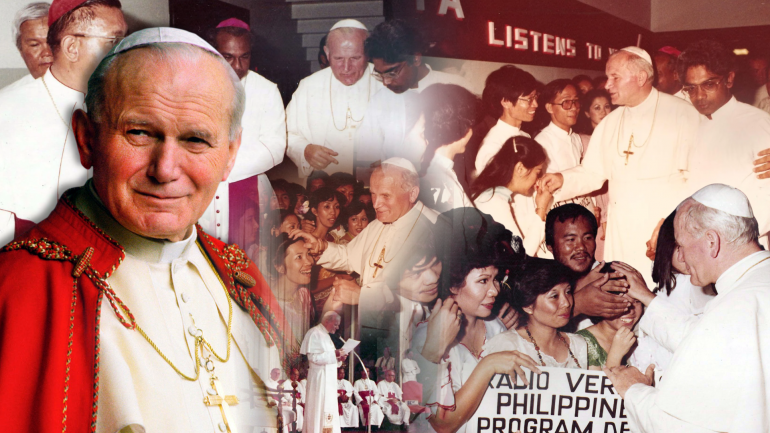
During his first pastoral visit to the country in 1981, the pope visited the RVA auditorium in Manila on February 21. Standing before microphones that carried broadcasts in numerous Asian languages, he addressed listeners across the continent.
From the studio, his message of hope reached millions of people throughout Asia.
On that occasion, the pope expressed his joy at sending greetings to Asian audiences through Radio Veritas. He acknowledged the station’s important role in transmitting papal messages and providing religious programming to communities throughout the region.
The visit affirmed RVA’s mission as a bridge linking the universal Church with the peoples and cultures of Asia.

Encouragement for Catholic broadcasting
John Paul II returned to the Philippines in January 1995 for World Youth Day, a historic gathering that drew millions of young people. The visit coincided with the 25th anniversary of Radio Veritas Asia, offering another opportunity to recognize the importance of Catholic broadcasting.
During the celebrations, the pope praised RVA as a “voice of Asian Christianity.” He commended the station for offering spiritual encouragement to believers, particularly those living in places where the Church faces social or political limitations.
Communicators as witnesses of truth
Throughout his pontificate, John Paul II reminded media professionals that communication carries a profound moral responsibility.
Journalists and broadcasters, he said, must always seek truth and promote a more humane society. In a media environment often shaped by sensationalism or superficiality, he called Catholic communicators to be authentic witnesses who combine professional skill with integrity and compassion.
This vision continues to guide the mission of Radio Veritas Asia. By sharing stories of faith, dialogue, and hope, the network seeks to build bridges among cultures and promote greater understanding among the peoples of Asia.
In doing so, it continues the missionary spirit that St. John Paul II believed should define the Church’s presence in the modern world, proclaiming the Gospel through every available means of communication.