(The RVA Central Office in Quezon City, Philippines, has been blessed by visits from three saints of the Catholic Church — St. Paul VI, St. John Paul II, and St. Teresa of Calcutta. Their presence remains a lasting inspiration for RVA’s mission to proclaim the Gospel across Asia. As we prepare to rename our chapel the Three Saints Chapel in their honour, RVA launches a special series reflecting on their lives, their contribution to the Church’s mission in Asia, and their memorable visits to our broadcast centre. Their witness continues to guide our work of faith and communication. – Editor)
Long before the world knew him as Pope John Paul II, Karol Józef Wojtyła was a young man acquainted with loss. Born in 1920 in Wadowice, Poland, he lost his mother at the age of nine, his brother a few years later, and his father before he reached adulthood.
Grief was not an episode - it was a constant companion.
Then came the Second World War. Nazi occupation reduced Poland to a landscape of fear and brutality. Wojtyła worked in a quarry and later in a chemical factory to avoid deportation, while quietly pursuing his priestly vocation in an underground seminary. Faith, in those years, was not a public expression - it was an act of quiet defiance.
When the war ended, relief was fleeting. Communist rule followed, bringing a different kind of control - less visible, but equally suffocating. The Church was tolerated, but watched. Speech was allowed, but measured.
It was in this crucible of oppression that Wojtyła’s faith was refined - disciplined, resilient, and deeply rooted in the dignity of the human person.
The Pope Who Came from the East
When he was elected pope in 1978, the world paused. A non-Italian pope, the first in over four centuries - and from behind the Iron Curtain.
John Paul II did not speak about oppression from theory. He had lived it.
His return to Poland in 1979 drew millions. It was more than a pastoral visit - it was a moment of awakening.
“Do not be afraid,” he urged.
Those words carried a quiet force. They did not topple regimes overnight, but they stirred something deeper, a moral courage among ordinary people. In time, that courage would find expression in movements like Solidarity, contributing to the eventual collapse of Communist rule in Eastern Europe.
Without holding political office, John Paul II had altered the course of history.
A Global Pastor Without Borders
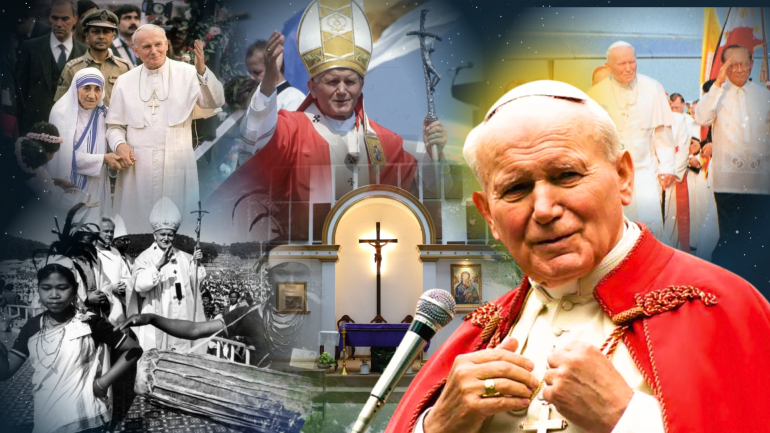
If his early years shaped his courage, his papacy revealed his reach. John Paul II became the most travelled pope in history, visiting more than 120 countries and bringing the Church into direct contact with the lived realities of people across continents.
He stood before vast crowds in Manila, engaged young people in every corner of the globe, and reached out across religious boundaries - visiting a synagogue in Rome, praying at the Western Wall, and entering a mosque in Damascus.
These were not symbolic gestures alone. They reflected a deliberate effort to position the Church as a bridge-builder in a divided world.
Lessons for the Church in Asia
For the Church in Asia, St. John Paul II was not a distant figure in Rome, but a familiar pilgrim who walked its soil and spoke to its soul. He often described Asia as a continent of deep spirituality and immense promise - a place where faith is lived quietly, but with profound resilience.
His visit to Singapore in 1986 left a lasting impression on the region. In the days that followed, I met the late Cardinal Soter Fernandez as a Catholic journalist, then Archbishop of Kuala Lumpur, who spoke with quiet admiration of the Pope’s presence.
“He came to Asia not as a visitor, but as a pastor,” Archbishop Soter reflected. “There was a sincerity in the way he listened to our people, our cultures. He made us feel that the universal Church had a place for Asia - not at the margins, but at its heart.”
That affirmation carried weight in a region where Catholics often live as minorities. It was not merely symbolic, it was deeply pastoral.
Through Radio Veritas Asia, that presence extended even further. The Pope’s voice travelled beyond physical boundaries, reaching homes, villages, and communities across Asia - sometimes even where the Church could not openly function.
This instinct - to meet people where they are, using every available means - remains one of his enduring contributions to the Church’s mission in Asia.
His life also offers a quiet but necessary challenge to clericalism. Despite the immense authority of his office, John Paul II consistently embodied humility - kneeling to kiss the ground of the countries he visited, meeting ordinary people with warmth, and placing service above status.
In many parts of Asia, where clergy can sometimes become distant through hierarchy or routine, his example calls for a return to pastoral closeness. Authority, he showed, is not diminished by humility - it is deepened by it.
A Saint for Our Times
Canonised in 2014, St. John Paul II remains one of the most recognisable figures of modern Catholicism. Yet his legacy is not confined to memory. It lives in the courage he inspired and the clarity of his witness.
He did not retreat from the complexities of the modern world. He engaged them, confident that faith must speak clearly, act justly, and remain rooted in the dignity of every human person.
When he died on April 2, 2005, the world responded not only with grief, but with recognition. In St. Peter’s Square, the cry arose: Santo subito - make him a saint now.
It was an acknowledgement of a life lived in service, marked by suffering, courage, and unwavering faith.
St. John Paul II was a pilgrim across nations, ideologies, and human experience. He confronted tyranny without weapons, spoke truth without fear, and bore suffering with grace.
For Asia - and for a world still searching for moral clarity - his life remains a compelling witness: that faith must not retreat into silence, that dignity must always be defended, and that even in uncertain times, the call endures - Do not be afraid!