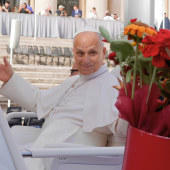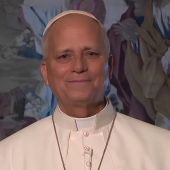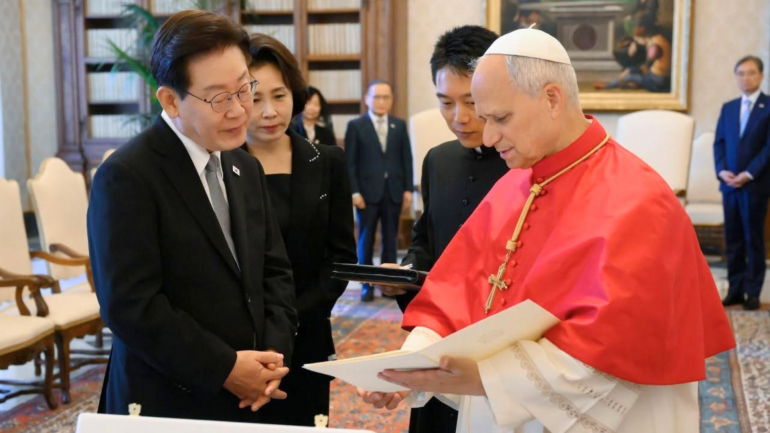
Pope Leo XIV received South Korean President Lee Jae-myung in a private audience at the Vatican on June 15, reaffirming the longstanding relations between the Holy See and the Republic of Korea.
According to Vatican News, the meeting took place at the Apostolic Palace, where the Pope welcomed the South Korean leader during his visit to the Vatican.
Following his audience with Pope Leo XIV, President Lee met with Cardinal Pietro Parolin, Vatican Secretary of State, and Archbishop Paul Richard Gallagher, Secretary for Relations with States and International Organizations.
During discussions at the Secretariat of State, both sides highlighted the strong ties between the Holy See and South Korea, which established diplomatic relations in 1963. Over the past six decades, relations have remained close, marked by papal visits to the East Asian nation. Pope St. John Paul II visited South Korea in 1984 and 1989, while Pope Francis traveled there in 2014 for the Sixth Asian Youth Day gathering.
According to a statement released by the Holy See Press Office and cited by Vatican News, the talks also acknowledged the contribution of the Catholic Church in South Korean society, particularly in the areas of education and social welfare.
The meeting further included discussions on preparations for World Youth Day 2027, which will be held in Seoul, the capital of South Korea. The event is expected to draw hundreds of thousands of young Catholics from around the world.
The Vatican statement noted that the conversations also addressed several regional and international issues of mutual concern.
South Korea is home to one of Asia’s most vibrant Catholic communities, with the Church playing an active role in education, charitable services, and social development.
Radio Veritas Asia (RVA), a media platform of the Catholic Church, aims to share Christ. RVA started in 1969 as a continental Catholic radio station to serve Asian countries in their respective local language, thus earning the tag “the Voice of Asian Christianity.” Responding to the emerging context, RVA embraced media platforms to connect with the global Asian audience via its 21 language websites and various social media platforms.
Latest News