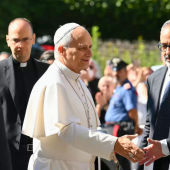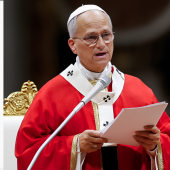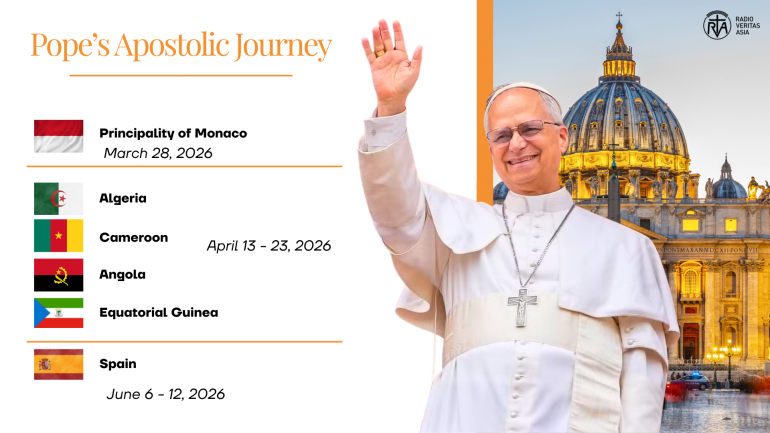
Pope Leo XIV will undertake three major Apostolic Journeys in the first half of 2026, visiting Africa, Monaco, and Spain, according to an announcement by the Holy See Press Office.
The Holy Father’s travels will begin with a one-day visit to Monaco on March 28, followed by a ten-day pastoral journey to Africa from April 13 to 23, and conclude with a six-day visit to Spain, including the Canary Islands, from June 6 to 12.
These journeys follow his significant trip to Türkiye and Lebanon at the end of 2025 and anticipated pastoral visits within Italy, including Lampedusa.
Africa: In the Footsteps of St. Augustine and a Mission of Peace
The longest and most complex of the three journeys will take Pope Leo XIV to four African nations: Algeria, Cameroon, Angola, and Equatorial Guinea.
In Algeria, the Pope will visit Algiers and Annaba, following in the footsteps of Saint Augustine of Hippo, the great North African Father of the Church. The visit highlights the enduring legacy of Augustine and the presence of a small but vibrant Christian minority in a predominantly Muslim country.
In Cameroon, the Holy Father will travel to Yaoundé, Bamenda, and Douala. His visit to the Anglophone region in the north comes amid a decade-long civil conflict between government forces and separatist groups.
Vatican officials say the journey will emphasize peace, reconciliation, and solidarity with communities affected by violence.
The Pope will then visit Luanda, Muxima, and Saurimo in Angola, before concluding in Equatorial Guinea, the only Spanish-speaking country in Africa, where he will stop in Malabo, Mongomo, and Bata.
The length of the African journey recalls the extensive 11-day, seven-nation African tour of Pope John Paul II in 1985. As with his predecessors, Pope Leo XIV is expected to focus on the poor, the marginalized, and those engaged in pastoral and humanitarian service.
Monaco: A Historic First in the Modern Era
On March 28, the Pope will make a brief but significant visit to Monaco, marking the first papal visit to the Principality in the modern era.
Catholicism is the state religion in Monaco, and dialogue between Church and civil authorities remains central in public life.
The visit responds to repeated invitations from the Monegasque authorities, first extended to Pope Francis and later renewed to Pope Leo XIV. The Principality is also known for its commitment to peace initiatives, a theme likely to resonate during the visit on the eve of Holy Week.
Spain and the Canary Islands: Faith, Culture, and Migration
From June 6 to 12, the Pope will visit Madrid and Barcelona before traveling to the Canary Islands.
In Barcelona, he will inaugurate the newest and tallest tower of the iconic Sagrada Familia. The visit coincides with the centenary of the death of Antoni Gaudí, the visionary architect who designed the basilica and was declared Venerable Servant of God last year.
The journey will continue to Tenerife and Gran Canaria in the Canary Islands archipelago—one of the main migratory routes from Africa to Europe, with tens of thousands of arrivals each year.
The visit echoes the pastoral concern of Pope Francis, who had expressed a desire to travel there to show closeness to migrants and local communities facing humanitarian challenges.
Diverse Contexts, One Pastoral Mission
Through these journeys, Pope Leo XIV will encounter diverse realities: from a Muslim-majority nation where Christians are a small minority, to African countries with vibrant Christian communities; from the second smallest country in the world after Vatican City, to a historically Catholic European nation navigating secularization; and finally, to a region at the heart of global migration flows.
In each destination, the Holy Father’s message is expected to center on peace, fraternity, solidarity with the poor, and the enduring hope of the Gospel.
For the Church in Asia and beyond, these visits underscore the universal mission of the Successor of Peter—to strengthen faith, promote dialogue, and build bridges across cultures and continents.
Radio Veritas Asia (RVA), a media platform of the Catholic Church, aims to share Christ. RVA started in 1969 as a continental Catholic radio station to serve Asian countries in their respective local language, thus earning the tag “the Voice of Asian Christianity.” Responding to the emerging context, RVA embraced media platforms to connect with the global Asian audience via its 21 language websites and various social media platforms.
Latest News