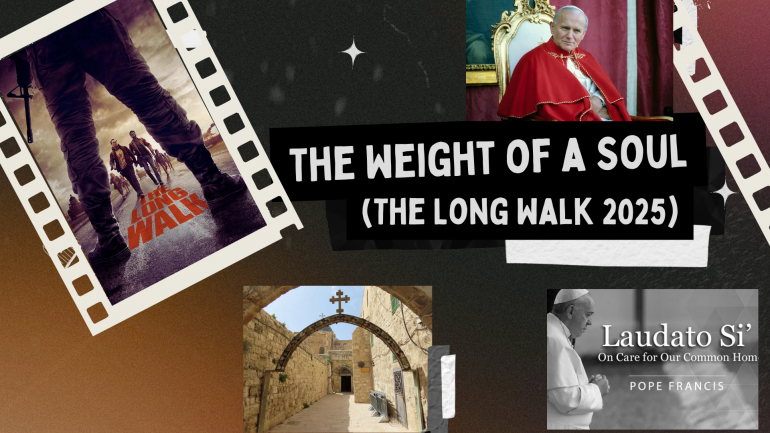
In a bleak, alternate America, one boy can win a fortune by being the last one walking. This is the stark premise of The Long Walk, the powerful 2025 film adaptation of Stephen King’s early novel. Directed by Francis Lawrence, the film follows fifty teenage boys who volunteer for a gruelling, state-sanctioned contest. They must walk. If their speed drops below 3 miles per hour, they receive a warning. Three warnings, and the soldiers following them execute them on the spot. There is no finish line; the contest ends when only one walker remains. Amidst this brutality, the film focuses on the bond between Ray Garraty (Cooper Hoffman) and Peter McVries (David Jonsson), who form a fragile community of support in a game designed to foster ruthless individualism.
Lawrence, a veteran of dystopian cinema, delivers his most critically acclaimed work to date. The film was a surprise box-office hit, praised for its unflinching vision and staggering performances from its young cast. Hoffman and Jonsson share a chemistry that is both heart-warming and heartbreaking, making their journey the emotional core of the film. Mark Hamill is chilling as "The Major," the soulless architect of the walk. The grim, beautiful cinematography by Jo Willems and the haunting, folk-infused score by Jeremiah Fraites of The Lumineers create an atmosphere of relentless dread and fleeting tenderness. While some critics found its political message overly blunt, the film was lauded for its raw power, earning several award nominations for its adapted screenplay and ensemble acting.
On its surface, The Long Walk is a thriller about physical endurance. But peel back a layer, and it reveals itself as a profound, if unintended, reflection on Catholic social teaching and the theme of redemptive suffering.
The walkers’ endless trek mirrors the Stations of the Cross: a Via Dolorosa where each step is laden with the threat of death. They are not just walking for a prize; they are walking through a valley of death, and their choices there define their humanity. This is where the film connects deeply with Christian thought. Pope St. John Paul II, in his apostolic letter Salvifici Doloris, wrote that suffering is a "world of its own" to which "man is called… to complete in his flesh what is lacking in Christ’s afflictions for the sake of his body, that is, the church." He wasn't speaking of a dystopian game, but of the mysterious way human suffering, when united with Christ’s, can have meaning.
The boys in the film are not Christ figures. They are flawed, scared, and desperate. Yet, in their refusal to completely surrender their humanity, they touch upon this mystery. The most powerful moments are not the executions, but the small acts of mercy. One standout scene shows Ray and Peter physically holding up a third boy, Olson (Ben Wang), as his legs give out, sharing his burden to keep him alive for just a few more minutes. They know it’s futile in the long run, but they do it anyway.
In this act, we see a reflection of Jesus’ command: "Carry each other’s burdens, and in this way you will fulfil the law of Christ" (Galatians 6:2). The "law" of the Walk is every man for himself. The law of Christ, enacted in this micro-community, is self-gift. Peter tells Ray at one point, "They say we have a choice, but do you know anyone, anywhere, who has it?" This speaks to a world stripped of freedom, a structure of sin. Yet, within that totalising system, they find the radical freedom to love. This is the "subtle wackiness" of the Gospel, finding freedom not in the absence of constraint, but in the choice to love within it.
The film’s violence is not glorified; it is presented as the brutal, senseless waste that it is. When a boy is shot, there is no triumph, only tragedy. This aligns with the Church’s consistent life ethic, which condemns a "culture of waste" that treats human beings as disposable, a theme Pope Francis has forcefully addressed in his encyclical Laudato Si'. The Major’s regime is the ultimate culture of waste, sacrificing its youth for a twisted notion of national morale. The walkers, in their shared suffering and compassion, become a silent protest against it.
The Long Walk forces us to ask: In a world that demands we walk alone, crush our competitors, and numb our hearts to survive, what is the true cost of winning? And what is the redemptive value of choosing to walk together, even if it slows us down?
The film ends not with a triumphant victor, but with a soul shattered by the cost of his survival. The final, haunting image leaves us with a question that makes us think of our own pilgrim way:
In your own long walk through life, what burdens are you willing to carry for the sake of another’s soul?