


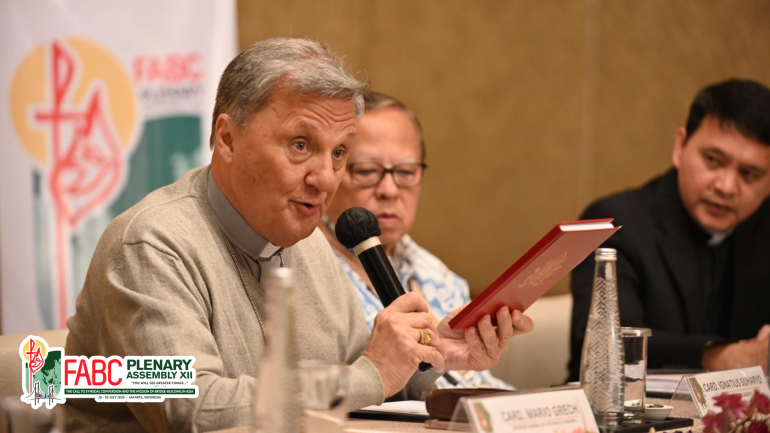
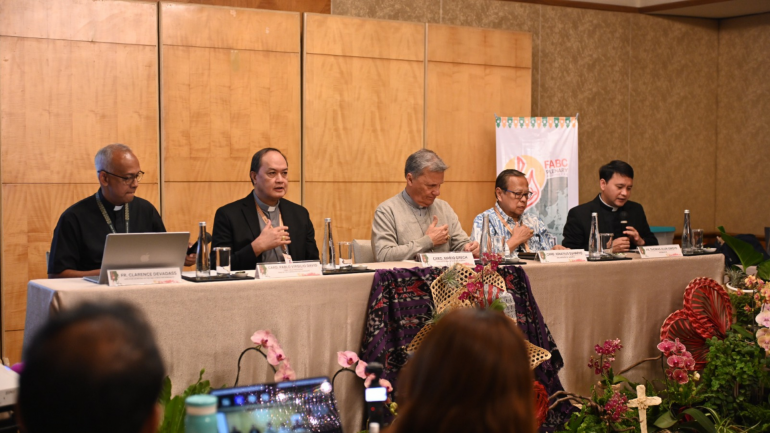
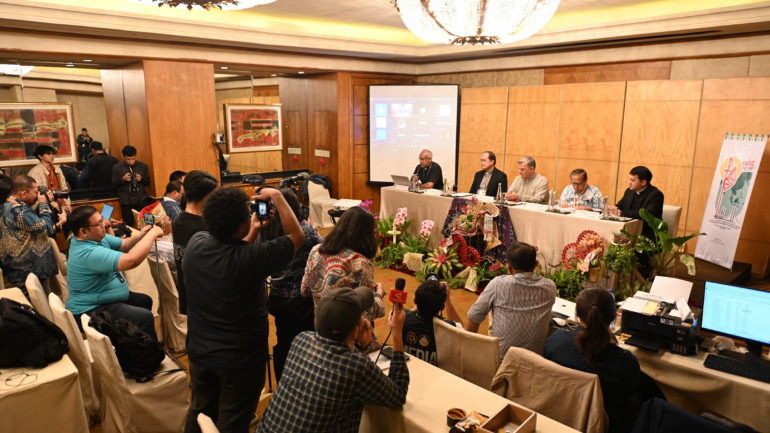
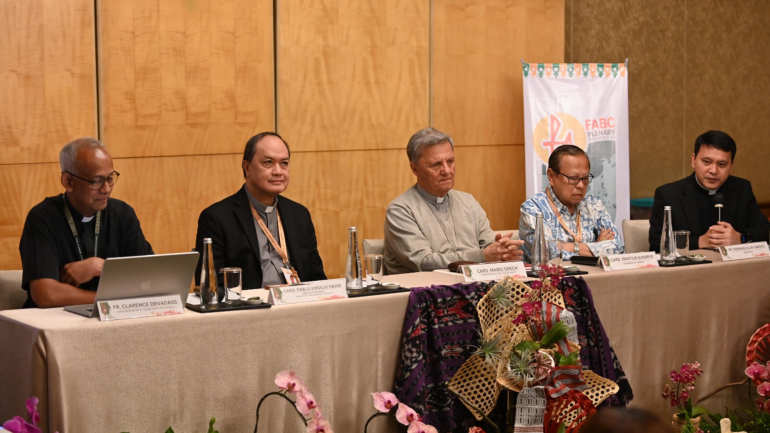
The future of synodality in the Catholic Church depends first on the conversion of hearts rather than changes to canon law, Cardinal Mario Grech told journalists during the second press conference of the 12th Plenary Assembly of the Federation of Asian Bishops' Conferences (FABC).
The Secretary General of the Synod of Bishops made the remarks on July 24 at the Media Room of Hotel Mulia, Jakarta, in response to a question about whether the fruits of the Synod on Synodality would eventually be incorporated into the Church's legal framework.
While acknowledging that canonical reforms may emerge from the synodal process, Cardinal Grech stressed that authentic renewal begins with the Gospel and a transformation of the human heart.
"Conversion is not of attitudes, but of heart," he said. "It's not a question of documents. We don't need documents. We have a fundamental document, which is the Gospel."
His response reflected one of the central themes of the Synod on Synodality, which Pope Francis launched in 2021 and which is now entering its implementation phase. The process calls local Churches around the world to deepen communion, participation, and mission through listening, discernment, and shared responsibility.
Responding to concerns about the relationship between synodality and Church law, Cardinal Grech drew a clear distinction between spiritual renewal and structural reform.
He acknowledged that structures and legal norms play an important role in the life of the Church, but insisted they cannot become the starting point of ecclesial renewal.
"The Gospel comes first," he said, explaining that only after hearts are transformed can structures effectively support a synodal way of life.
Cardinal Grech noted that the Church already has numerous structures capable of fostering synodality. These include parish and diocesan pastoral councils, presbyteral councils, colleges of consultors, diocesan synods, bishops' conferences, and other consultative bodies.
Rather than creating entirely new institutions, he suggested, the challenge is to make fuller use of the structures that already exist by animating them with the spirit of communion, participation, and mission.
At the same time, Cardinal Grech confirmed that the synodal process has prompted serious reflection on possible revisions to canon law.
With the approval of the Holy Father, he said, two commissions of canon lawyers were established during the Synod to examine how the Synod's insights might be reflected in the Church's legal framework.
One commission has focused on the Latin Church, while the other has been studying the needs of the Eastern Catholic Churches.
According to Cardinal Grech, the commission for the Latin Church has already completed its work, while the commission for the Eastern Churches is finalizing its report.
"Hopefully, when the documents are concluded, they will be submitted to the competent dicasteries and to the Holy Father, and we will see the changes," he said.
Even so, Cardinal Grech emphasized that any future legal reforms should serve the Church's deeper spiritual renewal rather than replace it.
Throughout the global synodal process, he has consistently argued that councils, assemblies, and canonical norms cannot by themselves create a synodal Church. Such structures become effective only when they are sustained by believers who have embraced the Gospel and are committed to walking together in faith.
As the Catholic Church continues implementing the Synod on Synodality, Cardinal Grech suggested that lasting renewal will come not primarily through legislation but through Christians whose hearts have been transformed by Christ. Only then, he said, can laws and structures genuinely strengthen the Church's mission of communion, participation, and evangelization.
Radio Veritas Asia (RVA), a media platform of the Catholic Church, aims to share Christ. RVA started in 1969 as a continental Catholic radio station to serve Asian countries in their respective local language, thus earning the tag “the Voice of Asian Christianity.” Responding to the emerging context, RVA embraced media platforms to connect with the global Asian audience via its 21 language websites and various social media platforms.
Latest News