



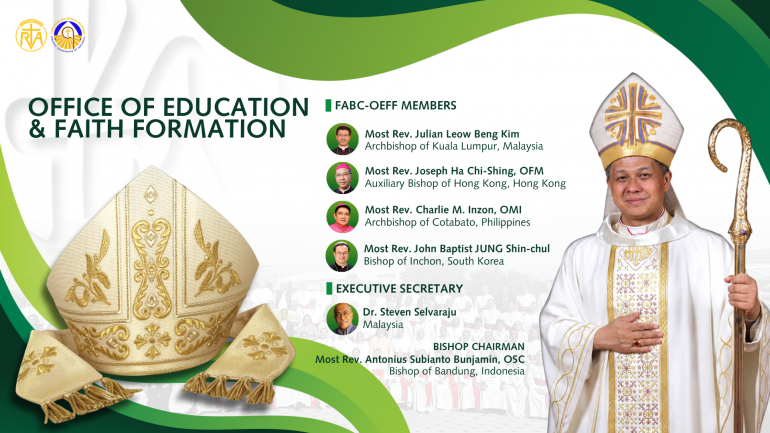
As the Federation of Asian Bishops' Conferences (FABC) prepares for its Plenary Assembly in Jakarta this July, one of its key pastoral offices continues to strengthen the Church's mission by forming faith, renewing catechesis, and supporting Catholic education across the continent.
Formerly known as the Office of Education and Student Chaplaincy (OESC), the Office of Education and Faith Formation (OEFF) is dedicated to strengthening catechetical leadership, promoting integral faith formation, and supporting Catholic educational ministries throughout the Asian episcopal conferences.
The office envisions close collaboration with the Commissions on Education and Catechesis of Asian countries to foster solidarity and address the educational and catechetical priorities of the Catholic Church. Its mission is to serve as a vital network for educational and catechetical leaders across the region, strengthen bonds among local Churches in education and catechesis, facilitate the sharing of pastoral strategies, and implement the broader resolutions and synodal objectives of the FABC.
Since its establishment, the office has organized numerous meetings and seminars focused on education and catechesis. Among its most significant contributions are three landmark gatherings that produced important documents shaping the Church's catechetical ministry in Asia.
The first, A Renewed Catechesis for Asia: Towards the Year 2000 and Beyond, was published in 1995 following the Pan Asian Conference on Catechesis held in Singapore. Organized by the then OESC in collaboration with the Singapore Pastoral Institute, the conference laid the foundation for a renewed catechetical vision for the continent.
More than a decade later, the office convened the Consultation Meeting on Family Catechesis: Challenges from Asian Realities in Bangkok in 2006. The meeting followed the Eighth FABC Plenary Assembly on "The Family in Asia," held in South Korea in 2004, and explored how families could become the primary setting for handing on the faith amid changing Asian realities.
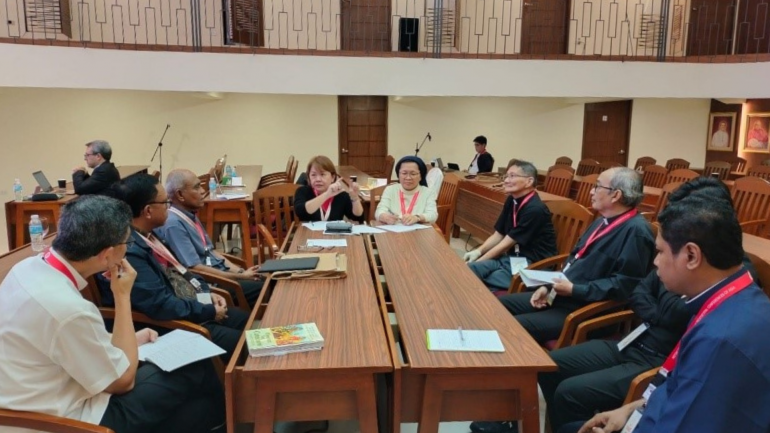
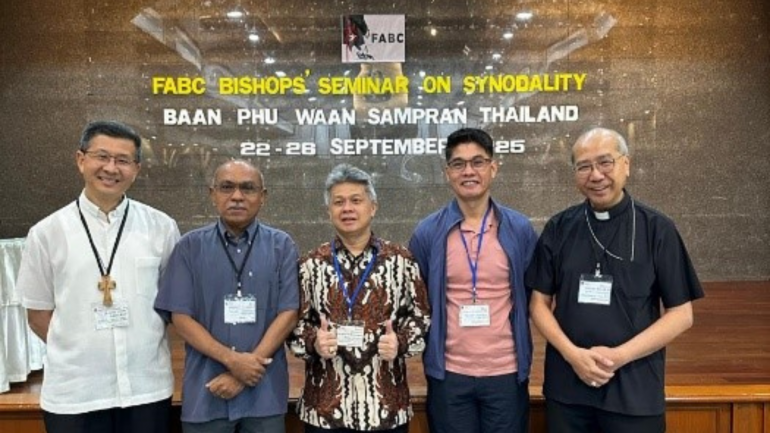
In 2022, under its present name, OEFF organized the Consultation Meeting on Antiquum Ministerium, bringing together 106 delegates from Asian episcopal conferences and catechetical commissions in an online gathering held from June 8 to 10. The meeting sought to discern Pope Francis' call to institute the lay ministry of catechist and concluded with the publication of its final statement and proceedings.
Drawing from these landmark documents and other FABC texts, OEFF has identified eight key focus areas that should guide catechesis in Asia. Catechesis, the office says, must be rooted in the realities of Asian societies, give importance to dialogue, show the face of the Asian Jesus and tell His story, give special attention to families, remain relevant and meaningful to young people, recognize the role and contribution of women, respond to today's social, cultural, and technological developments, and promote care for our common home.
These priorities closely mirror the nine pastoral priorities outlined in the Bangkok Document (2023), one of the most significant FABC documents in recent years.
The Office of Education and Faith Formation is chaired by Bishop Antonius Subianto Bunjamin, OSC, Bishop of Bandung, Indonesia. He is assisted by Archbishop Julian Leow Beng Kim of Kuala Lumpur, Malaysia; Auxiliary Bishop Joseph Ha Chi-Shing, OFM, of Hong Kong; Archbishop Charlie M. Inzon, OMI, of Cotabato, Philippines; and Bishop John Baptist Jung Shin-chul of Inchon, South Korea. The office's Executive Secretary is Dr. Steven Selvaraju of Malaysia.
As delegates gather for the upcoming FABC Plenary Assembly in Jakarta, OEFF's continuing commitment to integral faith formation, catechetical renewal, and educational collaboration stands as a reminder that the future of the Church in Asia depends not only on proclaiming the Gospel but also on forming disciples capable of living and witnessing that faith in the diverse realities of the continent.
Radio Veritas Asia (RVA), a media platform of the Catholic Church, aims to share Christ. RVA started in 1969 as a continental Catholic radio station to serve Asian countries in their respective local language, thus earning the tag “the Voice of Asian Christianity.” Responding to the emerging context, RVA embraced media platforms to connect with the global Asian audience via its 21 language websites and various social media platforms.
Latest News