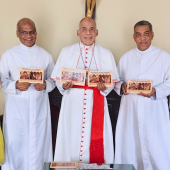


A Goan priest and liturgy professor has published a new book seeking to help Catholics move beyond simply performing sacramental rituals toward a deeper understanding of the sacraments and their power to transform Christian life.
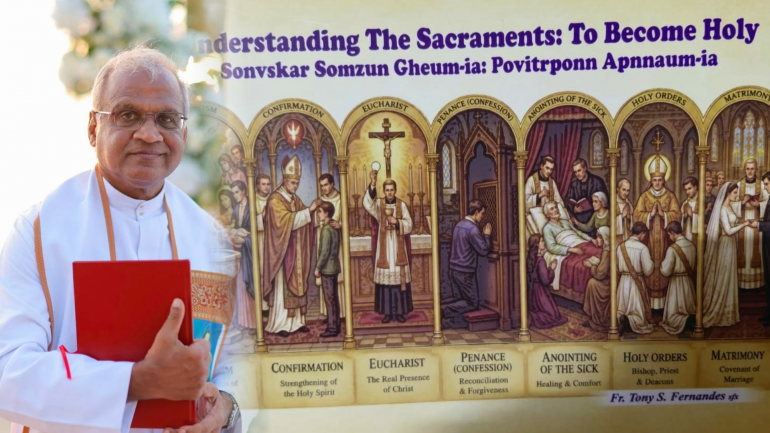
Understanding the Sacraments: To Become Holy, written in English and Konkani by Fr. Tony Fernandes, SFX, explores the meaning, grace and purpose of the seven sacraments and encourages Catholics to participate in them more consciously.
Fr. Fernandes, a priest of the Missionary Society of St. Francis Xavier, commonly known as the Society of Pilar, is a professor of liturgy at Pilar Theological College in Pilar, Goa, in western India. He holds a Licentiate in Liturgy from the Pontifical Institute of Liturgy at the Pontifical University of Sant’Anselmo in Rome and has taught at Rachol Seminary and other theological institutions.
The book grew out of reflections Fr. Fernandes began nearly nine years ago with lay Catholics on the Eucharist. He became convinced that people need to understand what they celebrate because understanding leads to appreciation and meaningful participation.
“It’s only when we understand well that we can enjoy what we celebrate or whatever we do. If not, we will do it for the sake of doing,” he said.
His concern later extended to the other sacraments, particularly after encountering people preparing for Confirmation who had little understanding of its meaning, the grace it conveys or its effect on Christian life.
For Fr. Fernandes, the purpose of the sacraments is clear: “Sacraments are to make us holy, make us Christ-like.”
The book therefore seeks to move Catholics “from ritualism to participation” by helping them understand what takes place in each sacrament. Rather than treating the sacraments as ceremonies to be completed, Fr. Fernandes presents them as encounters with the risen Christ that should bring about interior transformation.
He challenges Catholics to examine whether sacramental participation is producing a change in their lives.
“If, for example, I go for daily Mass and I remain the same, there is no internal change, neither do I become more and more Christ-like,” he said.
Fr. Fernandes also explains the significance of signs and symbols used in the sacraments. Water in Baptism, bread and wine in the Eucharist, the laying on of hands and the invocation of the Holy Spirit all communicate realities that cannot be seen directly.
He highlights the liturgical concepts of anamnesis, through which the Church makes present God’s saving action, and epiclesis, the invocation of the Holy Spirit. Understanding such elements, he argues, can help the faithful participate more fully rather than remain passive observers.
The book also presents the sacraments in relation to the different stages and experiences of human life. Baptism signifies new life in Christ; Confirmation strengthens the believer through the Holy Spirit; the Eucharist provides spiritual nourishment; Reconciliation brings healing from sin; and Anointing of the Sick accompanies people in illness. Holy Orders and Matrimony are presented in relation to vocation, service, communion and love.
Fr. Fernandes’ earlier work, Understanding What We Celebrate / Ami Somarombhtanv Tem Somzum-ia, published in 2014 and 2016, similarly focused on helping Catholics understand the liturgy.
His latest work is grounded in the conviction that understanding should lead to participation, participation to encounter, and encounter to transformation and holiness.
“Jesus through his bride has given us the Sacraments to help us on our journey of life,” Fr. Fernandes said.
For the priest and liturgist, the central question is ultimately not simply whether Catholics receive the sacraments, but what difference the sacraments make in their lives, leading them toward greater holiness and an increasingly Christ-like way of living.
Radio Veritas Asia (RVA), a media platform of the Catholic Church, aims to share Christ. RVA started in 1969 as a continental Catholic radio station to serve Asian countries in their respective local language, thus earning the tag “the Voice of Asian Christianity.” Responding to the emerging context, RVA embraced media platforms to connect with the global Asian audience via its 21 language websites and various social media platforms.
Latest News