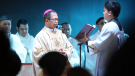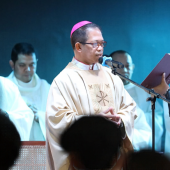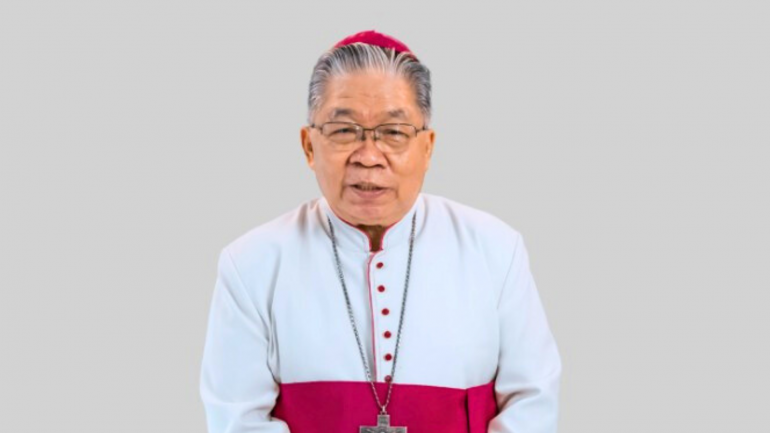
Among Indonesia’s national figures who worked quietly yet decisively to help resolve the mass communal violence in Ambon, Maluku (1999–2002) was Bishop Petrus Canisius Mandagi, MSC, then Bishop of the Diocese of Amboina.
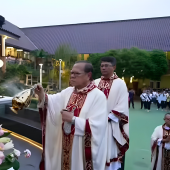
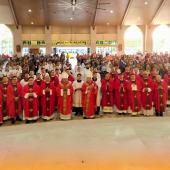
His golden jubilee of priesthood was celebrated on December 18 in Merauke, South Papua Province, marking 50 years of faithful service to the Church.
Bishop Mandagi has long been known as a firm and principled leader, always articulate in expressing his views, courteous in language, yet unafraid to speak forcefully when the situation demanded. For this reason, his leadership as Bishop of Amboina earned deep respect from both civil authorities and members of the military and police.
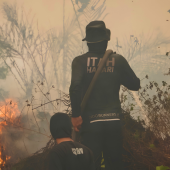
On one dramatic occasion during the height of tension in Ambon, Bishop Mandagi left the diocesan residence and went directly to the site of a potential large-scale communal clash, where two opposing groups were on the verge of violence.
“He spoke very loudly and firmly to both sides, ordering them to return home immediately, and it worked,” testified Fr. Johanis ‘Yance’ Mangkey, MSC, former Assistant General of the Missionaries of the Sacred Heart (MSC). Fr. Mangkey had earlier served as secretary and economer of the MSC Indonesia Province when Fr. Mandagi was Provincial Superior from 1990 to 1994.
Firm in substance, gentle in manner
Bishop Mandagi was ordained bishop of the Diocese of Amboina on September 18, 1994, a responsibility he carried for 26 years, until 2020.
“As a new bishop in Amboina, Bishop Mandagi began his pastoral ministry amid many challenges. It was there that I witnessed one of his outstanding Christian virtues: forgiveness,” Fr. Mangkey recalled. “He was able to embrace those who had once opposed him or held different views. He overcame difficulties through his inclusive spirit and forgiving heart.”
In his leadership, both as Provincial Superior of the MSC in Indonesia and later as a bishop, Bishop Mandagi was widely recognized as a firm, compassionate, and visionary shepherd.
“In his social interactions, he was easy to approach. His kindness and gentleness were evident, and he had a good sense of humor that could easily ease tense situations,” Fr. Mangkey added.
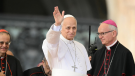
In 2020, Pope Francis appointed Bishop Mandagi as Archbishop of Merauke, transferring him from the Diocese of Amboina to the vast missionary territory of South Papua.
At his installation, Cardinal Ignatius Suharyo Hardjoatmodjo, Archbishop of Jakarta, remarked that despite his advanced age, physical frailty, and health challenges,- marked by scores of implanted teeth - Archbishop Mandagi remained a man of “clear and sharp thinking, integrity, and deep compassion” gifts he continues to offer to the faithful of the Archdiocese of Merauke.
Although Archbishop Mandagi reached the canonical retirement age of 75 in April 2024, the Vatican has continued to entrust him with the pastoral leadership of the archdiocese.
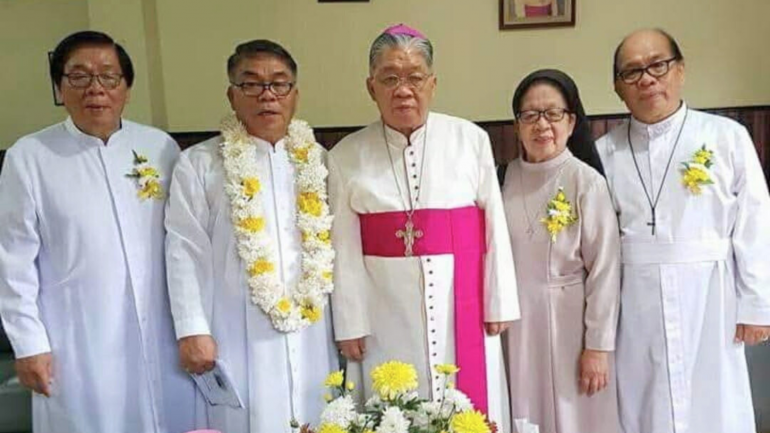
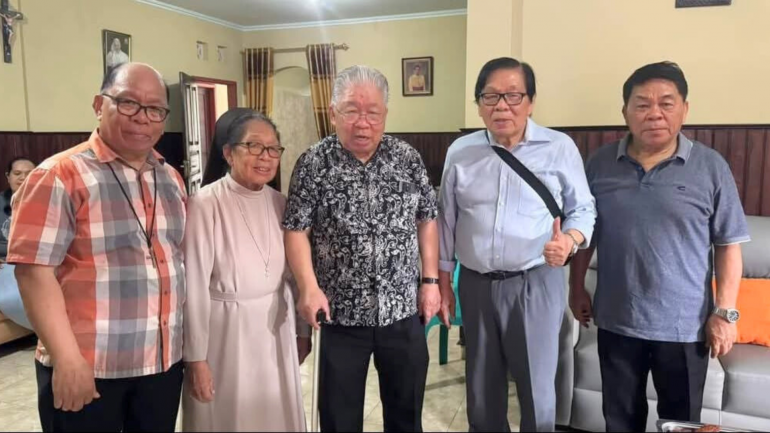
A family rich in vocations
Bishop Petrus Canisius Mandagi was born in Kamangta Village, about 10 kilometers from Manado City, to Mandagi and Dolang, simple farming parents. The eldest sibling, now deceased, chose married life, while the younger siblings embraced religious vocations: one DSY nun, two MSC priests (of whom is Archbishop Mandagi) and two CMM brothers.
“The role of parental formation and the spiritual atmosphere at home must have played a decisive role in nurturing these vocations,” Fr. Mangkey said. “I call it a complete spiritual family.”
Archbishop Mandagi received the Sacrament of Holy Orders on December 18, 1975.
After his ordination, the young priest served as a formator for MSC candidates in Karanganyar (1976–1977) and later as parish priest of the Sacred Heart of Mary Parish in Jakarta until 1978.
He earned a Licentiate in Dogmatic Theology from the Catholic University of Louvain (Leuven), Belgium, from 1978 to 1981. Upon returning to Indonesia, he was appointed lecturer in dogmatic theology at Pineleng Major Seminary, a role he held until 1990.
Between 1981 and 1982, he again served as socius and formator for MSC seminarians, and from 1982 to 1990, he was superior and formator of the MSC Scholasticate.
Radio Veritas Asia (RVA), a media platform of the Catholic Church, aims to share Christ. RVA started in 1969 as a continental Catholic radio station to serve Asian countries in their respective local language, thus earning the tag “the Voice of Asian Christianity.” Responding to the emerging context, RVA embraced media platforms to connect with the global Asian audience via its 21 language websites and various social media platforms.
Latest News