At 94, Conchita Tividad continues to fulfill a lifelong vow of faith, a panata (religious vow) she made decades ago when her youngest child, Augustito, was born frail and often ill. Since then, she has faithfully observed Holy Week traditions in her home village of Agkawayan on Lubang Island, Occidental Mindoro, Philippines.
“She made that vow when Augustito was still a baby because he was sickly,” said her daughter Susan, with whom Conchita occasionally stays in Canada.
Despite her age and time spent abroad, Tividad makes it a point to return, or ensure she is present, for the sacred season in the quiet coastal village.
Agkawayan lies on Lubang Island, several hours from Manila by sea. Travelers usually take a two-hour boat ride from Batangas when waters are calm.
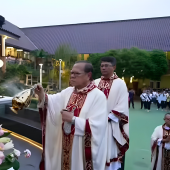
It is considered the “cradle” of the Society of the Divine Word (SVD) mission in Mindoro. The SVD missionaries arrived on Lubang Island in 1922 and have maintained a century-long presence, managing the local parish and establishing Stella Maris School in 1923, their first school in the province.
‘Panata’ at the Heart of Devotion
For village councilor and retired teacher Nieves T. Trambulo, one word best describes the deep faith of Agkawayan’s people: panata (religious vow).
“Here in Agkawayan, many people strongly believe in fulfilling a vow of devotion. Some express it through penitence, crawling in prayer, or joining the pasyon (chanting of the Passion of Christ) during Holy Week,” she said.
During Holy Week, the village welcomes visitors from different places who come to pray and fulfill their vows.
“People come to visit the poon, a solemn procession of sacred images on Black Saturday as part of their devotion, offering prayers for their families and expressing their faith,” she said.
For residents, Holy Week is also a time of repentance and reflection.
“This is a time to examine ourselves, to reflect on our shortcomings and the sins we have committed against others and against God,” she said. “We observe Holy Week through the pasyon (chanting of the Passion of Christ), acts of penitence, vigils, and other religious activities.”
Even during the COVID-19 pandemic, she said, such devotional practices were not given up.
Pabasa, Penitence, and the Poon
For decades, Tividad has hosted the pabasa, the continuous chanting of the Passion of Christ, in her home. The prayers begin on Good Friday and continue until mid-afternoon of Black Saturday.
Elderly villagers, relatives, and visitors quietly gather in her home to join the chanting.
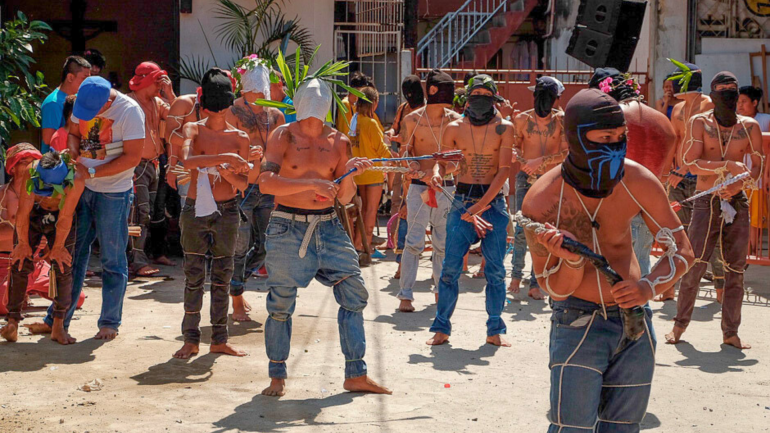
Outside, barefoot penitents, their faces covered with cloth, walk along Federico Tividad Street, named after the town’s first chief executive, whipping their backs as an act of sacrifice. Others follow in prayer as the procession moves toward the chapel and village plaza.
Despite her age, Tividad continues to oversee preparations. Food, often freshly caught seafood, is shared with guests. Neighbors and relatives help cook and serve meals, turning the gathering into both a spiritual and communal event.
Passing the Faith to a New Generation
Such practices are passed down within families.
For younger residents, Holy Week remains a deeply meaningful tradition.
Ana Marie Villaflores, a 27-year-old high school teacher at Looc National School of Fisheries, said her faith was shaped by family influence.
“As someone who grew up in the Church because of my grandmother, Holy Week is not just a tradition,” she said. “It is a time for deeper faith, reflection, and devotion to God.”
“We prepare through prayer, silence, and by setting aside distractions,” Villaflores said. “We attend Mass, listen to the Word of God, and pray together as a family.”
Julia Villaluna, 18, a Grade 12 student and choir member, said the youth help organize church activities and perform in the Senakulo (Passion play).
“Our role is very important,” she said. “We help lead activities and ensure everything runs smoothly.”
For her, participation is an expression of gratitude.
“It is my way of honoring Jesus Christ and expressing my faith,” Villaluna said.
She added that social media now helps spread awareness of church activities, making it easier to invite others to participate.
Faith Amid Hardship
Like many rural communities, Agkawayan faces environmental and economic challenges.
In 2024, the municipality declared a state of calamity due to drought linked to El Niño. Mayor Marlon dela Torre said nearly half of the town’s farmers harvested only about five percent of their usual rice production.
Despite dry farms and limited water supply, residents remain hopeful.
They say the island continues to provide, through the abundance of the sea, the resources of the land, and the strength of community bonds.
Despite rising fuel costs, residents look forward to the village fiesta on March 25, with traditional evening dances held at the covered court from March 21 to 25.
For Tividad, whose memory sometimes fades with age, returning home each year is about preserving something deeper than memory.
She hopes the traditions she helped nurture, the pabasa, the processions, and the spirit of community, will continue long after her time.
“May God keep this village in His care,” she said softly, “and may those who came from here remember their faith and their home.”
Radio Veritas Asia (RVA), a media platform of the Catholic Church, aims to share Christ. RVA started in 1969 as a continental Catholic radio station to serve Asian countries in their respective local language, thus earning the tag “the Voice of Asian Christianity.” Responding to the emerging context, RVA embraced media platforms to connect with the global Asian audience via its 21 language websites and various social media platforms.
Latest News