


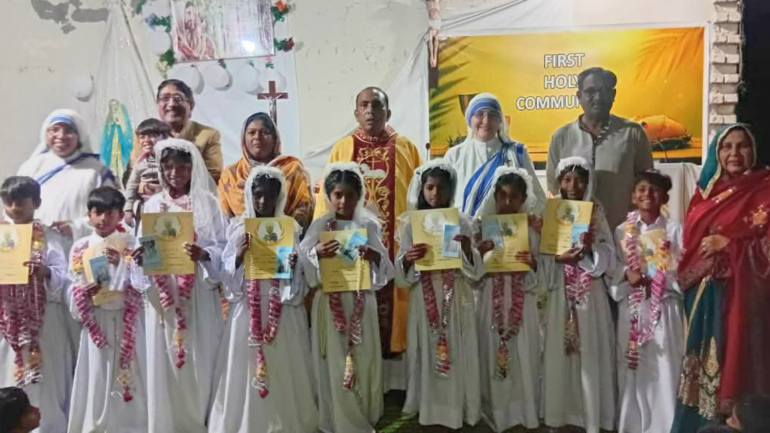
On Maundy Thursday, approximately 120 indigenous children received their First Holy Communion at Mother Mary Parish in Umerkot, located in the interior of Sindh province in southeastern Pakistan, near the border with India.
The children belong to the Parkari tribal community and received the sacrament at various locations within the mission territory. These decentralized celebrations were organized by the parish pastoral team in collaboration with the Missionaries of Charity, who helped prepare the communicants.
All under the age of 14, the children come from backgrounds traditionally rooted in Hinduism. The tribal mission was originally established more than 40 years ago by Columban missionaries and is now managed by the Oblates of Mary Immaculate (OMI), serving approximately 350 Catholic Parkari families.
The timing of the sacrament on Holy Thursday held deep symbolic meaning for the community. Fr. Khaliq Saleem, OMI, in-charge of the mission, highlighted the connection between the liturgical celebration and the children’s daily reality.
“Holding the First Holy Communion on Holy Thursday is deeply significant because it is the day the Church celebrates the institution of the Eucharist and the priesthood,” Fr. Khaliq said. “For these children, who live lives of humble service as landless tenant farmers working on the estates of wealthy landlords, receiving the Bread of Life on the same day Jesus shared the Last Supper with his disciples is an affirmation that they are invited to the Lord’s table as equals. It is a powerful message of inclusion and spiritual nourishment for a community that often feels forgotten by the world.”
The Parkari Catholics are among the most marginalized groups in Pakistan. Without a permanent church building, the parish pastoral team and religious sisters organize liturgical services in private homes, school classrooms, or technical education halls to reach the scattered community.
Fr. Khaliq, who joined the mission in November 2025, noted the depth of the community’s spiritual resilience. “In my time here, I have found that these families possess a remarkably strong faith, even when tested by external challenges,” he said.
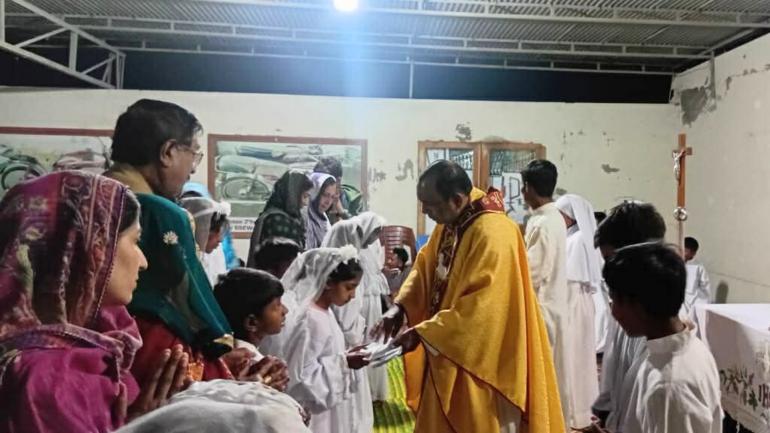
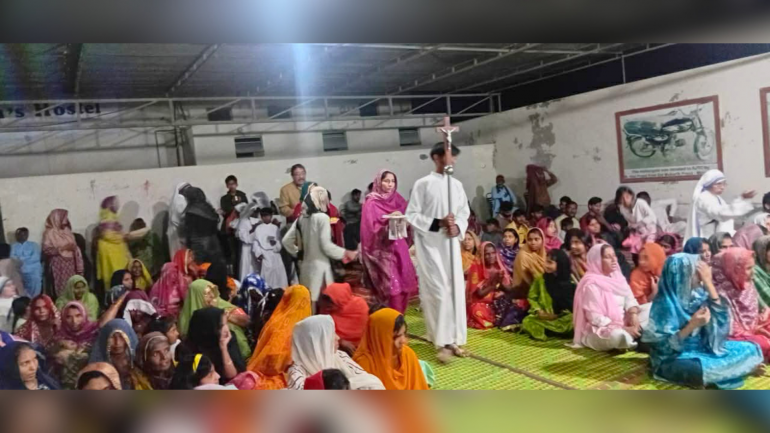
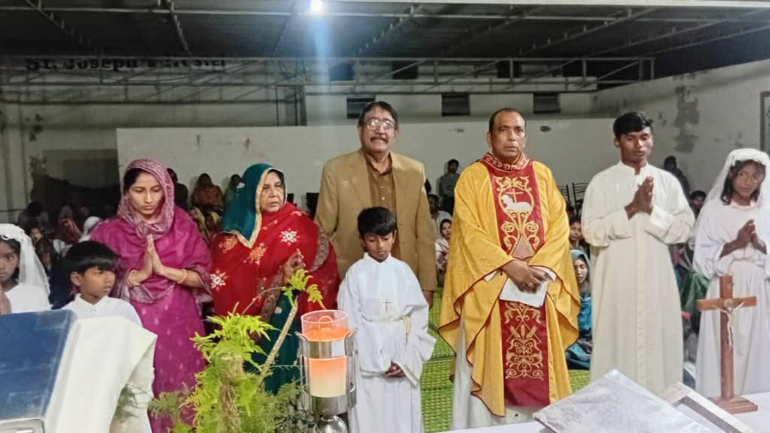
The community faces significant economic hardship, with many children attending the ceremonies barefoot. The Oblates operate four primary schools serving nearly 600 students, but only about 3 percent continue to higher education.
Reflecting on this reality, Fr. Khaliq pointed to the cycle of poverty. “When you see children coming to school without shoes or even a basic uniform, you realize the struggle is not just academic; it is a struggle for dignity. The lack of resources and long distances to schools act as invisible barriers,” he said.
Sozaina, 14, shared that as she walked forward in her white dress, she “did not feel the dust under her bare feet,” but only a “quiet peace.” Similarly, Versha, 12, said receiving the sacrament made her feel “rich in the eyes of God” despite their daily labor in the fields. “When Fr. Khaliq placed the Host in my hands, I felt a deep joy,” she said.
The mission continues to grow, with four families, or about 25 individuals, entering the Church through baptism this Easter. Fr. Khaliq is assisted by Fr. Prem Versha, who comes from the Kachi Kohli tribe, bringing a unique indigenous perspective to the ministry.
Radio Veritas Asia (RVA), a media platform of the Catholic Church, aims to share Christ. RVA started in 1969 as a continental Catholic radio station to serve Asian countries in their respective local language, thus earning the tag “the Voice of Asian Christianity.” Responding to the emerging context, RVA embraced media platforms to connect with the global Asian audience via its 21 language websites and various social media platforms.
Latest News