Philippine banks are being urged to strengthen restrictions on financing coal and fossil gas projects, as an energy crisis exposes the country’s vulnerability to volatile global fuel prices.
In a briefing on April 21 for the 2026 Fossil Fuel Divestment Scorecard, clean energy and finance watchdogs called on the country’s largest commercial banks to accelerate reforms in their lending policies and energy portfolios.
The report found that over the past 16 years, top domestic banks channeled a record $10.15 billion into energy financing. While investments in renewable energy surged, funding for fossil fuels remained significant.
Renewable energy financing quadrupled in 2025 compared to 2024, reaching $5.79 billion. However, fossil gas saw its highest level of financing at $3.37 billion, while coal received $985 million, its biggest allocation since 2019, despite the government’s coal moratorium announced in 2020.
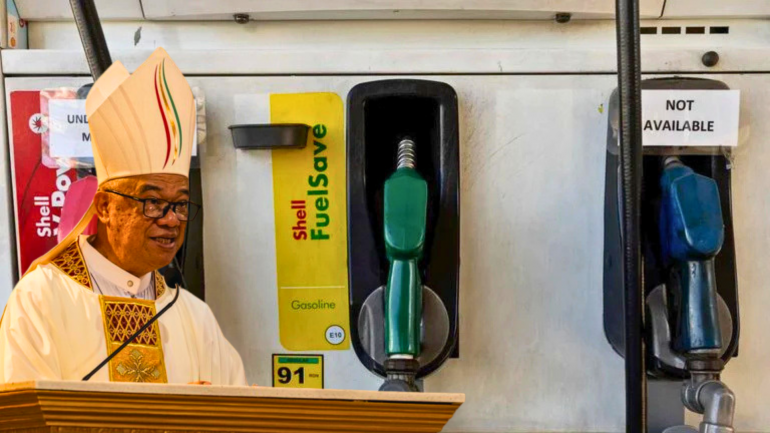
“Today’s energy crisis is but the latest concretization of the consequences of an energy sector reliant on coal, gas, and other fossil fuels,” said Bishop Gerry Alminaza, president of Caritas Philippines and lead convenor of Withdraw from Coal: End Fossil Fuels.
“It is a crisis felt at the gut by ordinary Filipinos, as prices of fuel for transport, electricity, and basic goods soar. And every peso that banks still pour on costly fossil fuels prolong our people’s agony,” he added.
The briefing cited recent geopolitical tensions, noting that within the first month of the United States and Israel’s war on Iran, global coal prices rose by 17 percent while liquefied natural gas (LNG) prices surged by 91 percent. The Philippines’ energy sector, which operates on pass-through fuel costs, leaves consumers directly exposed to such spikes.
Coal and gas accounted for 74 percent of the country’s power generation in 2025, underscoring continued dependence on imported fossil fuels.
The scorecard, published by the Center for Energy, Ecology, and Development (CEED), noted that most coal and gas financing deals were tied to refinancing or acquisitions, rather than new capacity. In contrast, around $3.1 billion in renewable energy financing supported approximately 5,000 megawatts of new projects last year.
Out of 14 banks assessed, nine have adopted policies restricting coal financing. However, six of these institutions were still involved in coal-related deals in 2025, largely due to loopholes in policies that allow refinancing and funding through investment subsidiaries.
No bank has yet adopted restrictions on gas financing.
“Philippine banks that have made policies to restrict coal financing must close loopholes that still enable them to contribute to continued dependence on coal,” said Ivan Andres, deputy head for research and policy at CEED.
He added that recent challenges in the LNG sector, including project delays, cancellations, and price volatility, should serve as a warning to financial institutions.
“It is in their and their clients’ best interest to shift away from both and toward portfolios focused on renewable energy,” Andres said.
Despite the continued financing of fossil fuels, advocates acknowledged the rapid growth in renewable energy investments as a positive development, while stressing the need for more decisive action.
“We see rising investments in renewable energy as a positive step forward for clean energy, but now is a time to be taking a leap,” Bishop Alminaza said. “In fully prioritizing renewables immediately… Philippine banks can help unlock hope for clean, affordable, and sustainable energy for all Filipinos.”
Radio Veritas Asia (RVA), a media platform of the Catholic Church, aims to share Christ. RVA started in 1969 as a continental Catholic radio station to serve Asian countries in their respective local language, thus earning the tag “the Voice of Asian Christianity.” Responding to the emerging context, RVA embraced media platforms to connect with the global Asian audience via its 21 language websites and various social media platforms.
Latest News