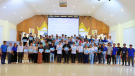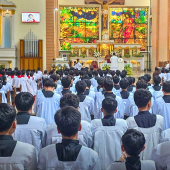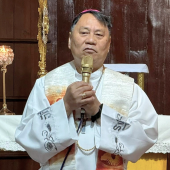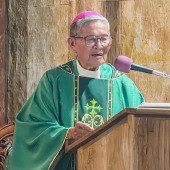
A Filipino Catholic bishop facing a civil lawsuit over his support for an anti-mining campaign in Nueva Vizcaya province, northern Philippines, has reaffirmed the Church's commitment to standing with vulnerable communities and protecting the environment.
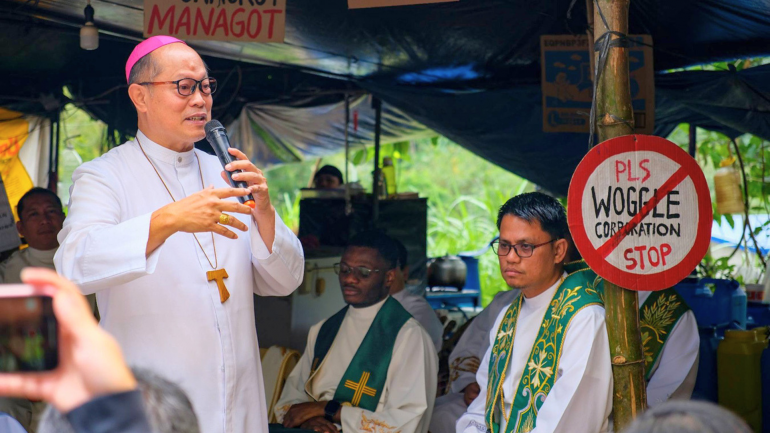
Bishop Jose Elmer Mangalinao of the Diocese of Bayombong said the Church must continue to be a voice for people affected by projects that threaten their land and livelihoods, stressing that environmental advocacy is part of the Church's pastoral mission.
"As Bishop of this Diocese, I carry the responsibility to stand with the poor, defend the vulnerable, and be a voice for those whose voices are often unheard," Bishop Mangalinao said. "This is not a political duty. It is a pastoral one."
The bishop issued the statement after being named among several defendants in a civil case linked to opposition to a mining exploration project in Kasibu, a municipality in Nueva Vizcaya province in the mountainous Cagayan Valley region of northern Luzon.
Bishop Mangalinao clarified that his visit to residents maintaining a barricade against the project was intended to provide spiritual support through prayer and the celebration of Holy Mass.
"I went to accompany, not to direct. I went to comfort, not to command," he said, rejecting claims that the Diocese of Bayombong played an adversarial role in the dispute.
The lawsuit was filed by a man identifying himself as the overall chieftain of the Bugkalot and Ilongot Indigenous communities.
The complaint seeks legal remedies concerning an anti-mining barricade established within ancestral domain areas affected by the exploration project.
According to reports from DWRV, the diocesan radio station, the case also includes Fr. Christian Dumangeng, former director of the diocesan Social Action Commission, and several other individuals.
A municipal trial court in Kasibu declined to issue a temporary restraining order sought by the plaintiff but scheduled a June 23 hearing on a petition for a writ of preliminary injunction.
Lawyer Fidel Santos, counsel for the defendants, described the case as a strategic lawsuit against public participation (SLAPP), which he said aims to intimidate environmental advocates and critics of mining operations.
Despite the legal challenge, Bishop Mangalinao said the Church would continue to listen to "the cry of the earth and the cry of the poor," while calling on the faithful to pray for affected communities and for a peaceful resolution of the conflict.
The bishop has received support from fellow Church leaders, including Cardinal Pablo Virgilio David of the Diocese of Kalookan in Metro Manila and former president of the Catholic Bishops' Conference of the Philippines (CBCP).
Recalling Bishop Mangalinao's recovery from a heart attack and quintuple bypass surgery several years ago, Cardinal David praised the bishop's courage in confronting the legal battle.
"Whether fighting for his own life or standing up for what he believes is life-giving for his people, Bishop Elmer has never lacked courage," the cardinal said. "From fighting for his life to fighting for life itself."
Archbishop Ricardo Baccay, chairman of the CBCP Episcopal Commission on Public Affairs, also expressed solidarity with Bishop Mangalinao and all those working to protect the environment.
"May their witness remind us that caring for the earth is not only an environmental concern but a moral responsibility," Archbishop Baccay said.
The case highlights ongoing tensions surrounding mining activities in Indigenous communities and the Church's continuing advocacy for environmental stewardship and the protection of human dignity.
Radio Veritas Asia (RVA), a media platform of the Catholic Church, aims to share Christ. RVA started in 1969 as a continental Catholic radio station to serve Asian countries in their respective local language, thus earning the tag “the Voice of Asian Christianity.” Responding to the emerging context, RVA embraced media platforms to connect with the global Asian audience via its 21 language websites and various social media platforms.
Latest News