Philippines to Host Historic Pilgrimage of Our Lady of Guadalupe Ahead of 500th Anniversary

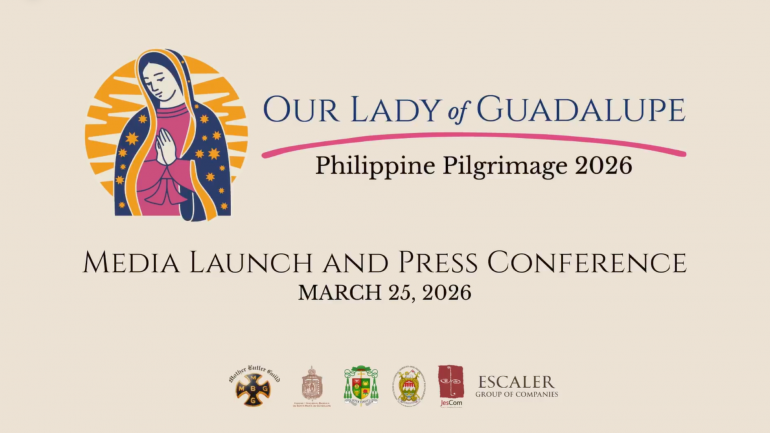
As the Church prepares to mark the 500th anniversary of the apparitions of Our Lady of Guadalupe in 2031, the Philippines is set to receive a nationwide pilgrimage of her image.
The initiative began with an unexpected invitation from Mexico.
“Out of the blue, the rector of the Basilica of Our Lady of Guadalupe in Mexico sent me a note… asking if they could invite the President to visit Mexico and, if possible, organize a pilgrimage of Our Lady of Guadalupe in the Philippines in preparation for the 500th anniversary of the apparitions,” shared Mr. Ernest Escaler, chairperson of the Guadalupe Committee.
The proposal was warmly received, and preparations quickly followed, with Church leaders in the Philippines joining the effort to bring the devotion closer to Filipino faithful.
For the Catholic Church, the pilgrimage is a reminder of a deep historical and spiritual connection between Mexico and the Philippines.
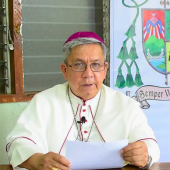
“Mexico was colonized by Spain, and the Philippines was also under Spain. There is a connection between Mexico and the Philippines,” explained Bishop Jose Colin Bagaforo, Bishop of Kidapawan and Spiritual Director of Guadalupe Committee. “The coming of Our Lady of Guadalupe is a great blessing for us,” he added.
Globally, the devotion to Our Lady of Guadalupe holds immense significance. The Basilica in Mexico is recognized as the most visited Marian shrine in the world, welcoming around 18 to 20 million pilgrims each year.
Her apparition is also considered one of the most impactful in Church history.
“Within a decade of her 1531 apparition to Saint Juan Diego, an estimated nine million indigenous people in Mexico were converted to Catholicism,” Bishop Bagaforo noted, describing it as “the greatest mass conversion in Christian history.”
Unlike many other Marian apparitions, Guadalupe left behind a tangible sign, the tilma of San Juan Diego, bearing the image of the Blessed Virgin Mary.
“The image… imprinted on the cactus fiber tilma remains vibrant even after 500 years,” the bishop said. “Despite the material’s natural lifespan of only 20 to 30 years, it has survived until now – very much alive.”
In the Philippines, devotion to Our Lady of Guadalupe is not new. In 1935, Pope Pius XI declared her the Heavenly Patroness of the Philippines, affirming her special role in the spiritual life of the nation. Over the centuries, devotion has flourished in places like Pagsanjan, Laguna, and Cebu.
She is also widely recognized as the patroness of life, protector of the unborn, the sick, the elderly, and the vulnerable.
“We pray and we hope that the coming of Our Lady would truly bless the Philippines and would bring the fruits of reconciliation and prosperity to many of us,” Bishop Bagaforo said.
A particularly significant aspect of the pilgrimage is the image itself that will be brought to the country. According to the organizers, the image is considered a second-class relic, closely connected to the original tilma in Mexico.
“The image that will remain here… is considered as a relic – almost like from the original,” Bishop Bagaforo explained. “This will be the first… second-class relic… that will be here in the Philippines.”
After the pilgrimage, the image will be permanently enshrined at the Manila Cathedral, making the Philippines one of the few places outside Mexico to house such a significant representation.
“They did not do that in Europe… but they will leave it here in the Philippines, almost like the one in Mexico,” he added.
As the image journeys across Mindanao, Visayas, and Luzon, the faithful are invited to encounter anew the message of Our Lady of Guadalupe, a message of hope, compassion, and God’s enduring presence among His people.
Radio Veritas Asia (RVA), a media platform of the Catholic Church, aims to share Christ. RVA started in 1969 as a continental Catholic radio station to serve Asian countries in their respective local language, thus earning the tag “the Voice of Asian Christianity.” Responding to the emerging context, RVA embraced media platforms to connect with the global Asian audience via its 21 language websites and various social media platforms.
Latest News