Singapore Diplomat Tommy Koh Wins 2026 Ramon Magsaysay Award for Diplomacy and Justice

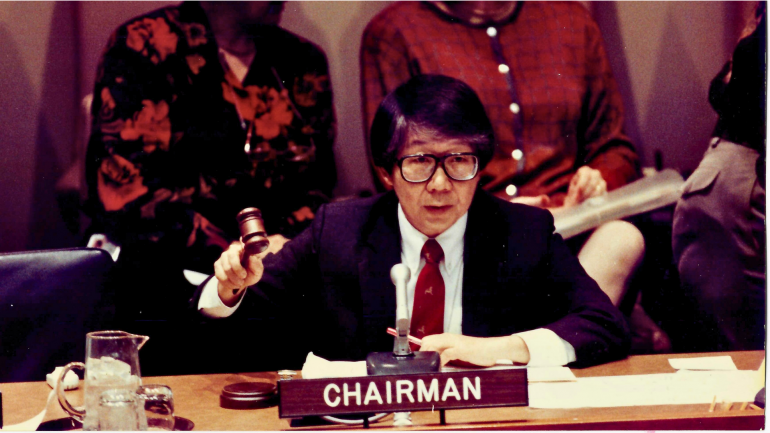
Singaporean diplomat and legal scholar Tommy Koh, whose work helped shape the international legal framework governing the world's oceans, has been named a recipient of the 2026 Ramon Magsaysay Award for his leadership in diplomacy and advocacy of justice and human dignity.
The Ramon Magsaysay Award Foundation recognized Koh for his “exemplary leadership in international diplomacy” and his role in forming a new generation of advocates committed to advancing justice and human dignity.
The award recognizes a diplomatic career spanning nearly six decades, from Singapore's foreign service to major international negotiations.
A lawyer and law professor at the National University of Singapore, Koh entered Singapore's foreign service in 1968 and later became the country's youngest ambassador to the United Nations.
His most significant contribution to international diplomacy came through his work on the United Nations Convention on the Law of the Sea (UNCLOS).
In 1978, Koh chaired a negotiating committee of the Third United Nations Conference on the Law of the Sea. As president of the conference four years later, he helped guide more than 150 countries toward adopting the convention, which established a comprehensive framework governing maritime rights and responsibilities and the peaceful settlement of disputes.
UNCLOS remains particularly important for Asian countries whose economies, security and livelihoods are closely tied to the sea, including the Philippines and other Southeast Asian nations.
Koh has continued to advocate for diplomacy, dialogue and the ability of smaller nations to maintain an independent voice amid major-power competition.
Speaking during a Zoom conference, he said smaller countries should have the confidence to defend their interests.
“Even if you are a small country, you stand,” Koh said.
He also urged Asian countries not to be forced into choosing between the United States and China as competition between the two powers intensifies in Southeast Asia.
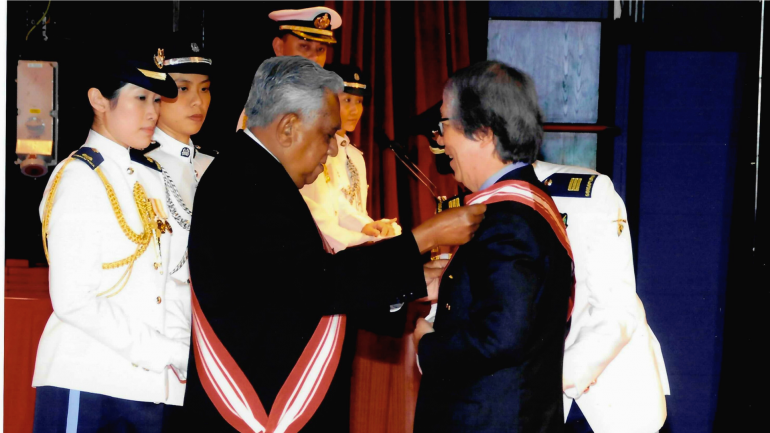
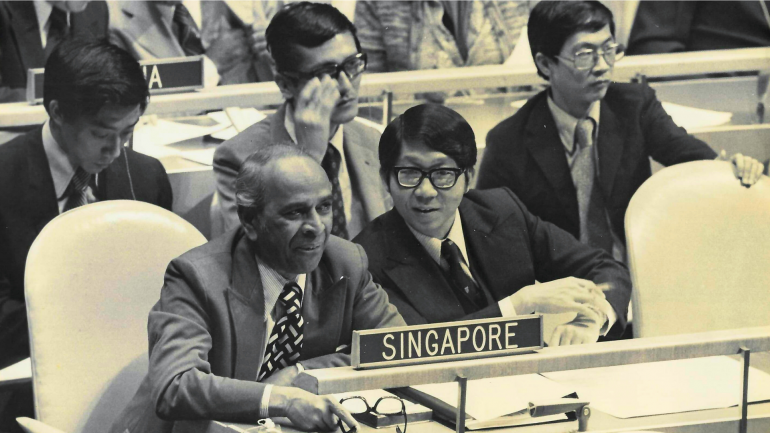
“There is intense competition between the United States and China in Southeast Asia,” he said, adding that Asian countries should seek to remain friends with both powers rather than take sides.
For Koh, diplomacy depends on a willingness to compromise and maintain communication even during periods of tension.
“Negotiation will not succeed without concession,” he said, while stressing that dialogue remains essential when countries are in conflict or facing strained relations.
That approach reflects his experience in the Law of the Sea negotiations, where countries with competing maritime, economic and strategic interests had to find common ground to produce an agreement accepted by the international community.
Koh's contribution also extends beyond diplomacy. Through his academic work at the National University of Singapore and the Institute of Policy Studies, he has helped educate generations of leaders, scholars and public servants. He has also supported the arts, heritage and humanitarian causes.
Reflecting on the nature of diplomacy, Koh cited the example of former South African President Nelson Mandela and urged countries to resist allowing conflict to become permanent hostility.
“Don't seek revenge, seek reconciliation and justice,” he said.
Koh expressed gratitude and humility upon receiving the Magsaysay recognition.
“The Ramon Magsaysay Award is a very prestigious Award. I feel humbled and happy to join their illustrious company,” he said.
The 2026 Ramon Magsaysay Awards will be formally presented on November 15 at the Metropolitan Theater in Manila. The award, established in 1957 and named after the former Philippine president Ramon Magsaysay, honors individuals and organizations in Asia whose work demonstrates selfless service and transformative leadership.
Radio Veritas Asia (RVA), a media platform of the Catholic Church, aims to share Christ. RVA started in 1969 as a continental Catholic radio station to serve Asian countries in their respective local language, thus earning the tag “the Voice of Asian Christianity.” Responding to the emerging context, RVA embraced media platforms to connect with the global Asian audience via its 21 language websites and various social media platforms.
Latest News