


As the Catholic Church moves into the implementation phase of the Synod on Synodality, local Churches are being encouraged to tell the story of how God is at work in their communities rather than simply produce administrative reports.
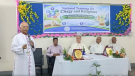
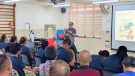
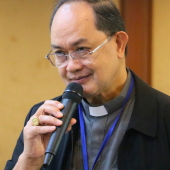
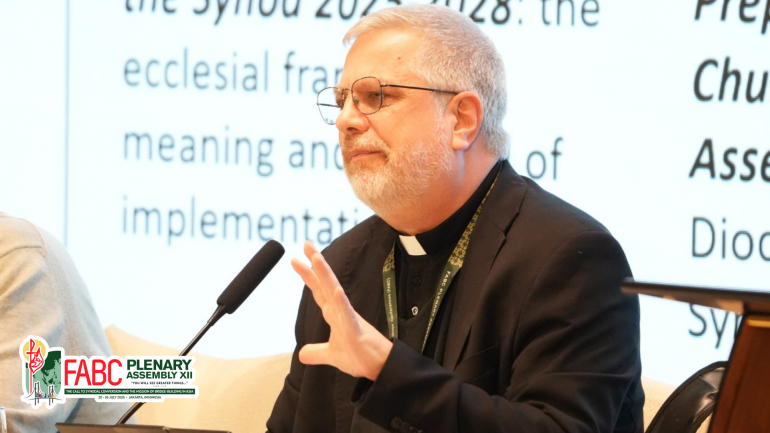
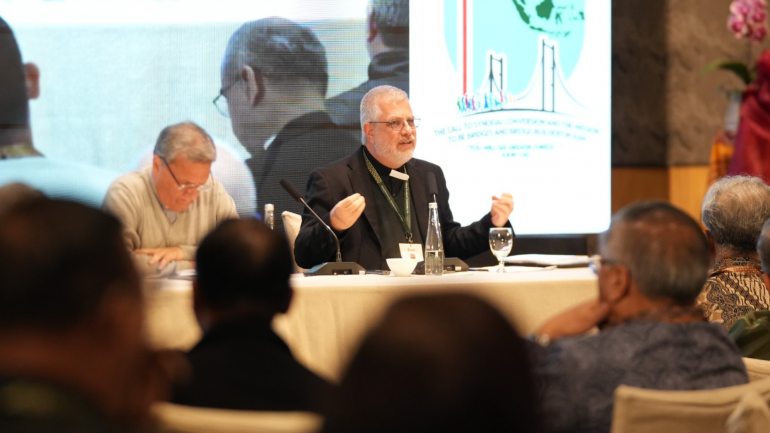
That was one of the key messages of Fr. Giacomo Costa, SJ, Consultor to the General Secretariat of the Synod, during his presentation at the 12th Plenary Assembly of the Federation of Asian Bishops' Conferences (FABC) in the Vanda Room of Hotel Mulia, Jakarta, on July 24.
Addressing bishops and Church leaders from across Asia, Fr. Costa said the implementation of the Synod should culminate in a prayerful reading of the Church's lived experience, enabling communities to recognize the work of the Holy Spirit in their midst.
Rather than asking dioceses to produce technical reports focused on activities and statistics, he proposed what he called a "narrative report"—a reflection that tells the story of God's grace at work in the life of the local Church.
"The essential question is not simply what we have done," he explained, "but what God has been doing among us."
To illustrate this approach, Fr. Costa turned to Scripture. Moses recognized the Lord only after God had passed by, while the disciples on the road to Emmaus understood their encounter with the risen Christ only after reflecting on their journey and realizing that their hearts had been burning within them.
These biblical accounts, he said, show that believers often recognize God's presence through prayerful remembrance. The Synod's implementation phase invites local Churches to do the same by reflecting together on their shared experience in the light of the Gospel.
Fr. Costa stressed that a narrative report should not be the work of a small committee drafting a document on behalf of everyone else. Instead, it should emerge from communal listening, prayer, dialogue, and discernment.
When a community reflects together, he said, it begins to recognize patterns of grace that might otherwise go unnoticed—relationships restored, new forms of participation emerging, deeper trust within the Church, and renewed missionary enthusiasm.
Such realities, he noted, cannot always be measured by numbers, but they can be faithfully expressed through stories.
For Fr. Costa, this emphasis on narrative reflects the very nature of Christianity. Before the Church formulated doctrines or developed institutional structures, it proclaimed the story of Jesus Christ—his life, death, Resurrection, and continuing presence among his people.
"The Church has always communicated the faith by telling what God has done," he suggested, encouraging local Churches to recover that tradition as they implement the Synod.
For the Churches of Asia, this proposal carries particular significance. Across the continent, Catholic communities live in diverse cultural, linguistic, and religious settings, each with unique experiences of dialogue, service, perseverance, and witness.
Sharing these stories, Fr. Costa said, allows local Churches to enrich one another while contributing their distinctive gifts to the universal Church.
As the Synod enters its implementation phase, he concluded, some of the Church's most valuable documents may not be official texts at all, but the stories believers tell one another—stories of conversion, reconciliation, hope, and faithful perseverance that reveal Christ continuing to accompany his people.
In an age dominated by data and efficiency, Fr. Costa's message offered a different vision: a synodal Church that preserves its memory by telling the story of God's grace and, in doing so, bears witness to the living Christ at work in every local community.
Radio Veritas Asia (RVA), a media platform of the Catholic Church, aims to share Christ. RVA started in 1969 as a continental Catholic radio station to serve Asian countries in their respective local language, thus earning the tag “the Voice of Asian Christianity.” Responding to the emerging context, RVA embraced media platforms to connect with the global Asian audience via its 21 language websites and various social media platforms.
Latest News