



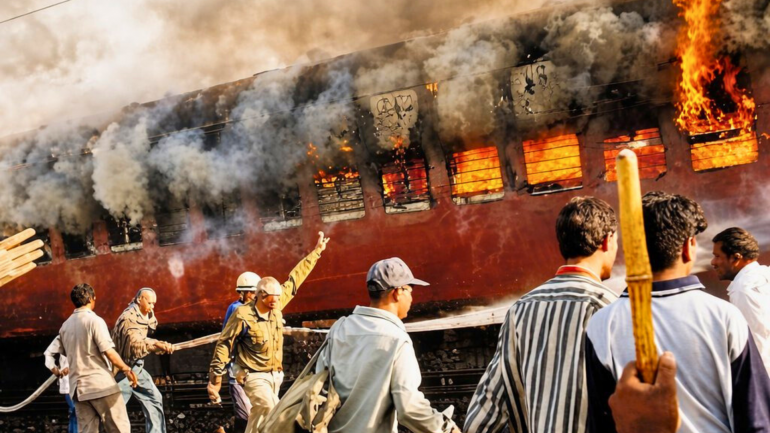
The events of 2002 in Gujarat, western India, remain one of the darkest chapters in post-independence India. On February 27, 2002, the S-6 coach of the Sabarmati Express, travelling from Faizabad to Ahmedabad, was set on fire near Godhra railway station, killing 59 people. The incident was widely condemned across the country. Several individuals were later convicted in connection with the train burning, although debate has persisted over the exact cause of the fire.
What followed, however, was a wave of violence across Gujarat that left deep scars on the nation’s conscience. In the days and weeks after the Godhra incident, large-scale attacks were carried out against members of the Muslim community. Reports documented killings, sexual violence, arson, and the destruction of homes and businesses. Thousands were affected. The intensity and spread of the violence led many observers to describe it as one of the most severe episodes of communal unrest in India’s recent history.
Eyewitness accounts and subsequent inquiries raised serious concerns about the role of state authorities during the violence. Allegations were made that law enforcement agencies failed to act decisively, and in some cases were complicit. Then Chief Minister Narendra Modi convened a meeting on the evening of February 27, 2002, though differing accounts exist about what transpired. The official minutes of that meeting were never made public.
On November 21, 2002, the Concerned Citizens’ Tribunal, headed by former Supreme Court judge Justice V. R. Krishna Iyer, released a report titled Crime Against Humanity. Based on more than 2,000 testimonies from survivors, human rights groups, academics, and civil society members, the report concluded that the violence was not merely spontaneous rioting but a targeted and organized assault. It indicted the Gujarat government and senior officials, alleging that the scale of the violence was made possible by administrative failure and political complicity.
Other independent groups echoed similar concerns, arguing that the attacks appeared coordinated and that the violence severely damaged the economic and social fabric of the Muslim community in Gujarat. Reports also noted the participation of individuals from different social backgrounds, including sections of the middle class, and documented instances where marginalized communities were drawn into the violence.
Judicial scrutiny followed in the years after the riots. In 2003, then Chief Justice of India V. N. Khare criticized the Gujarat government’s handling of riot-related prosecutions, questioning whether the state had fulfilled its constitutional duty. In a 2012 ruling, Acting Chief Justice of the Gujarat High Court Bhaskar Bhattacharya observed that the state’s inadequate response had contributed to an “anarchic situation” that continued for days.
Amid mounting legal challenges, the Supreme Court of India appointed a Special Investigation Team (SIT) to examine key cases, including a complaint filed by Zakia Jafri, whose husband, former Member of Parliament Ehsan Jafri, was among those killed. The SIT submitted its report in 2012, stating that it found no prosecutable evidence against Modi and other senior officials.
In June 2022, a three-judge bench of the Supreme Court upheld the SIT’s closure report. The bench ruled that no material evidence supported allegations of a larger criminal conspiracy at the highest levels of government. The Gujarat High Court had earlier declined to entertain Ms. Jafri’s plea. While the judiciary’s findings stand as the final legal position, debate continues in civil society and among survivors regarding accountability and justice.
In January 2023, the BBC aired a two-part documentary titled India: The Modi Question. The film revisited the events of 2002 and cited a previously unpublished UK government report that allegedly described the violence as premeditated and suggested state complicity. The documentary included interviews from various perspectives and noted that several individuals declined to participate due to safety concerns.
The Government of India rejected the documentary as propaganda and subsequently banned it from official circulation in the country. The film’s release reignited discussion both within India and internationally about the Gujarat riots and the broader state of communal relations.
More than two decades later, memories of the violence continue to shape public discourse. For some, the passage of time has brought fatigue; for others, the pain remains immediate. Survivors and human rights defenders, including prominent activists and former officials, continue to pursue what they describe as truth and justice, often at significant personal cost.
As Gujarat looks ahead to future developments, including major international events planned in the coming years, questions about remembrance and reconciliation persist. The tragedy of 2002 is not only about legal judgments but also about collective memory, accountability, and the moral responsibility of a society to confront its past.
The Gujarat violence of 2002 remains a reminder of the fragility of communal harmony and the urgent need to uphold justice, human dignity, and the rule of law. For many, the hope endures that truth will ultimately prevail, “Satyameva Jayate.”