In 1986, Filipinos reclaimed the right to speak.
But before that triumph, they endured years of imposed silence.
When Ferdinand Marcos, Sr. placed the country under martial law, TV stations and newspapers were shuttered, critics jailed, dissent punished.
Not even the Church’s media was spared. Catholic publications such as "Signs of the Times" and "The Communicator" were banned, and church-run radio stations were silenced by force — underscoring how deeply the regime sought to control every avenue of speech.
Public expression became dangerous. Conversations retreated into kitchens and sacristies. Fear controlled language.
Silence was not consent.
It was survival.
When the Church-run "Radio Veritas"–still part of "Radio Veritas Asia" at the time–aired Jaime Cardinal Sin’s call to protect the rebel soldiers, troops moved to disable its transmitter — proof that even Catholic airwaves were not beyond suppression.
But the message had already escaped the signal. By the time the station went dark, Filipinos were already moving toward EDSA.
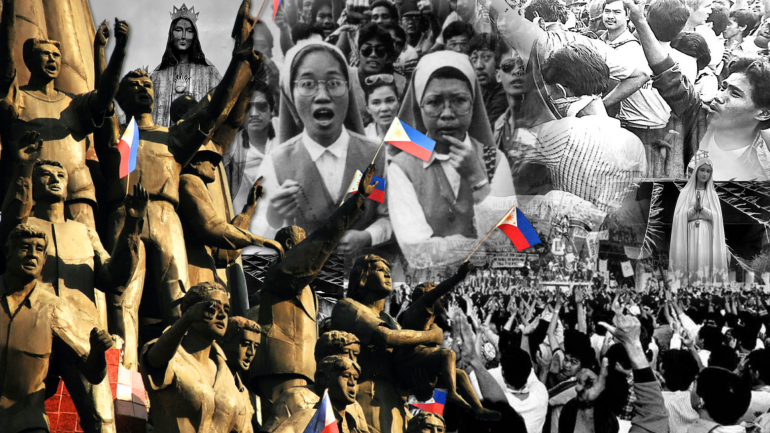
Along the highway, the People Power Revolution unfolded — not with artillery, but with moral courage and clarity. Citizens prayed, sang, and stood before tanks and soldiers.
When Corazon Aquino took her oath as president, Filipinos did not merely change leaders.
They regained voice.
After EDSA, speech exploded.
The press returned.
Commentators criticized freely. Activists marched again in the streets. Universities debated fiercely. Elections grew noisy.
Democracy, imperfect as it was, breathed.
For the first time in years, Filipinos could speak loudly — against the government and against policy.
Noise became a sign of liberty.
But what is freedom if truth itself is fragile?
Forty years later, the danger is no longer the midnight knock.
It is the manufactured narrative — not law imposed from above, but fake stories repeated until they feel like truth.
Filipinos today are not silenced by decree. They are surrounded by competing “truths” engineered to persuade, inflame, and divide.
Social media allows everyone to speak — instantly and endlessly — but algorithms reward outrage over nuance, emotion over evidence, repetition over reflection.
The result is not silence.
It is distortion.
Much of today’s noise is fueled by disinformation — narratives many embrace sincerely, believing them to be true.
Disinformation distorts public judgment, sometimes turning serious leadership into ridicule — and confusing spectacle with competence.
Disinformation gains power not because people are foolish, but because it is crafted to feel credible and is often accepted in good faith.
Before 1986, speech was restrained by fear.
Today, speech is amplified — but often shaped by disinformation.
Beliefs are molded not by censorship, but by curated feeds.
History is reframed. Facts are altered. Falsehood is repeated often enough until it appears to be true.
In 1986, Filipinos fought to regain democracy.
In 2026, the struggle is to defend discernment.
Filipinos once escaped the grip of authoritarian rule. Today, they face a different pressure — not silence imposed by law, but beliefs shaped by organized and sustained disinformation.
EDSA taught the nation that power ultimately belongs to the people.
But democracy requires more than the freedom to speak. It requires the discipline to seek truth. It demands critical thinking, historical memory, and moral courage–the courage to rise above personality-driven loyalties and emotional investments in order to serve the common good.
Authoritarianism once thrived on silence.
Now it can thrive on confusion.
In an age of disinformation, discernment begins with patience — with weighing claims before believing them, resisting the urge to react before we reflect, and learning to separate fact from narrative.
On this 40th anniversary of EDSA, the answer may not come from grand speeches or dramatic gestures. It may come from ordinary citizens who choose to verify before sharing, to question before reacting, and to defend truth even when it costs them something
And noise without discernment can erode the very freedom EDSA restored.
Forty years ago, a nation broke its silence.
The question now is whether it can rise above the noise — and who among us will choose to help it rise.