


Reflection Date: May 12, 2026 | Tuesday of the Sixth Week of Easter
Memorial of Saints Nereus and Achilleus, Martyrs
Memorial of Saint Pancras, martyr
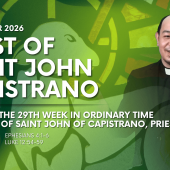
Daily Readings: Acts 16:22-34; John 16:5-11
Children of God:
In the 16th century, several issues within the Church became triggers for what is now known as the Protestant Reformation.
Practices like the selling of indulgences caused confusion and scandal among the faithful.
There was also a growing concern about corruption and the lack of discipline among some clergy.
Martin Luther publicly challenged these practices, calling for reform and a return to the Gospel.
His actions sparked debates that quickly spread across Europe.
That initial call for renewal, history tells us, led to division and the formation of different Christian communities.
The Catholic Church, in response, recognized the need for reform within itself.
This led to efforts like the Council of Trent, which clarified teachings and addressed abuses.
The Church also deepened its formation of priests and renewed its spiritual life.
This period showed that even in crisis, the Spirit continued to guide the Church.
It reminded everyone of the need for ongoing purification and discernment.
In the gospel of John, Jesus spoke about the coming of the Spirit who would guide his followers into truth.
He explained that the Spirit would reveal what is wrong and lead people toward what is right.
“And when he comes he will convict the world in regard to sin and righteousness and condemnation.”
This is hard real talk: truth is not always comfortable, but it is necessary for growth.
What can guide us today as we face our own need for correction and renewal?
First, allowing truth to challenge us.
Jesus said, “And when he comes he will convict the world in regard to sin and righteousness and condemnation.”
The Spirit did not come only to comfort but also to correct.
This correction was not meant to shame but to lead people back to what is right.
The time of the Reformation revealed painful truths within the Church.
These were not easy to face, yet they opened the door for renewal.
Without acknowledging the need for change, growth would not have been possible.
The Spirit worked even in conflict to bring about purification.
In our own lives, we often resist correction because it feels uncomfortable.
We prefer to remain as we are.
Yet real growth begins when we listen to the truth, even when it challenges us.
The Spirit continues to speak, inviting us to examine our actions and attitudes.
Second, the need to be open to the Spirit’s guidance.
Jesus said, “But when he comes, the Spirit of truth, he will guide you to all truth.”
The journey of faith did not end with one moment of correction.
It continued as a process of listening and responding to the Spirit.
The Church’s response after the Reformation showed this ongoing journey.
Renewal did not happen overnight. It required humility, discernment, and a willingness to be guided.
The Spirit continued to work through leaders, communities, and ordinary believers.
In our daily lives, we are also called to remain open.
Growth is not a one-time decision but a continuous process.
When we listen to the Spirit in prayer, in Scripture, and in our experiences, we find direction.
This openness allows us to move forward with clarity and purpose.
As we reflect, we ask ourselves: Do I allow truth to challenge me, even when it is uncomfortable?
Do I listen to the Spirit guiding me toward what is right? Do I remain open to growth, or do I resist change?
Children of God:
The history of the Church reminds us that even difficult moments can become paths to renewal.
Jesus promised the Spirit not only to comfort but also to guide and correct.
This guidance continues in our lives today.
Yes, truth may challenge us, but it also frees us.
We might as well remember all the time that God does not abandon us in our weaknesses.
Instead, through the Spirit, he leads us toward fullness of life.
Radio Veritas Asia (RVA), a media platform of the Catholic Church, aims to share Christ. RVA started in 1969 as a continental Catholic radio station to serve Asian countries in their respective local language, thus earning the tag “the Voice of Asian Christianity.” Responding to the emerging context, RVA embraced media platforms to connect with the global Asian audience via its 21 language websites and various social media platforms.
Latest News