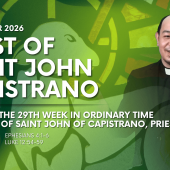
Reflection Date: April 06, 2026 | Monday in the Octave of Easter
Daily Readings: Acts 2:14, 22-33; Matthew 28:8-15
Children of God:
In the early days of Christianity, one of the first controversies that spread quickly was the claim that the body of Jesus was stolen.
Some religious leaders could not accept the news of the resurrection, so they offered an alternative explanation. They spread a story that the disciples came at night and took the body while the guards were asleep.
This narrative began to circulate among the people and created confusion. It became one of the earliest fabricated stories in Christian history.
However, this claim had weaknesses because sleeping guards could not witness what happened. The disciples, who were afraid and in hiding, were unlikely to risk their lives to steal the body.
Early Christians strongly disputed this accusation by pointing to the empty tomb and the appearances of the risen Christ. Their lives, marked by courage and even martyrdom, became their strongest testimony.
The truth of the resurrection continued to spread despite attempts to silence it.
In the gospel story of Matthew, the guards reported what happened, but they were bribed to spread the false story that the disciples stole the body.
Meanwhile, the women who encountered the risen Christ were filled with fear and great joy and ran to share the good news.
Two different messages began to spread: one out of fear and deception, and the other in truth and encounter.
What are our inspirations for today?
First, truth does not depend on popularity but on witness.
The fabricated story about the stolen body gained attention because it came from influential people. It was easier for some to believe a convenient explanation than to accept the reality of the resurrection.
Yet truth does not rely on how many people believe it but on its foundation.
In the gospel of Matthew, the chief priests instructed the soldiers and gave them money, saying, asking them to fabricate that the disciples came by night and stole the body of Jesus.
This showed that the false story was deliberately created and supported by authority, but it lacked truth.
The early Christians responded through their lives. Their courage, faith, and willingness to suffer became proof of the resurrection believed.
In our time, truth is also challenged by many voices, but our witness through actions and integrity can reveal what is real.
Second, encountering Christ gives us the courage to share the truth.
The women who went to the tomb experienced something life-changing. They saw the empty tomb and encountered the risen Jesus. Their fear turned into joy, and their confusion turned into mission.
In the gospel of Matthew, the women’s personal encounter with Christ became the source of their courage to speak.
Faith grows stronger when it is rooted in a real encounter with the Lord.
When we experience God in our lives, we become more confident in sharing hope with others. The resurrection invites us not only to believe but also to proclaim with our lives that Christ is truly risen.
We can pause and reflect on some questions in our hearts. In a world filled with many conflicting messages, do I take time to seek and stand by the truth?
When I encounter Christ in prayer and daily life, do I allow that experience to shape my words and actions? And in simple ways, how can I become a witness of truth and hope to others today?
Children of God:
The story of the resurrection reminds us that truth will always find a way to shine despite attempts to hide it.
False stories may spread quickly, but they cannot endure forever.
The empty tomb continues to speak across generations. Yet the resurrection invites us to stand firm in what is real and life-giving.
Christ calls us not only to believe quietly but to live boldly.
Every act of honesty, faith, and love becomes a testimony to the risen Lord.
As we continue our journey, we carry that truth with courage and hope.
Radio Veritas Asia (RVA), a media platform of the Catholic Church, aims to share Christ. RVA started in 1969 as a continental Catholic radio station to serve Asian countries in their respective local language, thus earning the tag “the Voice of Asian Christianity.” Responding to the emerging context, RVA embraced media platforms to connect with the global Asian audience via its 21 language websites and various social media platforms.
Latest News