The Christmas story unfolds not as a single, isolated event, but as a chain of meaningful encounters. Each meeting, between heaven and earth, between God and ordinary people, carries themes of hope, readiness, courage, faithful action, and hospitality. These encounters prepare the way for the birth of Christ and continue to speak to us long after the season has passed. Advent, in this sense, is a time of meeting: God meeting humanity, and humanity learning how to respond.
1. A lifelong posture of seeking
One of the first striking encounters is that of the magi with the star. Matthew tells us they saw a star rise and followed it, asking where the new-born king was to be found, and they came to worship. The star is more than a beautiful guide; it represents a restless, hopeful seeking. The magi noticed a sign, left their familiar world, faced uncertainty, and remained focused on their purpose. Their journey did not end with observation but with worship and offering.
For us, the magi invite a lifelong posture of seeking. Christmas offers many beautiful signs, lights, music, gatherings, but the question is whether we stop at the surface or allow these signs to draw us deeper toward God. The star could have been a passing wonder, but instead it prompted movement, risk, and transformation. The magi challenge us to let moments of grace redirect our lives rather than remain mere seasonal experiences.
2. First recipients of the Good News.
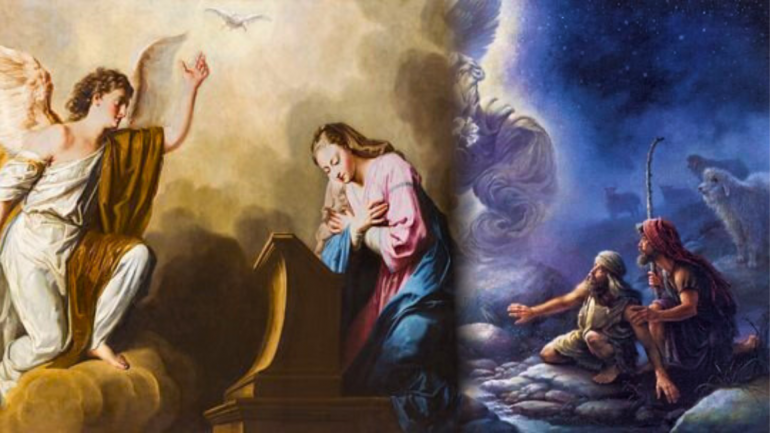
Another encounter occurs between shepherds and angels. Luke describes the shepherds as keeping watch over their flocks when an angel announces good news of great joy for all people: a Savior is born. These shepherds were ordinary, likely overlooked, and certainly not powerful. Yet they were chosen as the first recipients of the good news.
This meeting highlights God’s preference for the humble and the unexpected. The shepherds were not specially prepared; they were simply present. They listened, went to see, and then shared what they had witnessed- this raises an important question: are we open to receiving good news when it comes through unexpected channels or at inconvenient times? God’s messages often arrive quietly, in small kindnesses, moments of clarity in prayer, or unexpected peace amid anxiety. If we only expect God in dramatic displays, we may miss the angels who appear in ordinary life.
3. May your word be fulfilled
Mary’s encounter with the angel Gabriel reveals another dimension of faith: the courage to say yes amid uncertainty. Gabriel greets her as favored and announces that she will bear a son called the Son of God. Mary is disturbed and questioning, yet her response is a brave surrender: I am the Lord’s servant; may your word be fulfilled.
This meeting is not one of calm certainty but of trust in the face of fear. Mary does not have a clear plan, nor the full understanding. She has a promise and chooses to trust it. For people living with responsibilities, risks, and fear of consequences, Mary’s yes is deeply relevant. Faith does not remove uncertainty; it reorients life toward God’s purpose. Mary teaches that courage is not the absence of fear but the willingness to trust God’s word even when fear remains.
4. Unfolding of the extraordinary work of God
Joseph’s encounter with the angel, though in a dream, adds yet another layer to the story. Troubled by Mary’s pregnancy and determined to act righteously yet compassionately, Joseph plans to divorce her quietly. In a dream, an angel tells him not to fear taking Mary as his wife, for the child is from the Holy Spirit. Joseph listens and obeys.
Joseph’s faith is practical and protective. He acts with integrity, choosing responsibility over withdrawal. His obedience is quiet, steady, and costly. Joseph represents a form of spiritual leadership lived out in everyday decisions, choosing kindness over convenience, commitment over escape, and faithfulness over fear. His actions may seem small, but they provide the stability that allows God’s extraordinary work to unfold.

5. Provider of the cradle of the Saviour
The final, often overlooked encounter is that of the innkeeper with the strangers seeking shelter. Luke tells us there was no room in the guest house, so the child was laid in a manger. The innkeeper is unnamed, and his intentions are unclear. Yet his lack of space becomes part of the story. The manger, a place meant for animals, becomes the cradle of the Savior.
This moment invites reflection on hospitality and space. How do we respond to unexpected needs or interruptions? Do we guard our schedules, plans, and comforts so tightly that there is no room for the unfamiliar? At the same time, the story shows that God works even through lack and inconvenience. The absence of room does not prevent God’s coming; instead, it reveals divine humility and grace. God enters not through abundance, but through simplicity and vulnerability.
Taken together, these encounters form a mosaic of faith. The magi show us seeking hearts; the shepherds, open hearts; Mary, trusting surrender; Joseph, faithful action; and the innkeeper, the challenge of making space. Each meeting reveals a different way God intersects with human life and invites a response.
Whom did I meet this Christmas?
The question, then, becomes deeply personal: whom did I meet this Christmas? Perhaps you encountered someone who guided you like a star, someone who brought unexpected joy like an angel, someone who invited you to say yes despite fear, or someone who quietly supported and protected you. Perhaps you faced your own limitations and had to decide whether to make room.
We are called for honest assessment of how we respond to daily encounters. Did busyness or fear close us off? Did we recognize moments of grace? Did we respond with courage, openness, and faith? The Christmas story reminds us that God continues to meet us through people, events, and quiet promptings. Our task is to notice, to respond, and to allow these encounters to shape a way of living that carries the meaning of Christmas into every season.
A Message – for season beyond the calendar
Take time in the coming days and weeks to name specific meetings, persons, moments, emotions, decisions. Write them down. Pray over them. See which ones resemble the star, the angel, Mary, Joseph, or the innkeeper. Let each prompt a response: to seek, to receive, to trust, to act, to open space.
Keep the Christmas question alive: Whom did I meet? Who met me? Let it become a regular question, not only at the end of the month or year, but in quiet moments, at meal tables, in prayer. This ongoing examination of encounters cultivates awareness of God’s presence and deepens the meaning of the season beyond its calendar.