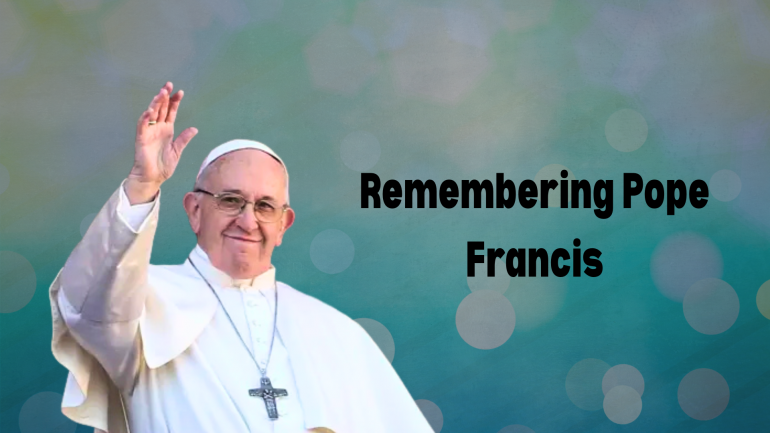
As April 21 marks one year since the passing of Pope Francis, Austen Ivereigh, a UK-based Catholic journalist, author, commentator, and biographer of the late Pope, and co-author of Let Us Dream: The Path to a Better Future, spoke to RVA freelancer Lavoisier Fernandes about a papacy that continues to shape the Church today.
Excerpts:
As Pope Francis’ biographer, how would you sum up his legacy?
It is a vast legacy that will take generations to unpack. Historians will likely describe Pope Francis as the architect of a historic transition in Catholicism, from a Europe-centered Church to a truly global Church rooted in diverse cultures and contexts.
At the heart of this shift was a transformation in style and approach, expressed in the defining words of his pontificate: humility, mercy, joy, synodality, pastoral care, mission, and fraternity. Francis did not simply promote these values; he embodied them in his gestures, decisions, and way of governing.
He led not primarily through structures or decrees, but through witness. That is why, at his funeral, it was said in effect: “This is how you evangelize the world today.” His papacy showed that credibility in the modern world depends on authenticity.
Which aspects of his leadership were most misunderstood?
The opposition he faced was unusually intense and, at times, deeply disrespectful. Much of it came from those who felt threatened by the changes he initiated. In many ways, it resembled the resistance Jesus encountered when he refocused attention on the heart of God’s law.
At its core was a kind of modern-day Pharisaism, an attachment to doctrine treated as a possession rather than a gift. Some critics feared losing clarity or control. On the other hand, certain liberal voices were disappointed that Francis did not deliver their expected reforms.
In reality, Francis governed from within the Church’s living tradition, rooted in the faith of ordinary people and open to the action of the Holy Spirit. He did not align with ideological camps, which is why he frustrated both extremes.
Despite perceptions, the Church was not deeply polarized. Much of the resistance came from vocal, well-funded groups, while the majority of the faithful understood and supported him.
Did his emphasis on mercy change how doctrine is lived?
Francis saw truth and mercy not as opposites, but as complementary realities held in creative tension. God’s mercy does not dilute truth; it reveals its deepest meaning.
This is especially evident in Amoris Laetitia, his teaching on marriage and family life. It upholds the ideal of lifelong, faithful marriage while also accompanying those who struggle or fail.
The discomfort surrounding this teaching came from an inability to hold these tensions together. Francis challenged the Church to move beyond rigid either-or thinking.
One of his major contributions was helping the Church live these tensions, truth and mercy, authority and service, local and universal, in a way that produces growth rather than conflict.
Has the Church embraced synodality?
Synodality is widely regarded as Francis’ most significant structural and spiritual legacy. At its heart is a renewed trust that the Holy Spirit actively guides the Church.
It involves prayerful listening, dialogue, and communal discernment. By listening deeply to one another, the Church becomes more attentive to what the Spirit is saying.
Far from weakening authority, synodality strengthens it, because decisions are made after genuine consultation with the People of God. Bishops and the Pope exercise leadership in a more discerning and participatory way.
However, this journey has only just begun. Synodality requires a profound cultural conversion, particularly in regions where clericalism or rigid institutional habits prevail. It is demanding, but essential for the Church’s future.
Has the “field hospital” vision taken root?
The image of the Church as a “field hospital” reflects what Latin American theology calls “pastoral conversion,” a shift from a rules-centered approach to one focused on accompaniment.
Rather than beginning with doctrine, the Church is called to begin with people, their wounds, struggles, and hopes. By walking alongside them, the Church allows Christ’s healing presence to be experienced.
Francis showed the direction, but the Church is still learning how to live it fully. In today’s world, especially in the West, where culture no longer supports Christianity, it is not enough to simply hold correct beliefs.
The Gospel must first be proclaimed through witness: through compassion, closeness, and authenticity. This awakens curiosity and opens hearts to faith. Evangelization today depends not only on what we say, but on how we live.
Did his focus on global issues strengthen the Church’s voice?
Pope Francis placed Catholic social teaching at the center of global concerns, making the Church a significant voice in contemporary debates.
Laudato Si’ stands out as one of the most influential social encyclicals in modern times. By linking care for creation with human dignity, it reshaped how the Church engages environmental issues and contributed to global conversations, including the 2015 Paris Agreement.
On migration, Francis consistently emphasized the human face of the issue, urging the world to welcome, protect, promote, and integrate migrants. He reframed migration not as a problem, but as a call to recognize human dignity.
On war, he moved the Church toward a clearer commitment to nonviolence, highlighting the moral limits of armed conflict.
He also addressed economic inequality, particularly in the digital age, warning against systems that marginalize the poor and foster indifference. In doing so, he restored the Church’s moral credibility in addressing global challenges.
How did he personally influence you?
For me, Pope Francis revealed what it means to live the Gospel in our time. He was both a teacher and a model.
He showed that Christian joy is real and rooted in recognizing God’s action in history. He expanded my understanding of faith and helped me see the Church in a new way.
I was privileged to know him personally and to work with him, and I treasure those encounters. But beyond personal experience, his impact is visible in countless lives.
He will not be forgotten. Whenever people speak about him, there is a sense of warmth and gratitude. He brought light, and that light continues to guide the Church today.