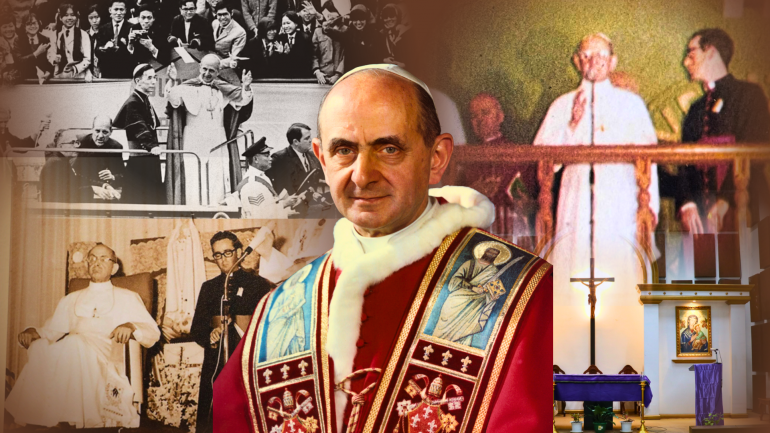
Pope Paul VI, remembered as the “Pilgrim Pope,” left an enduring legacy not only through his leadership of the Catholic Church during the transformative years of the Second Vatican Council but also through his deep commitment to the Church’s missionary outreach, especially to Asia.
His historic visit to Radio Veritas Asia (RVA) in Quezon City remains a significant moment in that missionary vision. The visit symbolized the Church’s determination to reach the peoples of Asia through modern means of communication, encouraging the use of media in proclaiming the Gospel and fostering dialogue among cultures and religions.
In recognition of this historic connection, Radio Veritas Asia is planning to rename the chapel at its central office in Quezon City as the “Three Saints Chapel.” The dedication will honor three towering figures of the universal Church who personally visited the station: St. Paul VI, St. John Paul II, and St. Mother Teresa of Calcutta. Their visits reflect the shared missionary spirit that continues to guide RVA’s work in serving the Church across Asia.
Early Life and Formation
Giovanni Battista Enrico Antonio Maria Montini was born on September 26, 1897, in Concesio, a village near Brescia in northern Italy's Lombardy region. He came from a devout Catholic family; his father was a journalist and anti-fascist activist. Montini showed early signs of intelligence despite dealing with health issues such as scoliosis, which kept him from serving in World War I. He studied philosophy and civil law before becoming a priest on May 19, 1920, in Brescia.
Montini's early career took him into Vatican diplomacy. He joined the papal Secretariat of State in 1922 and developed his administrative skills during a time of rising tensions in Europe. By 1952, he was Pro-Secretary of State for General Affairs, shaping the Church's global strategy. In 1954, Pope Pius XII appointed him Archbishop of Milan, where he navigated urban challenges through innovative evangelization, including missions for workers and outreach to youth.
Rise to the Papacy
Montini's rise accelerated in 1958 when Pope John XXIII made him a cardinal. After John XXIII died in 1963, the conclave elected Montini as pope on June 21. He chose the name Paul VI. At 65, he took on the unfinished Second Vatican Council, which his predecessor had called to renew the Church's connection with the modern world.
Paul VI's first action was to reconvene the council, overseeing its last three sessions from 1963 to 1965. This resulted in 16 documents that reshaped liturgy, ecumenism, religious freedom, and the Church's societal role. It highlighted the importance of collaboration among bishops while maintaining papal authority.
Key Contributions
Paul VI's implementation of Vatican II was his most significant achievement. He reformed the Roman Curia to improve efficiency without alienating conservatives. He introduced the Synod of Bishops for shared governance and published the new Roman Missal in 1969, which allowed local languages in the Mass to encourage lay participation.
His encyclical Humanae Vitae (1968) reaffirmed the Church's ban on artificial contraception. This decision stirred controversy but defended human dignity during the cultural changes of the 1960s. This strong position, based on natural law, shaped global bioethical discussions, emphasizing marital fidelity and openness to life.
Ecumenism was a key focus of his outreach. In 1964, Paul VI met Ecumenical Patriarch Athenagoras I in Jerusalem, marking the first papal-Orthodox meeting in 500 years. They lifted the mutual excommunications of 1054. He set up secretariats for non-Christians and nonbelievers, visited the World Council of Churches in 1969, and promoted dialogue between Jews and Catholics after Nostra Aetate.
Paul VI's social doctrine also flourished. Populorum Progressio (1967) framed the idea of integral human development. It criticized unchecked capitalism and Marxism while urging global solidarity against poverty. He established an office for economic development and aid in 1971, declared January 1 as the World Day of Peace, and engaged with communist leaders to support Eastern European Catholics.
Global Missionary
The “Pilgrim Pope” changed the tradition of papal travel. He visited the Holy Land in 1964, India that same year, the United States in 1965, Africa in 1969, and Asia in 1970. These nine trips to six continents broadened the reach of the papacy and affirmed the Church's universal mission. They amplified voices from the Global South.
Paul VI also made strides in Mariology by declaring Mary as Mother of the Church in 1964. He also worked toward reforming canon law, culminating in the 1975 apostolic exhortation Evangelii Nuntiandi on evangelization. Amid the challenges following the council, he balanced progress with tradition, working to maintain unity.
Legacy and Canonization
Paul VI passed away on August 6, 1978, in Castel Gandolfo from heart failure at the age of 80. His 15-year reign, the longest since the 18th century, significantly influenced post–Vatican II Catholicism. He was beatified in 2014 by Pope Francis and canonized a saint in 2018.
Though some pointed to tensions regarding liturgy and dissent, many admire his careful approach. As biographer Peter Hebblethwaite noted, Paul VI completed the council without causing a schism, practiced ecumenism without compromising identity, and engaged the world in a prophetic way. His contributions remain significant in a Church that is now more open, just, and focused on its missionary work.