Thousands of Pilgrims Venerate Relics of Saint Francis of Assisi During Centenary Commemoration

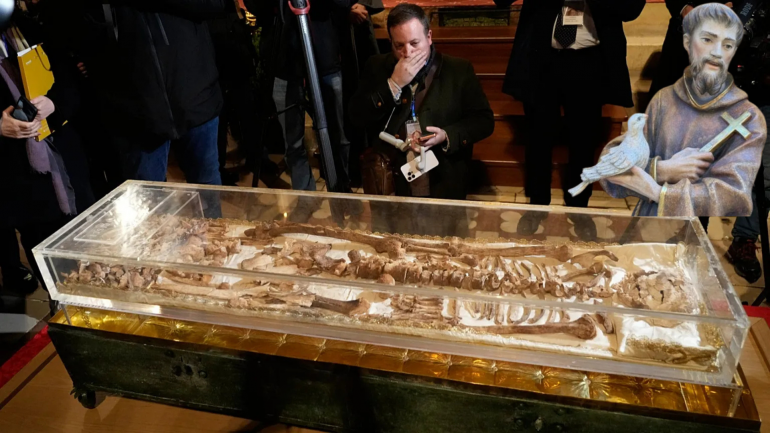
In a rare and historic moment for the Catholic Church, thousands of pilgrims from across the globe have gathered in Assisi to venerate the major relics of Saint Francis of Assisi, publicly exposed for the first time in nearly 800 years.
Church officials reported that about 18,000 pilgrims filed past the mortal remains of the beloved saint on the first Sunday of the exposition. The relics are displayed in the crypt of the Basilica of Saint Francis of Assisi, where Francis was buried in 1230.
The month-long exposition, from February 22 to March 22, forms part of the commemoration of the 800th anniversary of the death of the “Poverello,” the Little Poor Man of Assisi, whose radical Gospel witness continues to inspire millions worldwide.
A Moment of Grace and Fraternity
Franciscan Father Giulio Cesario described the opening day as marked by “an atmosphere of reflection but also of joy.” According to him, pilgrims arrived not merely to see sacred remains, but to encounter spiritually the enduring message of Francis, a call to goodness, peace, and conversion of heart.
He expressed heartfelt gratitude to all who helped organize the event, calling it “a true moment of fraternity,” a living expression of the communion that Saint Francis tirelessly promoted.
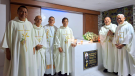
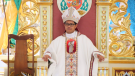
The day was highlighted by a Solemn Mass presided over by Cardinal Ángel Fernández Artime, Pontifical Legate for the Papal Basilicas of Assisi.
In his homily, the cardinal emphasized that Francis embodied freedom from “the logic of the world,” a freedom rooted not in power or possessions, but in total trust in God.
Confronting Temptation with Trust
Reflecting on the Gospel account of Christ’s temptation in the desert, the cardinal noted that Francis faced similar trials: pride, wealth, and self-sufficiency. Yet instead of seeking dominance or security, he chose humility, poverty, and obedience.
“The victory over temptation never closes us in on ourselves,” Cardinal Fernández Artime said. Just as Christ emerged from the desert to proclaim the Kingdom, Francis overcame temptation in order to embrace the leper and serve all as brothers and sisters.
Venerating the relics, he added, is not simply an act of devotion to the past, but “a strong and concrete invitation” for believers to examine their own lives: Where is my desert? What temptation dwells within me? Where is the Lord calling me to take a leap of faith?
The Year of Francis and a Message for Asia
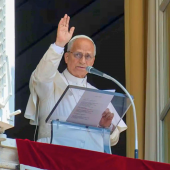
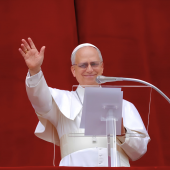
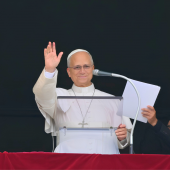
In connection with the centenary celebrations, Pope Leo earlier proclaimed a special Year of Francis, inviting the universal Church to rediscover the evangelical radicalism of the saint of Assisi.
In his message, the Pope presented Saint Francis as a model of peacebuilding, fraternity, care for creation, and dialogue, themes that resonate deeply within the Asian context.
Across Asia, where Christians often live as minorities amid diverse religious traditions, Francis’ spirit of humility and encounter offers a powerful pastoral path.
The Pope underscored that Francis’ witness challenges today’s world to move beyond the “logic of domination” toward a culture of encounter and solidarity.
This call carries particular urgency in Asia, a continent marked by rapid economic growth, persistent poverty, ecological vulnerability, migration, and interreligious tensions.
For many Asian Churches engaged in promoting human dignity, combating human trafficking, caring for migrants, and responding to climate crises, the Franciscan charism echoes their daily mission. His embrace of the poor and marginalized mirrors the lived reality of countless communities across the region.
A Living Spiritual Legacy
As pilgrims continue to visit Assisi during this extraordinary month, the centenary celebration stands as more than a historical remembrance. It becomes a renewed invitation to live the Gospel with simplicity, courage, and compassion.
For the Churches of Asia, the quiet yet prophetic voice of the Poverello continues to speak: true freedom is not found in possession but in trust; not in power but in service; not in isolation but in fraternity.
Radio Veritas Asia (RVA), a media platform of the Catholic Church, aims to share Christ. RVA started in 1969 as a continental Catholic radio station to serve Asian countries in their respective local language, thus earning the tag “the Voice of Asian Christianity.” Responding to the emerging context, RVA embraced media platforms to connect with the global Asian audience via its 21 language websites and various social media platforms.
Latest News