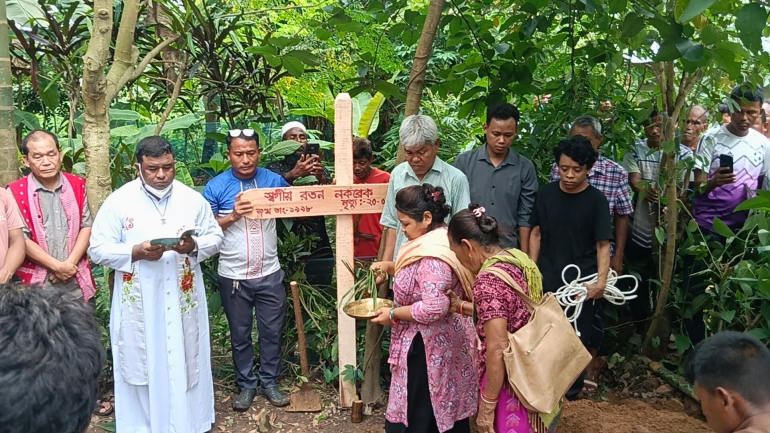
Four members of a Catholic family in a tribal village in central Bangladesh died in a desperate attempt to rescue a goat from an abandoned well, causing immense sorrow to the local Catholic community.
The incident occurred on the morning of June 20 in Joloi village, under Jalchatra parish in Madhupur upazila of Tangail district. What began as a routine effort to save a household animal quickly turned into a devastating chain of deaths that shocked the local Catholic community.
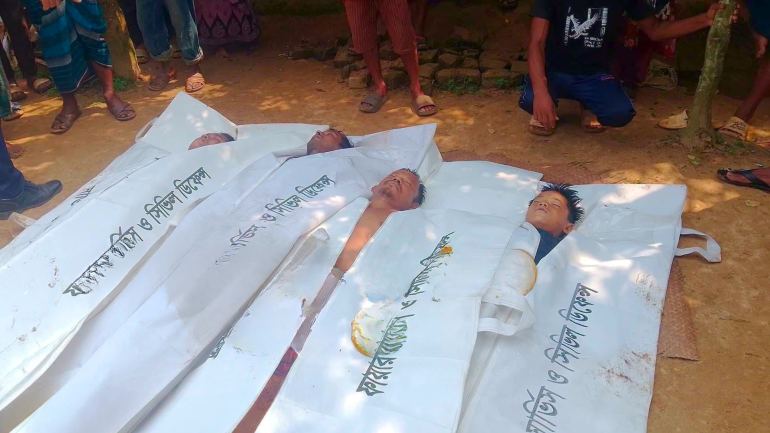
The deceased were identified as Babul Hadima, 48, his teenage son Neymar Mrong, 14, and their relatives Ratan Nokrek, 27, and Gabriel Nokrek, 32. All belonged to the indigenous Garo community, many of whom are Christians living in forested areas of northern Bangladesh.
According to local residents and police, a goat owned by Babul Hadima fell into a disused well near the family’s home. In an attempt to retrieve it, the boy Neymar was first lowered into the well. When he did not respond, his father entered the confined space. One after another, two more relatives followed, hoping to rescue them. None emerged alive.
“It all happened within a very short time,” said Hashmat Ali, local union parishad member, who rushed to the scene after hearing of the incident. “When no one came out, we realized something was terribly wrong and immediately informed the fire service.”
Rescue teams later retrieved all four bodies from the well, as well as the dead goat. Initial findings suggest that the victims died from exposure to toxic gases or oxygen deficiency inside the abandoned structure, a known but often overlooked hazard in rural Bangladesh.
Police officer-in-charge AKM Fazlul Haque confirmed the incident, adding that a formal investigation would determine the exact cause of death.
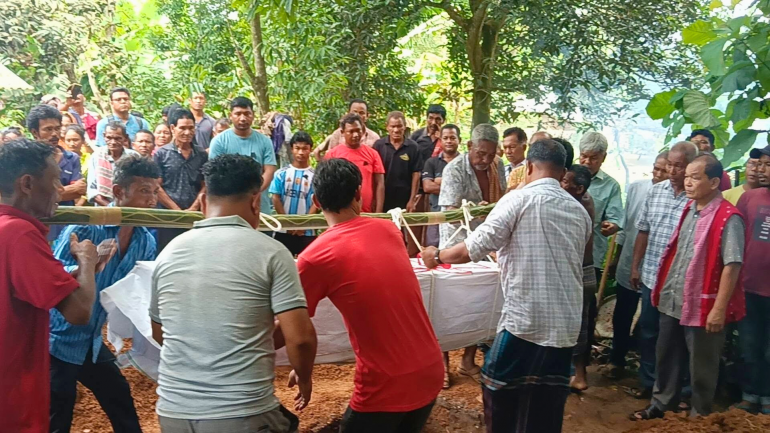
For the Garo villagers of Jalchatra, however, the tragedy is far more than a statistic. It has left a deep emotional scar, particularly within the Catholic parish community that serves many indigenous families.
Priests from Jalchatra parish visited the bereaved family shortly after the incident, offering prayers and comfort. “This is truly a heartbreaking and unexpected tragedy,” said Fr. Nayan Joseph Gomes, assistant parish priest, speaking to RVA News. “Four of our faithful lost their lives while trying to save a household animal. When we visited the family, there were no words that could console them. We could only pray and stand beside them in silence.”
Fr. Gomes noted that the well had been used just days earlier when a rabbit fell in and was successfully rescued, making the sudden fatal outcome all the more shocking. “The incident eminds us how vulnerable life can be, especially for rural and marginalized communities,” he said.
Funeral rites for the victims were held in the village the following day, with parish members, relatives, and neighbors gathering in mourning. The atmosphere was heavy with grief, as families struggled to comprehend the loss of four lives within a single household network.
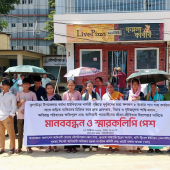
The tragedy also drew sympathy across religious and social boundaries. Local Muslim leaders and political representatives visited the family, offering condolences and financial support.
Such incidents are not isolated in Bangladesh, where abandoned wells, septic pits, and other confined spaces often pose hidden risks. According to safety observers, dozens of deaths occur each year due to toxic gas exposure in poorly ventilated structures, particularly during rescue attempts made without protective equipment.
For the Catholic Church in Jalchatra, the tragedy has prompted reflection as well as mourning. Parish leaders say they plan to raise awareness among villagers about the risks of entering confined spaces and the importance of seeking trained rescue support.
As Fr. Gomes reflected, “Their intention was to save life, even that of a small animal. In that act of love, they lost their own lives. We entrust them to God’s mercy and pray that such tragedies can be prevented in the future.”
Radio Veritas Asia (RVA), a media platform of the Catholic Church, aims to share Christ. RVA started in 1969 as a continental Catholic radio station to serve Asian countries in their respective local language, thus earning the tag “the Voice of Asian Christianity.” Responding to the emerging context, RVA embraced media platforms to connect with the global Asian audience via its 21 language websites and various social media platforms.
Latest News