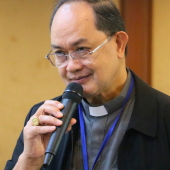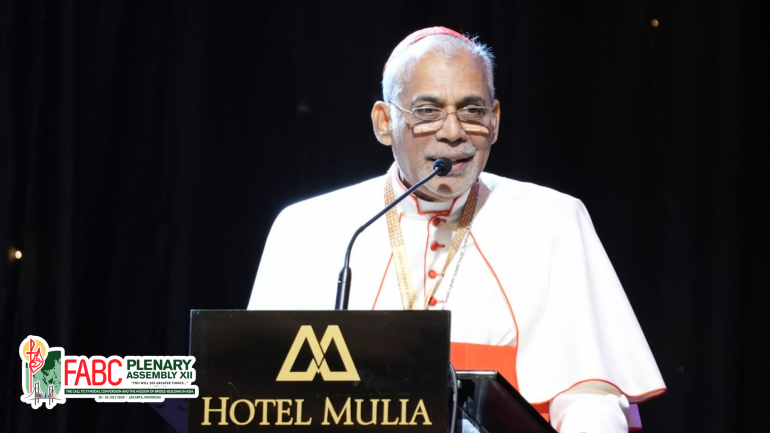
Synodality must move beyond discussion and become a way of life in every parish, diocese, religious community, and family across Asia, Cardinal Filipe Neri Ferrão, president of the Federation of Asian Bishops' Conferences (FABC), said in his keynote address at the opening of the 12th FABC Plenary Assembly on July 21.
Addressing bishops and delegates gathered in Jakarta, Cardinal Ferrão said the assembly is not simply an organizational meeting but a spiritual journey of communal discernment.
"We have not gathered merely to discuss the future of the Church in Asia," he said. "Rather, we have come together to seek God's will for His people."
His message centered on the assembly's theme, "A Call to Synodal Conversion and the Mission to Be Bridges and Bridge-Builders in Asia," which reflects the Church's commitment to fostering a culture of listening, participation, and shared discernment inspired by the Synod on Synodality.
For Cardinal Ferrão, synodality is neither another pastoral program nor an administrative reform.
"The real question before us is not whether synodality is important, but how it can take deeper root in our dioceses, our parishes, our institutions, our religious communities, and our families," he said.
Throughout his address, the cardinal emphasized that the Church's mission begins with encounter. Reflecting on the Gospel account of Philip inviting Nathanael to "Come and see," he said evangelization is rooted not in winning arguments but in inviting people to encounter Jesus Christ.
He said the same spirit should shape the plenary assembly itself, where bishops from across Asia gather to pray, listen, discern, and share the pastoral realities of their local Churches.
"These are not simply items on the program," he said, describing prayer, dialogue, and communal discernment as authentic expressions of synodality.
Cardinal Ferrão also reflected on the Church's mission in Asia, a continent marked by ancient civilizations, diverse cultures, and major religious traditions. These realities, he said, present both opportunities and challenges for the Church.
"The Church in Asia is called to be both a bridge and a builder of bridges," he said, encouraging greater dialogue, reconciliation, and communion across cultural and religious differences.
He also acknowledged the profound changes reshaping the continent, including artificial intelligence, migration, environmental degradation, inequality, and armed conflict. Rather than diminishing Christian hope, he said, these realities call the Church to offer a more credible witness through solidarity, compassion, and renewed missionary commitment.
Looking ahead, Cardinal Ferrão urged participants to remain attentive to the Holy Spirit throughout the weeklong assembly.
He expressed hope that the assembly's final document would become more than a summary of discussions. Instead, he said, it should provide practical guidance to help local Churches throughout Asia embrace synodality as a lived experience.
Before reports are presented, discussions held, and recommendations adopted, he said, the assembly's primary task is to discern together what God is asking of the Church in Asia today.
Cardinal Ferrão concluded by saying the success of the 12th FABC Plenary Assembly will ultimately be measured not by the document it produces, but by whether those who leave Jakarta return to their local Churches more attentive to the Holy Spirit, more committed to one another, and more prepared to serve as bridge-builders across Asia.
Radio Veritas Asia (RVA), a media platform of the Catholic Church, aims to share Christ. RVA started in 1969 as a continental Catholic radio station to serve Asian countries in their respective local language, thus earning the tag “the Voice of Asian Christianity.” Responding to the emerging context, RVA embraced media platforms to connect with the global Asian audience via its 21 language websites and various social media platforms.
Latest News