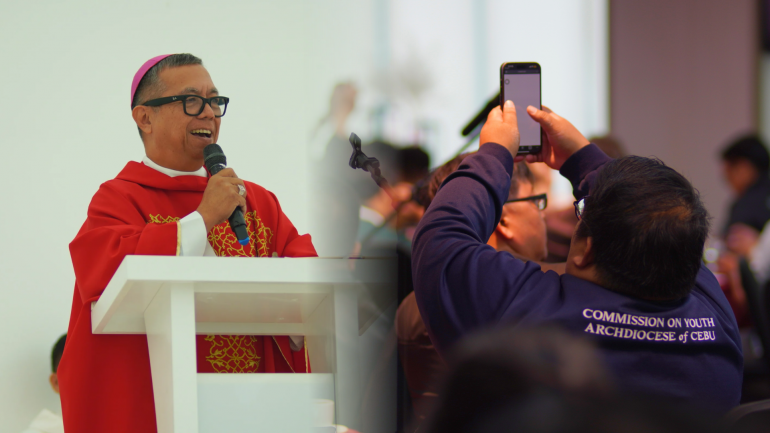
A Catholic bishop in the Philippines has warned that the increasing influence of artificial intelligence (AI) is contributing to a growing crisis of accompaniment, intimacy, and faith formation among young people, challenging the Church's mission of guiding the next generation.
Speaking during a Mass of the First National Youth Directors Assembly, Bishop Bartolome Santos Jr. of Iba, urged church leaders and youth ministers to address the spiritual and social impact of rapidly advancing technology on the lives of the youth.
The assembly, organized by the Catholic Bishops' Conference of the Philippines (CBCP) Episcopal Commission on Youth, was held from June 4 to 6, 2026, at Ibis Styles Manila Araneta City and the Sagrada Familia Chapel in Gateway Mall 2, Quezon City. It gathered around 100 youth directors and youth ministers representing 62 dioceses and various national youth organizations across the country.
In his homily, Bishop Santos, vice chairman of the CBCP Episcopal Commission on Youth, identified technology as one of the major challenges confronting young people today.
"The next enemy we have to make as our footstool is the crisis brought by technology—the crisis of AI, the crisis of accompaniment, and the crisis of intimacy," Bishop Santos said.
The bishop stressed that while technology offers many benefits, excessive reliance on digital platforms and AI can weaken human relationships and diminish meaningful personal interactions.
"Even if you ask AI what brought about the crisis of intimacy, the first reason is technology—too much time spent with AI lessens the personal relationships and intimacy felt by the heart," he said.
Bishop Santos noted that many young people now spend more time engaging with AI and online platforms than interacting with their parents, family members, and friends.
This trend contributes to what the bishop described as a "crisis of accompaniment," where emotional struggles are increasingly addressed through technology instead of genuine human relationships rooted in faith and family.

"The crisis of accompaniment happens when loneliness and depression are dealt with by AI rather than through a close personal relationship with God and family," Bishop Santos said.
The bishop emphasized that accompaniment remains a central mission of youth ministry, calling on Church workers to remain present in the lives of young people and to journey with them amid the complexities of modern society.
He encouraged youth ministers, pastoral workers, and Church leaders to become "fellow pilgrims" of the young, helping them navigate the opportunities and challenges brought about by technological developments while remaining grounded in their relationship with God.
The First National Youth Directors Assembly was convened to strengthen collaboration among diocesan youth leaders, share pastoral experiences, and deepen the Church's response to emerging issues affecting young people in the Philippines.
Radio Veritas Asia (RVA), a media platform of the Catholic Church, aims to share Christ. RVA started in 1969 as a continental Catholic radio station to serve Asian countries in their respective local language, thus earning the tag “the Voice of Asian Christianity.” Responding to the emerging context, RVA embraced media platforms to connect with the global Asian audience via its 21 language websites and various social media platforms.
Latest News