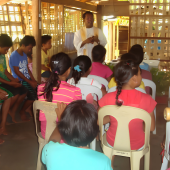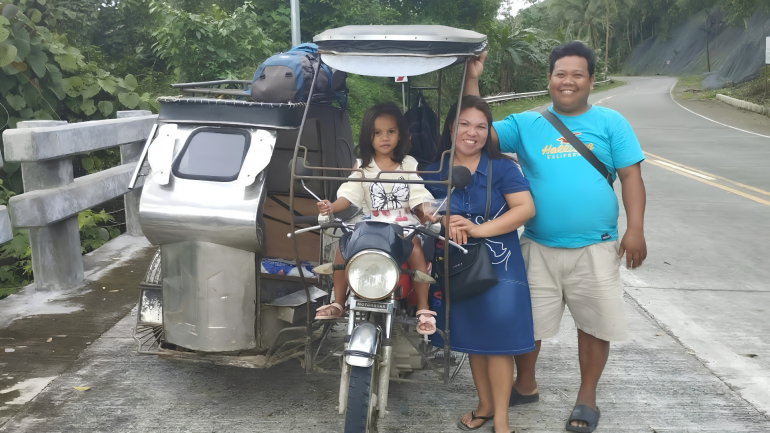
Gloria Lintawagin Reyes knows what it means to enter a classroom carrying more than schoolbooks.
The 36-year-old Alangan Mangyan teacher from Oriental Mindoro in the central Philippines once experienced discrimination at school because of her Indigenous identity. Today, she teaches Indigenous children, helping them pursue formal education while keeping their language, culture and traditions alive.
“I was born into a simple family. My parents were not able to go to school,” Gloria said. “Because of the difficulties of life, I dreamed of finishing my studies and becoming a teacher someday so I could have a good job.”
Her school years were not easy.
“During my elementary years, I experienced unequal treatment from Tagalog people toward us Mangyans,” she said. “We experienced discrimination.”
Rather than abandoning her studies, the experience strengthened her determination to become a teacher.
“My family and the discrimination I experienced became my inspiration to continue my studies,” she said.
Today, Gloria and her husband, Arnold Reyes, 40, a Buhid Mangyan from Bongabong, serve as Department of Education teachers in remote Indigenous communities of Oriental Mindoro.
Their work goes beyond the classroom. It involves long journeys, difficult terrain and efforts to ensure that education does not come at the cost of Indigenous identity.
Education beyond the road
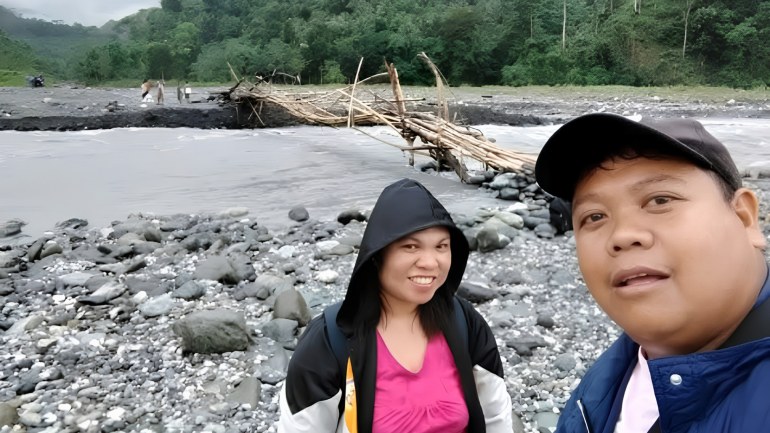
Arnold was among those who helped establish Naswak Hatubuan Bangon Elementary School, serving children in a mountainous community where reaching school can require crossing rivers and damaged bridges.
Before becoming a permanent public school teacher in 2018, he worked as a volunteer teacher with the Mangyan Mission and the Holy Spirit Sisters. He continues to travel to the community each week.
The difficulties teachers face became particularly evident in August, when 12 teachers were reportedly stranded after the Bongabong River suddenly rose. Police and disaster responders later rescued them.
For Gloria, teaching in a Bangon community also meant adapting to a culture different from her own Alangan heritage.
“It was difficult for me to teach the Bangon tribe because I came from the Alangan tribe,” she said. “But we have cultures and traditions that are similar, so I was also able to adapt some of the lessons.”
Gloria earned a Bachelor of Arts in Anthropology from the University of Southeastern Philippines in 2011 and a Bachelor of Secondary Education in Social Science from John Paul College in 2016. She later completed a master's degree in educational management in 2021.
Arnold also completed a master's degree in educational management in 2021. Both have served with the Department of Education for eight years, following years of volunteer work with the Mangyan Mission and the Holy Spirit Sisters.
Bringing culture into the classroom
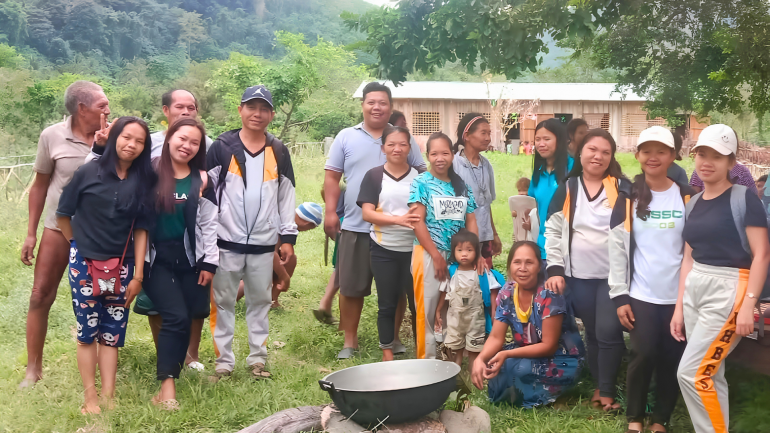
Gloria incorporates Mangyan language, culture and traditions into her lessons.
She uses Bangon and Buhid languages, Indigenous knowledge and practices, and examples drawn from the children's daily lives. Lessons may include caring for nature, traditional songs known as amban and lisbay, or community stories.
“It is important for Mangyan children to see their culture inside the classroom,” she said. “This is one way of ensuring that while they learn modern knowledge, they do not forget their culture. Instead, they can enrich it further.”
For her, culturally sensitive education means listening to and respecting Indigenous peoples' language, culture, way of life and identity.
“It is important to connect learning with the real lives and experiences of Indigenous people,” she said.
From student to teacher
Gloria's own experience gives her a particular understanding of the changes education can bring.
She recalled one student who walked for three hours each day to attend school, sometimes through floods and heavy rain. That student is now among those teaching at Naswak Hatubuan Bangon High School.
She has also watched students who were once reluctant to speak gradually gain confidence.
“The biggest change we have seen among our students is that they have gained confidence in themselves,” she said. “Before, they would not answer questions. Now, little by little, they are interacting with other people.”
Such moments encourage her to continue.
“That's all it is, Ma'am,” students would sometimes tell her after understanding a difficult lesson. “We thought studying was difficult. We thought we couldn't do it.”
For Gloria, education should help Mangyan children overcome discrimination without requiring them to abandon their identity.
“There were times when we wanted to give up because while we were serving the Bangon tribe, we lost our firstborn child,” Gloria said.
“It felt as though our dreams had collapsed, and we no longer wanted to continue.”
Support from their family, the Holy Spirit Sisters, the Mangyan Mission and friends helped them continue.
“They believed that we could overcome this,” she said. “And there are still many people waiting for our service.”
Gloria envisions a community “with a living culture and young people who confidently take pride in their roots.”
At the same time, she considers herself a learner.
“I have learned from my students their own language and culture and their simple way of life,” she said.
For Gloria and Arnold, education is therefore not simply about helping children complete their studies. It is about opening opportunities while allowing Indigenous communities to carry their identity into the future.
Sometimes, keeping that path open means crossing a river, repairing a bridge and returning week after week to the children waiting on the other side.
Radio Veritas Asia (RVA), a media platform of the Catholic Church, aims to share Christ. RVA started in 1969 as a continental Catholic radio station to serve Asian countries in their respective local language, thus earning the tag “the Voice of Asian Christianity.” Responding to the emerging context, RVA embraced media platforms to connect with the global Asian audience via its 21 language websites and various social media platforms.
Latest News