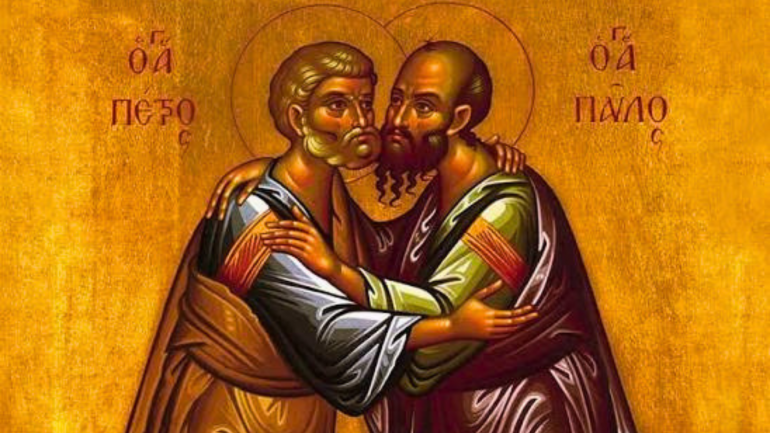
On June 29, the Church celebrates two men together who, during their lives, did not always see eye to eye. Peter was a fisherman, and Paul was a scholar, and their personalities, backgrounds, and approaches were so different that they once argued openly at Antioch, where Paul "opposed Cephas to his face" (Galatians 2:11). The Church does not hide this conflict. Instead, it places them together on the same altar, showing how grace can work through differences and disagreements.
Two Unlikely Candidates
It's important to remember that neither man would have seemed like a strong leader at first. Simon was impulsive, often making big promises he could not keep, able to walk on water one moment and then panic the next. Saul was strict and so passionate that his certainty turned into cruelty, as seen when he watched over the coats of those who stoned Stephen. Neither seemed like a natural choice to build on. But the same qualities that once made them risky became strengths when redirected: Peter's impulsiveness turned into courage, and Saul's zeal became the energy behind his mission.
One detail that is often left out of Sunday sermons is how ordinary their failures were. Peter was married and ran a fishing business before leaving it behind. Paul continued to work as a tentmaker even when his ministry was at its busiest, so he would not be a financial burden. They were not distant mystics, but regular working men who brought their past experiences and struggles into their new callings.
Identity Rewritten
Modern psychology can help us understand this. Dan McAdams talks about narrative identity, which means we become who we are by telling a clear story about ourselves. He found that the most resilient people often create "redemptive" stories, in which suffering and failure are not ignored but seen as the basis for growth.
Both apostles precisely underwent this kind of narrative reconstruction, and Scripture marks it with a change of name. Simon becomes Peter, the Rock. Saul becomes Paul. A new name signals a re-authored self. But the rewriting did not delete the past. Peter is forever the man who denied Christ three times, and the risen Jesus does not pretend otherwise; he gently invites Peter to undo the threefold denial with a threefold "Do you love me?" (John 21). Jesus does not shame Peter into reform. He distinguishes, as the researcher Brené Brown would centuries later, between guilt ("I did something bad") and shame ("I am bad"). Shame isolates and paralyses; guilt, properly held, motivates repair. Peter is allowed to feel the weight of what he did without being crushed under the verdict of who he is.
Paul's change is like someone facing a deep inner conflict and finding a new path through conversion. He had built his life on opposing the followers of Jesus, but then he was stopped, blinded, and had to face the hard truth that the God he thought he was serving was actually the one he was fighting against. What comes out of this is not a gentler Saul, but a new Paul, who later speaks honestly about his "thorn in the flesh" and how he learned that strength comes from weakness (2 Corinthians 12). He no longer tries to appear invulnerable. This leads us to why both men are still important today.
Why They Still Matter
Today, our culture is quick to expose mistakes but slow to offer redemption. One failure can follow a person forever online, with the past always available to replay. In contrast, the feast of these two imperfect men shows that failure does not have to be the end. Peter denied Jesus but was restored. Paul was broken down and rebuilt. Neither was let off the hook, but both were changed. This raises the question of why their contrasts are just as important as their similarities. It's easy to think that real unity means everyone must be the same, and that people who disagree as much as Peter and Paul cannot work together. But the Church's choice to celebrate them together says otherwise. People with different personalities, even those who sometimes clash, can still share a deep purpose. The steady leader and the energetic missionary both needed each other. Their shared feast is about more than just getting along; it's also about working together for a greater mission.
For anyone who remembers being too impulsive, too sure of themselves, or too flawed, Peter and Paul offer gentle reassurance. The part of us that fails is not thrown away. Instead, it is given a new name and invited to love again.