





Harvest festivals are older than temples and churches. Long before theology was articulated and liturgy formalised, human beings learned to look at the soil, the rain and the grain and to recognise a simple truth: life is received, not manufactured.
Pongal, celebrated today by Tamil communities worldwide, belongs to this ancient language of gratitude.
Tamil is one of the world’s oldest living classical languages, with a rich literary tradition dating back over two millennia. Spoken by the vast majority of people in Tamil Nadu, South India, Tamil is also embraced by a vibrant global diaspora across Sri Lanka, Malaysia, Singapore and beyond.

For Catholic Indians, especially within Malaysia’s plural and deeply cultural landscape, Pongal does not stand outside the faith. It quietly finds its place within it.
The word “Pongal”, in Tamil, means “to boil over”. It is at once a culinary act and a prayer of hope — that life, relationships and sustenance may overflow with goodness.
This instinct is profoundly Eucharistic. Every Mass is an act of thanksgiving, the offering of what the earth produces and what human hands have shaped, returned to God with gratitude.
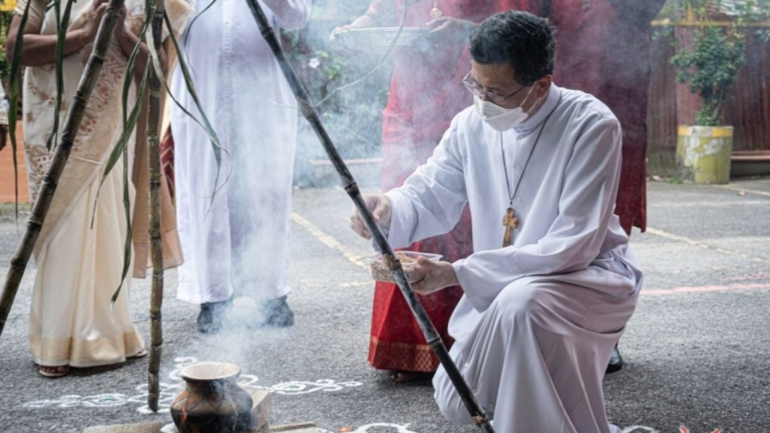
When rice, milk and sugarcane are prepared during Pongal and offered in prayer, they echo the same movement of the altar: gift received, gift offered, gift shared.

Within Catholic Indian communities, Pongal is celebrated not as a religious compromise but as a lived expression of faith. Homes are cleaned and blessed, food is prepared with reverence, and thanksgiving Masses are offered.
The symbols remain recognisably Tamil — kolams at the doorway, pots of rice bubbling over, families gathered in shared joy — but their direction is clear. Gratitude is addressed not to the elements or the seasons themselves, but to God the Creator who sustains them all. Culture is not abandoned; it is baptised by intention and prayer.
Pongal carries within it a moral rhythm that speaks deeply to Christian life. Before eating, one gives thanks. Before enjoying abundance, one remembers dependence. Before celebrating the harvest, one honours the labour that made it possible.
On the second day of Pongal, known as “Mattu Pongal”, cattle are remembered and honoured; there is an implicit recognition that creation is not a tool to be exploited but a survival partner. This echoes the Church’s growing ecological consciousness and its insistence that creation care is inseparable from faith.
In Malaysia, where many Indian families no longer live close to paddy fields, Pongal becomes an act of memory as much as celebration. It remembers ancestral labour, village rhythms and a way of life shaped by seasons rather than schedules.
Yet it also becomes something new. Open houses, shared meals and visits across ethnic and religious lines reflect a uniquely Malaysian expression of gratitude. Pongal here is not enclosed; it is expansive, generous and hospitable.
For Catholic Indians, the resemblance between Pongal and the wider Judeo-Christian tradition is striking. Jewish communities celebrate Sukkot after the harvest, dwelling in temporary shelters to remember their vulnerability and God’s provision.
Christians lift bread and wine at the altar, fruits of the earth and human labour transformed through thanksgiving. Tamil communities cook rice until it overflows, remembering abundance while acknowledging dependence. In all these traditions, food is never merely consumed. It is first remembered, blessed and shared.
This shared instinct reveals something essential about faith itself. Gratitude protects memory. Memory cultivates humility. Humility sustains community. When gratitude is lost, abundance turns hollow. When gratitude is preserved, even simple food becomes sacred.
For the Malaysian Catholic Indian community, celebrating Pongal within the life of the Church becomes a quiet witness. It affirms that the Gospel does not demand cultural amnesia, and that Catholic faith is most alive when it takes flesh in local customs and languages. When rice meets the altar, the Church looks like the people it serves — and in doing so, becomes more fully itself.
In a world increasingly detached from soil, seasons and shared meals, Pongal stands as a gentle reminder that life is a gift before it is a right. To celebrate Pongal as Catholics is to acknowledge that everything which sustains us — land, labour, family and faith — ultimately flows from grace. When the pot boils over, it is not excess that is being celebrated, but trust.
And in that moment of shared thanksgiving, the harvest becomes holy.



- Reply
Permalink