

“Jesus Called Real People With Limitations and Histories,” Macau Bishop Says as FABC-OSC Meeting Opens

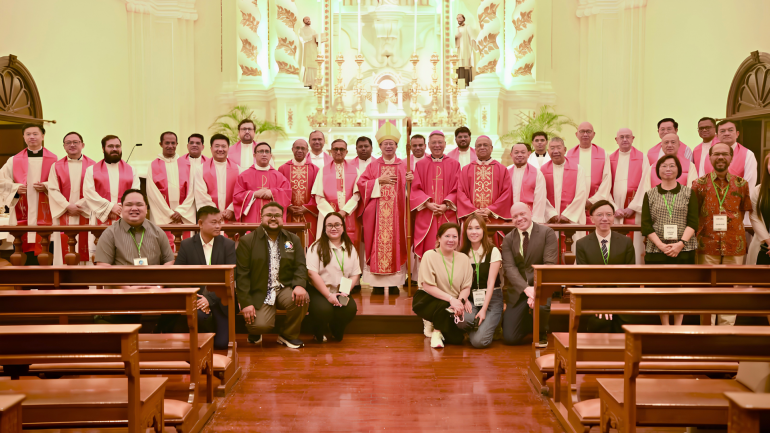
Jesus calls people with their own limitations and histories to serve others, reminding Church communicators that proclaiming the Gospel requires humility, closeness, and a willingness to accompany people in their struggles, Bishop Stephen Lee Bun-sang of Macau said on October 28.
Presiding over the opening Mass of the Federation of Asian Bishops’ Conferences Office of Social Communication (FABC-OSC) Bishops’ Meeting at the historic St. Joseph’s Seminary Church in Macau, Bishop Lee urged Asian bishops and Church communicators to embrace this missionary model as they address the challenges of evangelization in an age shaped by artificial intelligence (AI).
The Mass coincided with the feast of Saints Simon and Jude, apostles whom the Church commemorates on October 28. Reflecting on the Gospel account of Jesus praying before choosing the Twelve Apostles, Bishop Lee highlighted the connection between prayer, discernment, encounter, and healing.
Jesus did not send perfect or extraordinary people detached from human experience, he said, but real people with names, histories, and limitations, called to serve others rather than dominate them.
Applying this message to Church communication, Bishop Lee emphasized that proclaiming Christ requires more than disseminating information or adopting new technologies. It demands personal presence, genuine listening, and a willingness to be interrupted by the suffering of others.
“Listening before speaking, accompanying before judging,” he urged, outlining an approach to communication rooted in the Church’s synodal journey.
The October 27–31 gathering brings together Asian bishops, priests, and communication delegates under the theme “Magnifica Humanitas and the Synodal Ways of Evangelization in Asia: Communicating Christ in the Age of Artificial Intelligence.”
Concelebrants at the Mass included Cardinal Francis Sebastian of Penang, Malaysia, and Bishop Marcelino Antonio “Junie” Maralit Jr. of San Pablo, Philippines, chairman of FABC-OSC, alongside other bishops and priests participating in the assembly and members of the seminary faculty.


Bishop Lee challenged those entrusted with Church communication to ask whose stories are being told and whose voices remain unheard. He also encouraged collaboration across national and linguistic boundaries to ensure that communication reflects the experiences of people, particularly those who suffer or are marginalized.
As artificial intelligence transforms communication, he stressed that technology must serve the common good and safeguard human dignity. The challenge is to use emerging tools in ways that foster authentic relationships and communion rather than reduce human beings to data or categories.
The gathering also takes place as Macau celebrates the 450th anniversary of its diocese, established by Pope Gregory XIII on January 23, 1576. The city became a historic gateway for Catholic missionaries traveling to China, Japan, and other parts of Asia.
St. Joseph’s Seminary, founded in 1728, provides a fitting setting for the meeting as participants reflect on how the Church can renew its missionary commitment in a rapidly changing world.
Bishop Lee encouraged participants to draw from Macau’s missionary heritage while discerning new pathways for evangelization in the digital age.
The meeting will culminate on October 31 with an address by Cardinal Luis Antonio Tagle, pro-prefect of the Vatican’s Dicastery for Evangelization and dean of the College of Cardinals. His talk, “Magnifica Humanitas: Synodal Ways for Evangelization in Asia,” will explore how the Church can connect its missionary legacy with contemporary challenges and opportunities for proclaiming the Gospel.
Bishop Lee’s message set the tone for the assembly: Church communicators, despite their own limitations, are called to serve as witnesses of Christ through prayer, humility, listening, and a willingness to accompany the people they serve.
Radio Veritas Asia (RVA), a media platform of the Catholic Church, aims to share Christ. RVA started in 1969 as a continental Catholic radio station to serve Asian countries in their respective local language, thus earning the tag “the Voice of Asian Christianity.” Responding to the emerging context, RVA embraced media platforms to connect with the global Asian audience via its 21 language websites and various social media platforms.
Latest News