Sri Lanka: Peace Must Be Built in a World Driven by Arms Trade, Says Cardinal Ranjith at Christmas Midnight Mass

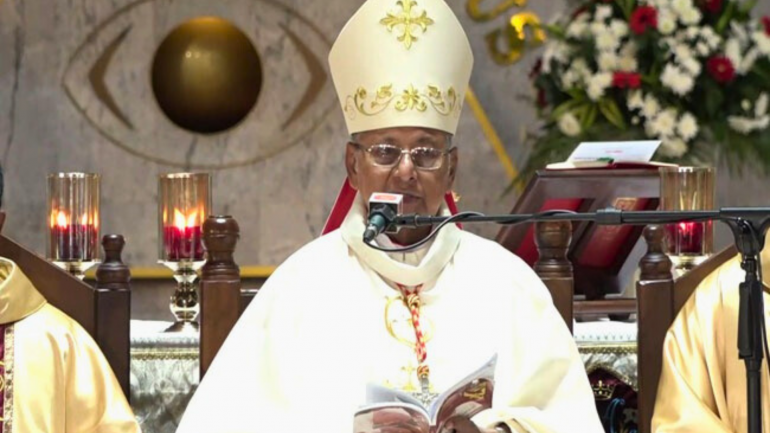
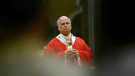
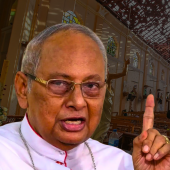
Even in the absence of a formally declared Third World War, peace must be consciously and actively built, Cardinal Malcolm Ranjith, Archbishop of Colombo, Sri Lanka said in his Christmas Midnight Mass homily, warning that today’s world increasingly profits from the trade of weapons rather than the pursuit of peace.
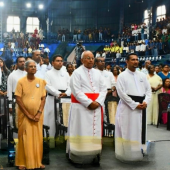
Delivering his homily on Christmas Midnight Mass at St. Mary’s Church, Uswetakeiyawa, north of Colombo, Cardinal Ranjith reflected on the growing global culture of violence and conflict, noting that although there is no official “Third World War,” wars are being waged in every region of the world. He stressed that the message of Jesus Christ, the Prince of Peace, poses a serious challenge to a world that prioritizes profit through armaments.
Pointing to the ongoing conflicts in the Holy Land, the birthplace of Jesus, the Cardinal lamented the countless lives lost to war, underscoring the urgency of Christ’s message of peace. “Even in the land sanctified by the birth of Christ, violence continues unabated,” he said, describing it as a tragic contradiction to the Gospel.
A World at War Without a Name
Drawing from Pope Francis’s apostolic exhortation Evangelii Gaudium (The Joy of the Gospel), Cardinal Ranjith recalled a moment during Pope Francis’ visit to Sri Lanka in January 2015. When a former president asked the Pope why there had been no Third World War, the Pope replied that instead of one large global conflict, the world has been sustaining itself through many smaller wars since the end of World War II.
“These wars,” the Cardinal explained, “are driven by the arms trade and the pursuit of economic and geopolitical dominance.” As a result, while a Third World War has not officially erupted, humanity continues to live amid constant warfare and insecurity.
The Evil of the Arms Trade
Cardinal Ranjith strongly criticized the global arms industry, warning of its devastating consequences. He noted that weapons production has become deeply embedded in the global economy, creating a vast and lucrative market that thrives on human conflict.
Quoting Pope Francis, he described the arms trade as “a great evil, an inhuman business” that deliberately fuels wars by exploiting divisions among people. He warned that the relentless pursuit of profit has led to the creation of increasingly destructive weapons, including nuclear arms, which pose a grave threat to the survival of humanity.
“The enormous resources spent on weapons could instead be used to eradicate hunger and ensure food security for all,” he said, lamenting that countless lives are sacrificed to selfish ambition and profit-driven agendas.
Choosing the Poor: A Theological Call
Beyond the critique of war and violence, Cardinal Ranjith highlighted a central Christian theme closely tied to Christmas: the call to choose the poor.
He emphasized that this choice is not political but profoundly theological. The birth of Jesus itself reveals God’s preferential love for the poor—born in a humble stable, raised in a working family, and surrounded by the marginalized.
Citing Scripture, he recalled Jesus’ words: “Blessed are you who are poor, for yours is the kingdom of God” (Luke 6:20). The Church, he said, must therefore stand with the poor not merely as a social obligation, but as a divine calling rooted in faith.
Reading passages from Evangelii Gaudium, the Cardinal reminded the faithful that God’s heart has a special place for the poor and that every Christian is called to reflect this divine preference in daily life.
Rediscovering the True Meaning of Christmas
Cardinal Ranjith also cautioned against the growing commercialization of Christmas, warning that modern market economies risk reducing the feast to consumerism and profit.
“Christmas is not about trees, Santa Claus, or shopping festivals,” he said. “Its true meaning lies in understanding and following the path shown by Jesus Christ.”
He urged Christians to resist turning Christmas into a purely economic celebration and instead rediscover its spiritual essence—a call to peace, humility, and solidarity with the poor.
In his Christmas message, Cardinal Malcolm Ranjith offered both a challenge and a reminder: peace must be built in a world addicted to weapons and profit, and the true spirit of Christmas is found in choosing the poor and walking faithfully in the path of Christ.
Radio Veritas Asia (RVA), a media platform of the Catholic Church, aims to share Christ. RVA started in 1969 as a continental Catholic radio station to serve Asian countries in their respective local language, thus earning the tag “the Voice of Asian Christianity.” Responding to the emerging context, RVA embraced media platforms to connect with the global Asian audience via its 21 language websites and various social media platforms.
Latest News