



From People Power to Silent Spectators: Two Women Religious Reflect on the Church after EDSA

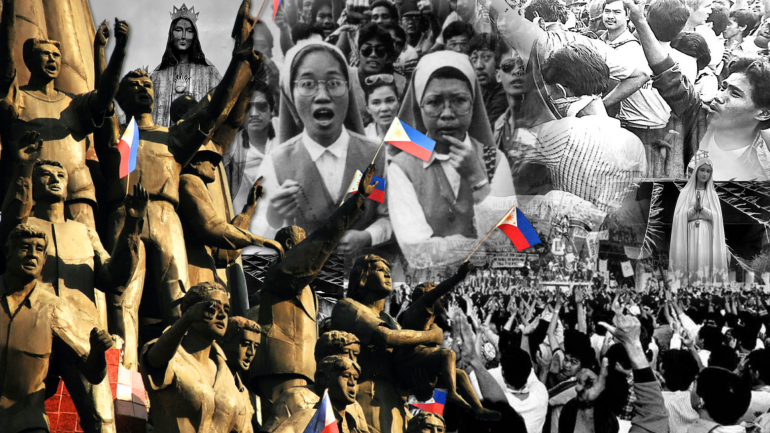
Forty years after the 1986 People Power uprising, two Filipino women religious remember EDSA not simply as a political revolt but as a graced spiritual awakening, and ask whether the Church has failed to sustain that prophetic courage.
Neither Sr. Elleanor Llanes (Missionary Sisters of the Immaculate Heart of Mary) nor Sr. Elizabeth De Jesus (Little Sisters of Jesus) stood physically on Epifanio de los Santos Avenue during those tense February days. But they were united in prayer with the millions who faced tanks and soldiers. Yet for them, EDSA was unmistakably both political and spiritual.
“It was an awakening,” Sr. Llanes recalls, “the rising of a whole country toward liberation from tyrannical rule.” But that awakening, she says, was rooted in faith. Across the country, people surrendered the nation “into the hands of the Liberating God.”
Sr. De Jesus calls it a “graced moment” when Filipinos recognized that all power belongs to God. “We were helpless,” she says. “But when we surrendered to God and loved one another in solidarity, we became fearless.”
Like the Exodus story, she believes, the revolution was not something the people could have accomplished on their own.
“That is why we called it a miracle.”
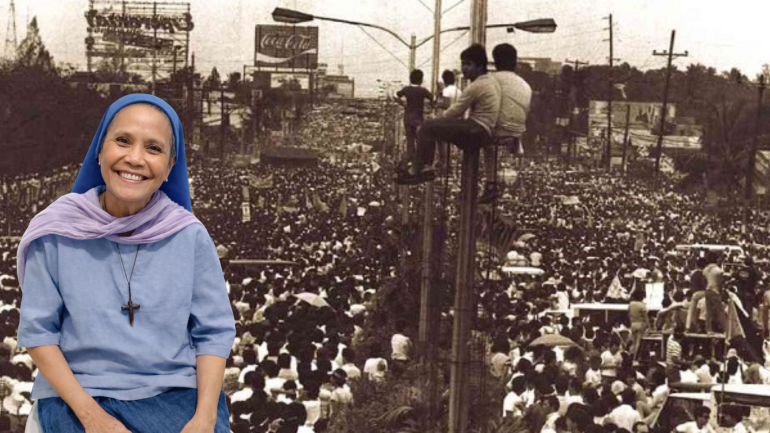
The Catholic Church played a visible role in that miracle.
Church leaders and religious congregations offered moral cover, sanctuary and language that framed resistance as a moral duty.
The uprising led to the fall of Ferdinand Marcos Sr., and the Church was widely seen as having stood on the right side of history.
But four decades later, both sisters speak not only with gratitude, but with unease.
“Our memory is short,” Sr. Llanes says.
She echoes the challenge of Archbishop Socrates Villegas, who recently lamented that “we squandered EDSA.”
The phrase stings.
After all, the People Power Revolution demonstrated what a united and faith-filled citizenry could do.
Yet, Sr. Llanes observes, when another period of violence gripped the country during the bloody anti-drug campaign of former President Rodrigo Duterte, many Christians were silent.
“A similar tyrannical rule happened,” she says quietly. “Many of us were silent spectators before the killings.”
The contrast is difficult to ignore.
In 1986, the Church’s language was prophetic and public. During the drug war years, criticism existed, but the unity and mass mobilization of EDSA did not.
For Sr. De Jesus, part of the reason lies deeper than political calculation. It lies in formation.
“We were sacramentalized, but not evangelized,” she says.
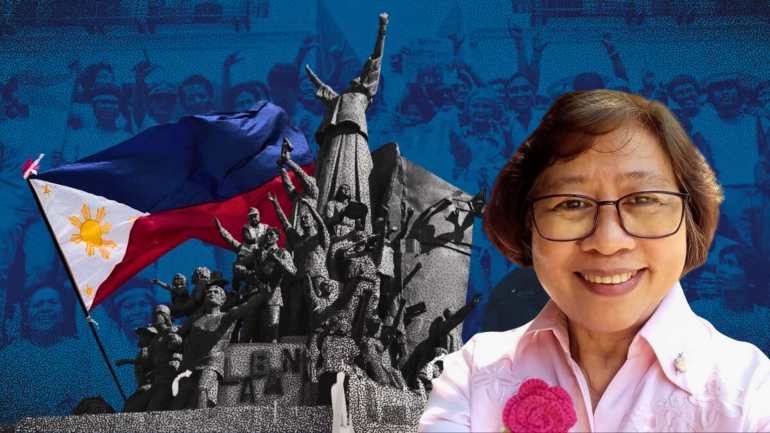
In the years following EDSA, she believes, the Church celebrated outward freedom but did not sufficiently address internal divisions between rich and poor, educated and uneducated, powerful and powerless.
Catholic social teaching, she notes, remained “the best secret” of the faith.
The faithful gathered for large liturgical events and devotions. But political formation, the integration of faith and civic responsibility, did not always take root in daily life.
“Politics was more and more separated from spirituality,” she reflects.
Without sustained formation, prophetic moments risk becoming isolated memories rather than enduring commitments.
The sisters suggest that the Church may have celebrated the miracle of EDSA without fully cultivating the moral and social discipline needed to resist future injustices.
And yet, neither speaks without hope.
Recent public protests against corruption, Sr. Llanes notes, suggest that the national conscience is not dead.
Sr. De Jesus points to the growing empowerment of laypeople and to the vision of “social friendship” articulated in Pope Francis’ encyclical Fratelli Tutti, which calls for solidarity beyond divisions.
But both insist that waiting for another “big event” like EDSA is not enough.
“Every ordinary day is important,” Sr. Llanes says.
Awakening must be daily, in families, parishes, and neighborhoods. The Church’s social teaching must move from documents to lived formation. Spirituality and political responsibility, they argue, must be deeply blended in Christian life.
Forty years ago, Filipinos discovered the power of collective surrender to God.
The question now is whether that surrender can mature into sustained moral courage, not only in moments of national crisis, but in the ordinary, demanding work of justice.
If EDSA was a miracle, these sisters seem to suggest, its greater miracle would be a Church that remembers.
Let us know how you feel!
Comments


- Reply
Permalink