



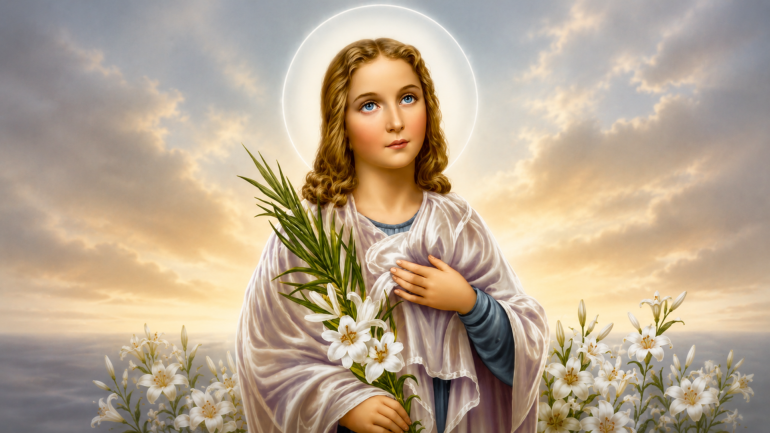
Most people familiar with the name Maria Goretti recall only the basic facts: she was an eleven-year-old Italian girl, stabbed fourteen times in 1902 while resisting a sexual assault, and canonised in 1950 as a martyr of purity. Her story is frequently invoked to illustrate a single lesson about chastity. However, when her life is considered in its entirety, particularly the events following her death, it reveals a narrative far more complex and instructive than the simplified lesson often presented.
It is important to begin with the often-overlooked context. The Goretti family were impoverished sharecroppers. Following the death of Maria's father from malaria, her mother worked in the fields while Maria, though still very young, managed the household and cared for her siblings. Unable to afford their own home, the family lived with the Serenelli family. The threat that ultimately led to Maria's death was present within their shared residence, not due to any moral failing, but as a consequence of poverty. Alessandro Serenelli, aged twenty, had previously pressured and threatened Maria. When he ultimately confronted her with a knife, Maria told him it was a sin and that he would go to hell. Even in fear, she was concerned for the soul of her attacker.

What happened next is often skipped over in devotional pamphlets. Maria lived for almost a day after the attack. Before she died, she forgave Alessandro and said she wanted him to be with her in heaven. At first, Alessandro showed no remorse and was sentenced to thirty years in prison. For nearly ten years, he remained bitter and closed off. Then, according to his own story, he dreamed of Maria in a garden, handing him lilies, and he woke up a changed man. After serving twenty-seven years, he went to Maria's mother, Assunta, and asked for her forgiveness. She forgave him. On Christmas Eve, they knelt together and received communion side by side: the mother of a murdered child and the man who killed her.
Alessandro later lived as a lay brother in a Capuchin friary, and he was still alive, with white hair and at peace, when the Church declared that Assunta’s act of forgiveness did not signify weakness or denial. Through forgiveness, she reclaimed agency over her inner life from the individual who had already taken her daughter’s. Alessandro's transformation exemplifies a redemptive narrative: a life restructured around a pivotal moment that transforms guilt into personal growth. His dream served as the catalyst for the transition from guilt to grief, and from grief to change. The reconciliation between the two families anticipates a key principle of restorative justice: genuine healing often requires the offender to confront the human consequences of their actions, while the survivor’s community is offered more than punishment alone.
Describing Maria Goretti solely as a "martyr of purity" centres attention on her physical resistance, implying that her worth depended on remaining untouched. This narrative has caused harm to many survivors of abuse by suggesting that dignity can be lost through the actions of others. Upon closer examination, her story is fundamentally about mercy, demonstrated in two forms: a dying child who refused to hate, and a grieving mother who refused to allow hatred to prevail. Maria’s refusal of Alessandro was, in a profound sense, also an attempt to save him.
This enduring relevance explains why her story continues to resonate today. Maria is regarded as a patron for survivors of sexual violence, not because she "triumphed" through death, but because her narrative demonstrates that violence does not define a person’s identity. In an era marked by swift outrage and scepticism toward personal transformation, her story poses a challenging question: do we truly believe individuals can change? Alessandro’s transformation provides compelling evidence, as witnessed in the church on Christmas Eve.
It is not necessary to choose between holding individuals accountable and believing in their capacity for change. Maria Goretti’s enduring legacy is that mercy lies at the centre of both: accountability and transformation can coexist, and mercy, far from being naïve, may represent the most demanding moral act.
Radio Veritas Asia (RVA), a media platform of the Catholic Church, aims to share Christ. RVA started in 1969 as a continental Catholic radio station to serve Asian countries in their respective local language, thus earning the tag “the Voice of Asian Christianity.” Responding to the emerging context, RVA embraced media platforms to connect with the global Asian audience via its 21 language websites and various social media platforms.
Comments

Latest News




- Reply
Permalink